.png)


The migration risk sits elsewhere. Separate four layers: the cloud commitment, discount application, access and automation, and vendor-specific fees or protection. A clean transition addresses all four without duplicate purchases or a broken audit trail.
Short Answer
Existing Savings Plans, Reserved Instances, Azure reservations, savings plans, and Committed Use Discounts normally do not disappear when you replace an optimization platform. They remain subject to the term, payment schedule, scope, and modification or cancellation rules of the cloud provider that issued them.What changes is who can see, recommend, purchase, modify, report on, or financially protect those commitments. If the transition also changes the billing owner, reseller, cloud organization, enrollment, billing account, or tenant, treat it as a separate commercial migration because discount scope and transfer rights may change.
What Stays and What Changes When You Switch Providers
The fastest way to evaluate a transition is to stop treating “the commitment” as a single object.| Transition layer | Usually stays in place | Changes or requires verification |
|---|---|---|
| Cloud commitment | Identifier, term, hourly or resource commitment, payment schedule, and cloud-native status | Scope, sharing, exchange, return, or transfer only if someone changes cloud settings or billing structure |
| Discount application | Cloud-provider application logic | Account, subscription, project, region, or sharing configuration can change eligible usage |
| Optimization operations | Historical cloud billing data | Dashboard, forecasts, recommendations, renewal rules, automation, and purchasing authority |
| Vendor contract | Accrued rights already earned, subject to contract | Fees, final invoice, pending credits, buyback or cashback, data retention, and post-termination support |
Determine Who Owns and Manages Each Commitment
Classify every commitment into one of three operating models before discussing cutover dates.Customer-purchased and customer-managed. Your team purchased the commitment directly in its cloud environment. A new provider can analyze it once granted appropriate read access; management actions depend on the permissions you delegate.
Provider-managed in the customer’s cloud environment. The provider recommended or executed the purchase through a delegated role. The commitment can remain in the customer account even after that role is removed, while the provider’s automation and contractual protection may end separately.
Reseller, managed-billing, or third-party commercial arrangement. Billing ownership, discounts, credits, or commitment obligations may be tied to another agreement. Do not assume these items transfer with a software migration.
Labels who pay, receive the discount, can change the commitment, and absorb underutilization. If the answers differ, require both technical and commercial sign-off.
How AWS, Azure, and Google Cloud Commitments Behave
The high-level answer is consistent across clouds, but the scope and exit mechanics are not.| Cloud | What the buyer should verify during a provider change |
|---|---|
| AWS |
Active Savings Plans automatically apply to eligible usage. Within consolidated billing, AWS applies them to the owner account first and then to other accounts when sharing is enabled. A software change does not alter that logic. Returns are narrowly limited: a Savings Plan with an hourly commitment of $100 or less may be returned if it was purchased within the past seven days and the same UTC calendar month, provided the account has not reached its return limit. The EC2 Reserved Instance Marketplace accepts eligible Standard EC2 RIs, not Convertible RIs or reservations for services such as RDS and ElastiCache. |
| Azure |
Reservation management permissions are separate from subscription permissions, and a purchase creates both a Reservation Order and a Reservation. Scope can be changed within the applicable billing context. Reservations may be refunded subject to Microsoft’s eligibility rules and cancellation limit. Exchange eligibility varies by product and purchase date, with additional restrictions scheduled to take effect for certain compute and database reservations on February 1, 2027. Azure savings plans cannot be canceled, exchanged, or refunded, although transfers between supported agreements may be available. |
| Google Cloud |
Resource-based Compute Engine commitments are linked to a project and region; their discounts may cover eligible usage across projects when CUD sharing is enabled. Compute flexible commitments are purchased at the Cloud Billing account level. Commitments are billed for their term and cannot be canceled after purchase. Moving a project to another billing account changes how its resource-based CUDs apply. |
How to Change Providers Without Creating New Commitment Risk
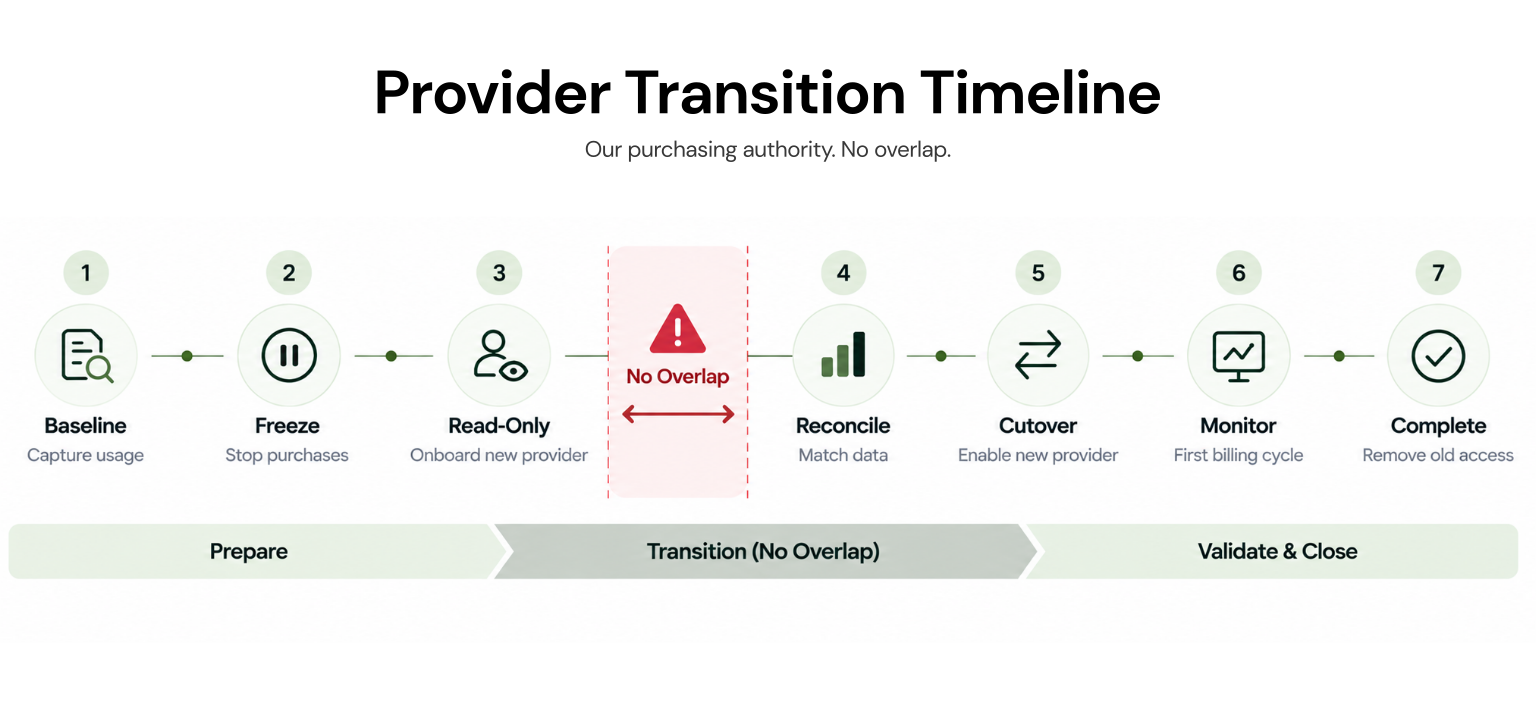
A safe handoff is a controlled change in decision rights, not merely a new integration.Inventory the current position. Reconcile cloud-native commitment records with the outgoing provider’s ledger. Resolve missing IDs, inconsistent scopes, pending purchases, scheduled start dates, renewals, and modifications before cutover.
Preserve the baseline. Export commitment inventory, actual and amortized cost, coverage, utilization, on-demand-equivalent cost, savings methodology, account mappings, and report timestamps. Retain raw cloud billing exports where available. A screenshot of “total savings” is not an auditable baseline.
Freeze new purchases and renewals. Establish a written freeze window for both providers. Include queued recommendations, API jobs, marketplace actions, scheduled renewals, and manual purchases by internal teams.
Onboard the incoming provider read-only first. Let the new provider observe the full inventory and billing hierarchy without transaction authority. Validate that it recognizes existing commitments before enabling purchase or modification permissions.
Reconcile the two models. Compare coverage, utilization, normalized hourly commitment, eligible spend, discount application, and excluded services. Differences may come from time windows, amortization, currency, shared-account allocation, credits, or the savings formula, not necessarily from better optimization.
Cut over authority once. Record the exact time the outgoing provider loses transaction rights and the incoming provider receives them. Assign one accountable approver and one rollback owner.
Monitor the first complete billing cycle. Check for uncovered spend, double coverage, unexpected renewals, scope changes, protection gaps, fee overlap, and differences between estimated and finalized cloud data.
Read-only overlap can support comparison; write-enabled overlap requires explicit coordination and a single source of approval.
Exit Safeguards to Confirm Before the Cutover
Do not rely on “cancel anytime” as an offboarding plan. Attach owners and dates to this checklist. Commercial and financial- Final service date, final invoice formula, and any overlapping fees
- Treatment and payment timing for accrued cashback, credits, guarantees, or buyback claims
- Responsibility for pending, future-dated, disputed, or recently modified commitments
- End date for protection on commitments placed by the outgoing provider
- Export format and retention period for commitment, savings, fee, and protection history
- Access to calculation definitions and account-allocation logic
- Reconciliation process for late cloud billing adjustments
- Complete list of roles, service principals, service accounts, API credentials, and external users
- Separate dates for disabling automation and revoking read access
- Evidence that old access was removed, without deleting customer-owned billing exports or cloud records
How Usage.ai Supports a Controlled Transition
When switching providers, the incoming platform must account for existing commitments before recommending additional coverage. We analyze usage at the billing layer and work alongside existing RIs, Savings Plans, and CUDs, so recommendations can focus on eligible usage that remains.We offer read-only access for the initial savings assessment. In manual mode, we call the relevant cloud provider’s API after a customer approves a recommendation. Customers can also enable Autopilot to automate commitment actions for selected accounts, regions, or commitment types.
Managed commitments and realized savings are reported through our dashboard. With Flex Insured Commitments, teams can access 30–50% savings on covered AWS, Azure, and Google Cloud workloads with none of the commitment risk.
If an eligible Flex Commitment costs more than equivalent On-Demand usage, we provide cashback protection for the calculated loss, subject to current program eligibility and terms.
Customers pay an agreed percentage of realized savings, billed monthly in arrears after the cloud provider finalizes its billing data.
During a transition, the assessment should confirm how pending purchases, accrued cashback, protection after termination, access removal, data exports, and final billing will be handled under the executed agreement.
Final Verdict: Commitments Stay, but Management Must Transfer
Changing optimization providers usually leaves cloud-native commitments intact. The real decision is whether the incoming provider can recognize them accurately, preserve measurement continuity, assume authority without overlap, and explain what protection begins or ends. Treat billing-structure changes as a separate migration and require written answers before cutover.Review commitments, baseline, controls, and protection before switching providers.
Frequently asked questions
Do existing commitments disappear when I change optimization providers?
Usually not. Commitments recorded in your AWS, Azure, or Google Cloud environment continue under their existing provider terms. Confirm separately whether the outgoing optimization vendor’s fees, management, credits, cashback, or other protection continue.
Can a new provider manage commitments purchased through the previous provider?
It depends on where the commitment resides and what the contracts permit. If it is in your cloud account, a new provider may be able to analyze or manage it with the right permissions. A reseller-held or contractually protected commitment may require consent, transfer, or separate treatment.
Can two optimization providers run at the same time?
They can overlap for read-only evaluation. Avoid giving both independent purchasing authority unless they share a documented approval process, inventory, and cutover rule. Otherwise, both may buy against the same demand.
When should we revoke the old provider’s access?
Disable its automation at the agreed freeze time, confirm there are no pending actions, and preserve required exports before revoking transaction access. Remove remaining read access after final reporting and financial reconciliation, according to your security and retention requirements.
Does cashback or commitment protection continue after the contract ends?
Do not assume it does. The cloud commitment and the vendor’s protection are separate obligations. Confirm the protection end date, treatment of underutilization after termination, accrued payout timing, claim process, and any survival clauses in writing.