.png)



Cloud infrastructure is one of the fastest-growing cost centers for modern engineering teams. The default pay-as-you-go model is convenient, but it’s also the most expensive way to run workloads at scale.
For FinOps and DevOps teams looking to meaningfully reduce cloud spend, commitment-based discounts represent one of the single highest-impact levers available. Applied correctly, they can reduce effective compute rates by up to 72%, without requiring any architectural changes to your infrastructure.
But these discounts come with real trade-offs. They require accurate forecasting, disciplined management, and a strategy that balances savings against the risk of over-committing to capacity you may not fully use.
This guide covers everything you need to know about commitment-based discounts: what they are, how they work across AWS, GCP, and Azure, when to use them, and how modern automated platforms.ai help teams maximize their value while eliminating underutilization risk.
%2021%20(16).svg)
What Are Commitment-Based Discounts?
Commitment-based discounts are cloud pricing agreements in which organizations commit to a predetermined level of resource usage or spending, typically over a one- or three-year term, in return for substantially lower rates than pay-as-you-go pricing, often up to 72% off on-demand costs.
By locking in predictable consumption, businesses reduce infrastructure spend and improve budget visibility, while cloud providers secure the revenue consistency needed to plan capacity at scale.
In practical terms, a commitment-based discount is a financial agreement between your organization and your cloud provider. You promise to use, or spend, a certain amount of cloud resources over a defined period, and in return, the provider gives you a substantially reduced rate on those resources.
This model benefits both sides. Organizations gain predictability and lower costs. Cloud providers gain a guaranteed revenue stream, which lets them plan infrastructure investments more efficiently. That operational risk premium built into on-demand pricing is, in effect, what you’re trading away when you commit.
The FinOps Foundation describes commitment-based discounts as financial instruments, tools that allow companies to monetize their ability to forecast future usage patterns and, in doing so, access lower infrastructure rates. As part of a broader cloud cost optimization strategy, they are one of the most impactful levers available to any FinOps team.
Spend-Based vs. Resource-Based Commitments
Not all commitment-based discounts work the same way. There are two primary structures:
- Spend-based commitments: You commit to spending a minimum dollar amount per hour on cloud services. AWS Savings Plans and GCP Flexible CUDs fall into this category. The discount applies automatically as long as you meet your hourly spend threshold, regardless of which specific instance types you use, giving you meaningful flexibility.
- Resource-based commitments: You commit to a specific type and quantity of compute resource, for example, a particular EC2 instance family in a specific region. AWS Reserved Instances and GCP Standard CUDs are resource-based. These tend to offer deeper discounts but require more precision and carry higher utilization risk.
How Do Commitment-Based Discounts Work?
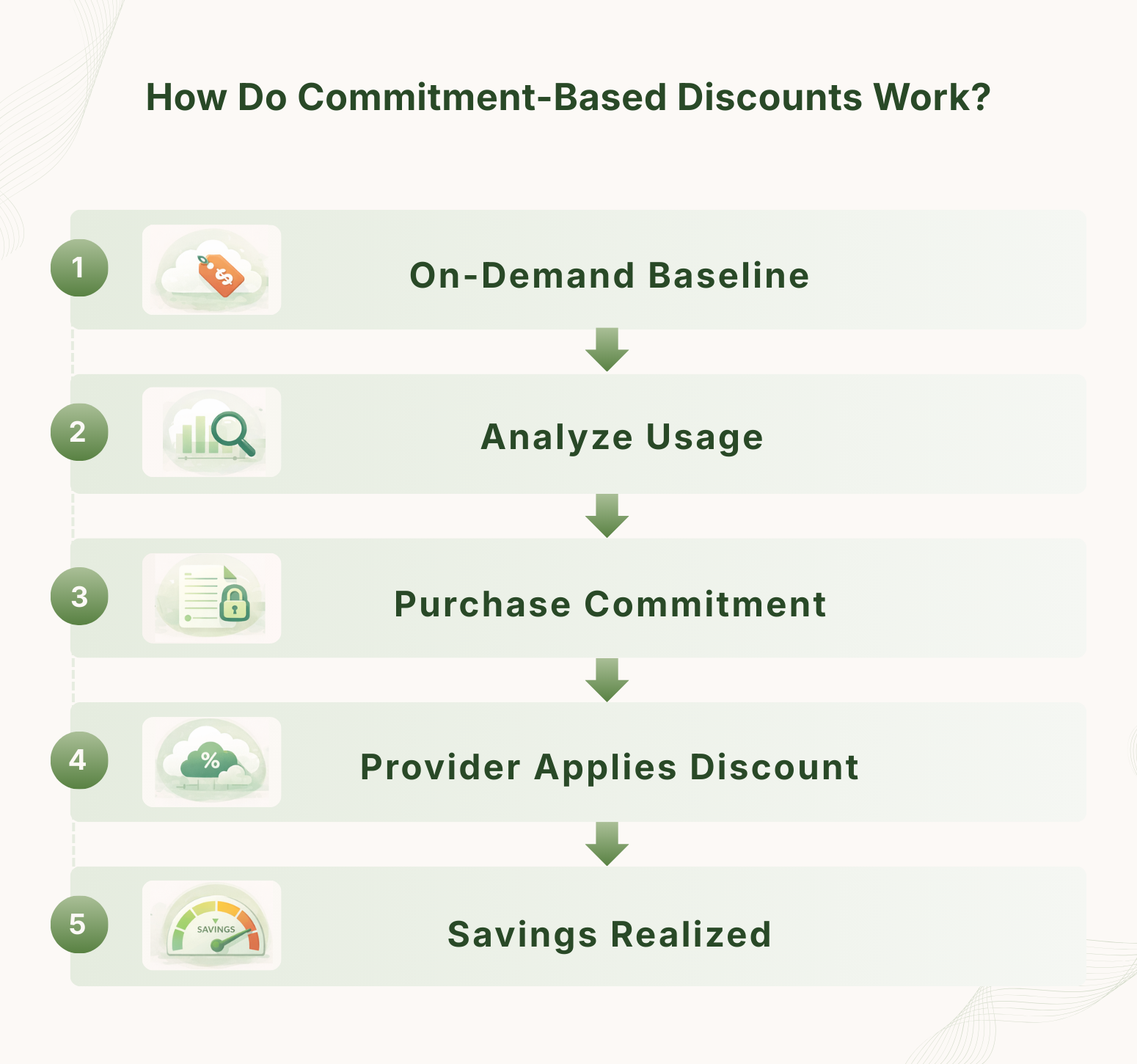
At their core, commitment-based discounts reduce your effective compute rate by shifting financial risk from the cloud provider to your organization. The mechanism varies slightly across providers, but the structure is consistent:
- Analyze 60–90 days of historical compute usage to identify your stable ‘base load’, the portion of usage that runs consistently regardless of traffic fluctuations.
- Identify your commitment candidates: workloads that are always-on, predictable, and unlikely to change significantly over the commitment term.
- Purchase a commitment for a 1-year or 3-year term, with your preferred payment structure (all upfront, partial upfront, or no upfront).
- The cloud provider automatically applies the discounted rate to matching usage throughout the term.
- Any usage above your committed amount continues to be billed at standard on-demand rates.
The Economics of the Discount
The discount structure reflects how much certainty you’re providing the cloud provider. As a general rule:
- 3-year terms deliver larger discounts than 1-year terms
- All-upfront payment unlocks the deepest savings (maximum upfront cash flow to the provider)
- No-upfront payment provides the smallest discount but requires no capital outlay
- More specific resource commitments (instance type, region, OS) yield higher discounts than flexible spend-based commitments
The trade-off is clear: the more flexibility you retain, the less you save. The more specific and locked-in your commitment, the greater the discount, but the harder it is to fully utilize. This tension is precisely why commitment management automation has become a core FinOps practice.
Types of Commitment-Based Discounts Across Major Cloud Providers
Each major cloud provider has built its own version of commitment-based discounts, with different names, structures, and discount levels. Understanding each is essential for teams operating across multi-cloud environments.
AWS: Savings Plans and Reserved Instances
AWS Savings Plans
Savings Plans are AWS’s most flexible commitment product, introduced to address the rigidity of traditional Reserved Instances. There are three types: Compute Savings Plans (the most flexible, offering up to a 66% discount), EC2 Instance Savings Plans (specific to instance families, offering up to a 72% discount), and SageMaker Savings Plans for ML workloads.
You commit to a minimum hourly spend, for example, $10/hour, and the discount is automatically applied to any matching compute usage.
AWS Reserved Instances (RIs)
Reserved Instances are resource-based commitments for specific EC2 instance types in a particular region, offering up to 72% discount over on-demand rates. Standard RIs offer the highest discount but are the least flexible.
Convertible RIs allow you to change instance attributes over the term but deliver a somewhat lower discount (~54%). Standard RIs can also be listed on the AWS Marketplace if they become underutilized, a meaningful risk-management option.
Also read: How to Choose Between 1-Year and 3-Year AWS Commitments
GCP: Committed Use Discounts and Sustained Use Discounts
GCP Committed Use Discounts (CUDs)
GCP offers two types of commitment-based discounts. Standard CUDs commit to specific vCPU and memory resources for 1 or 3 years, delivering up to 57% discount. Flexible CUDs (Spend-based CUDs) commit to a monthly spend level with discounts ranging up to 28–70% depending on resource type.
Flexible CUDs apply across regions and instance families, making them particularly powerful for teams running dynamic or distributed workloads.
GCP Sustained Use Discounts: An Important Distinction
It’s worth distinguishing CUDs from Sustained Use Discounts (SUDs). Volume discounts based on negotiated commitment levels, like CUDs, require you to proactively commit. SUDs, by contrast, are automatically applied by GCP when a resource runs for more than 25% of a billing month. No commitment is required.
However, SUDs typically cap out at lower savings than CUDs, which is why active commitment strategies still matter on GCP, especially for predictable, high-utilization workloads.
Also read: GCP Committed Use Discounts: A Complete Guide
Azure: Reserved Instances and Savings Plans for Compute
Azure Reserved VM Instances
Azure Reserved VM Instances work similarly to AWS Reserved Instances. You commit to a specific VM type and region for 1 or 3 years, receiving up to 72% discount versus pay-as-you-go pricing. Azure supports instance size flexibility within the same series, reducing the risk of over-committing to a configuration you might outgrow.
Azure Savings Plans for Compute
Introduced in late 2022, Azure Savings Plans for Compute mirror AWS’s model closely. You commit to a fixed hourly compute spend, and the discount is automatically applied to eligible usage across VM series, regions, and operating systems.
Maximum savings reach up to 65% for 3-year commitments. Usage.ai was the first platform to offer Azure savings of 50%+ with a guaranteed buyback mechanism, a significant innovation for teams hesitant to increase Azure commitment coverage.
Key Benefits of Commitment-Based Discounts for FinOps Teams
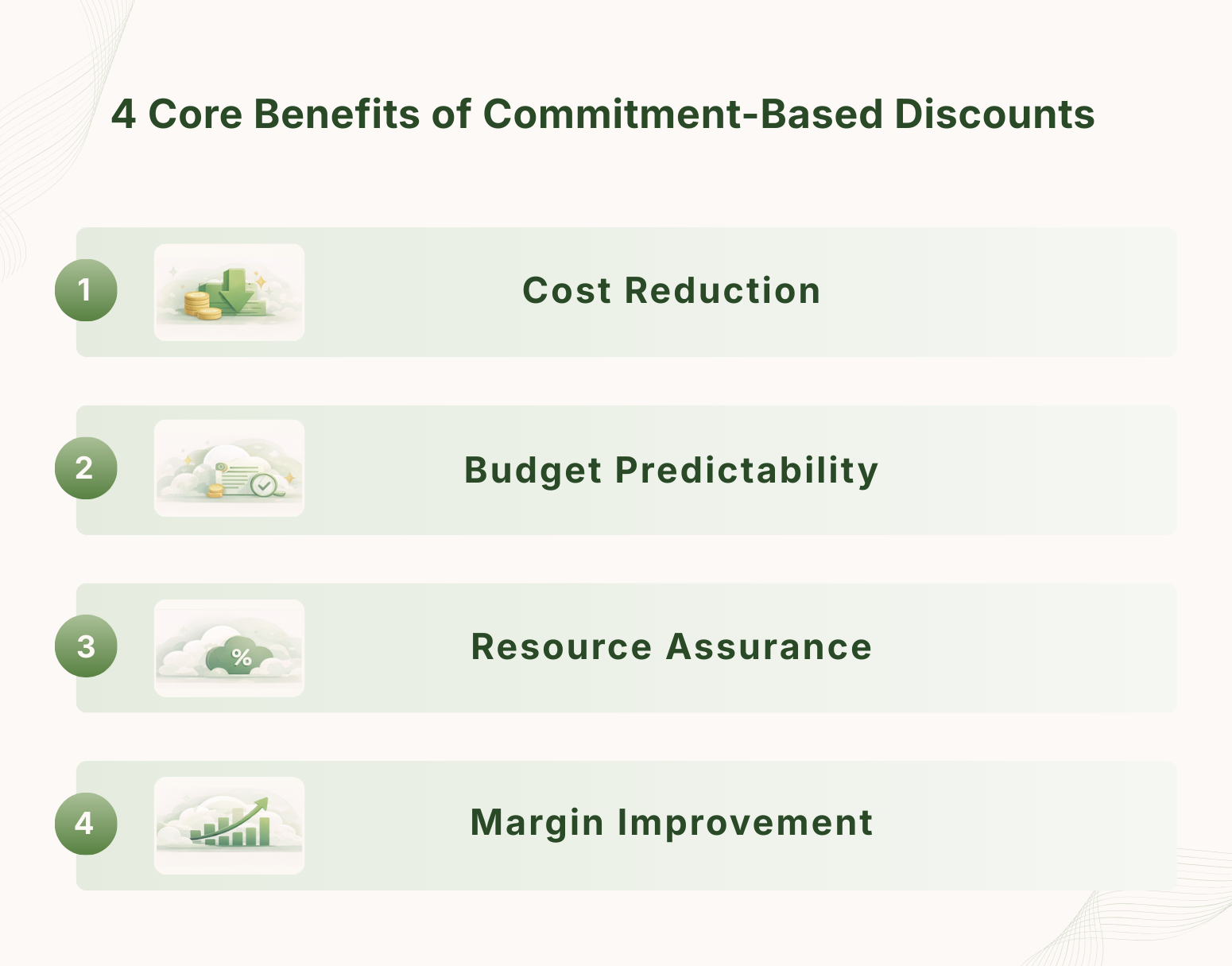
1. Significant Cost Reduction
The most direct benefit is lower effective compute rates. Organizations moving from fully on-demand to well-managed commitment coverage typically reduce compute costs by 30–60%, depending on discount type and coverage level. At scale, even for mid-size environments, this translates to hundreds of thousands of dollars in annual savings.
2. Budget Predictability
Commitment-based discounts convert variable compute costs into more predictable monthly expenses. Finance teams gain greater visibility into infrastructure spend across planning cycles, a core FinOps objective. Instead of managing a cloud bill that fluctuates with every workload change, committed spend becomes a known, manageable baseline.
3. Guaranteed Resource Availability
Resource-based commitments often include priority access to reserved capacity, particularly valuable during high-demand periods or regional capacity constraints. For workloads where availability is mission-critical, commitment-based plans can provide both cost and operational advantages simultaneously.
4. Direct Gross Margin Improvement
For SaaS companies and API platforms that track cloud unit economics, the cost to serve each user, transaction, or API request, reducing effective compute rates directly improves gross margin. When commitment coverage is optimized, the infrastructure cost per unit falls without any change to the product itself.
Risks and Challenges of Managing Commitment-Based Discounts
Despite their significant savings potential, commitment-based discounts introduce real financial and operational risks when managed without the right strategy or tooling.
Underutilization Risk
If workloads shrink, migrate to different services, or change architecture, committed resources may go unused, yet you still pay for them at the committed rate. This is the single biggest risk in commitment management. A commitment purchased based on last year’s usage patterns can become a stranded cost if the product or infrastructure evolves unexpectedly.
Over-Commitment
Many teams err on the side of over-committing to maximize coverage, which compounds underutilization risk. The financially optimal strategy is to commit to a stable, consistent base of your compute usage and cover dynamic or unpredictable workloads with on-demand or spot pricing.
Multi-Cloud Complexity
Organizations running workloads across AWS, GCP, and Azure must manage fundamentally different commitment structures, application rules, and discount mechanisms simultaneously. Without dedicated tooling or a platform designed for cloud cost management, this quickly becomes operationally burdensome and error-prone.
Forecasting Accuracy
Commitment-based discounts are only as valuable as your ability to predict future usage. Poor forecasting leads to over-commitment (underutilization, waste) or under-commitment (missed savings). Mature FinOps teams invest in usage forecasting as a prerequisite to any commitment to purchasing decisions.
Also read: 10 Biggest Cloud Cost Optimization Challenges (and How to Solve Them)
A FinOps Framework for Commitment-Based Discount Strategy
Effective management of commitment-based discounts follows a structured lifecycle. Here’s the framework used by mature FinOps teams:
Step 1: Analyze Baseline Usage
Before purchasing any commitments, analyze 60–90 days of compute usage data. Identify the consistent portion of your usage, your ‘base load’, versus spiky or unpredictable demand. The base load is your primary commitment candidate: it’s the usage you’re confident will persist throughout the full commitment term.
Step 2: Segment Workloads by Stability
Not all workloads are equally suitable for commitment. Always-on production workloads (databases, web servers, data pipelines) are ideal candidates. Development environments, experimental workloads, and highly variable traffic patterns are not. Segmenting clearly before committing is critical to avoiding stranded capacity.
Step 3: Choose the Right Commitment Type
Match the commitment structure to the workload profile. For workloads running across multiple regions or likely to change instance configurations, spend-based commitments (Savings Plans, Flexible CUDs) offer the best risk-adjusted return. For long-lived, stable workloads with known configurations, resource-based commitments (Reserved Instances, Standard CUDs) deliver the deepest discounts.
Step 4: Determine Term and Payment Strategy
1-year commitments offer moderate savings with lower risk, appropriate when you’re uncertain about long-term usage. 3-year commitments maximize savings but require high confidence in future usage stability. Payment strategy depends on available capital: all-upfront maximizes per-dollar savings; no-upfront preserves cash flow at the cost of a smaller discount.
Step 5: Purchase, Monitor, and Continuously Adjust
After purchasing, monitor commitment utilization weekly. Track your coverage rate (the percentage of eligible spend covered by commitments) and your utilization rate (how much of your committed capacity is actually consumed). Both should remain above 80% for a healthy portfolio. Re-evaluate commitments at least quarterly as workloads evolve, and never auto-renew expiring terms without reassessing current usage.
Also read: AWS Cost Explorer: Advanced Guide for FinOps Teams
How Automated Platforms Eliminate the Hard Parts of Commitment Management
As commitment portfolios have grown in complexity, especially across multi-cloud environments, a category of dedicated platforms has emerged to automate and optimize the entire commitment lifecycle. The cost of commitment-based discounts management platforms goes far beyond what native cloud consoles offer.
What Native Cloud Tools Miss
AWS Cost Explorer, GCP Recommender, and Azure Advisor all provide basic commitment recommendations, but these tools typically update slowly (weekly or monthly), don’t account for real-time workload changes, and offer no protection against underutilization risk. For teams managing millions of dollars in compute spend, this lag is costly.
What Automated Platforms Do
Continuous recommendations: Analyze billing and usage data daily, or even more frequently, to generate updated commitment purchase recommendations that reflect current workload behavior rather than stale historical snapshots.
- Risk scoring and lock-in analysis: Evaluate the financial exposure of each potential commitment based on usage volatility, helping teams decide how aggressively to commit without taking on excessive risk.
- Multi-cloud management: Provide a unified view across AWS, GCP, and Azure commitments, normalizing different discount structures into comparable efficiency metrics.
- Underutilization protection: Some platforms offer cashback or buyback mechanisms for unused commitments, allowing teams to increase coverage without bearing the full downside risk of changing workloads.
- FinOps showback and reporting: Allocate commitment savings across teams, products, or cost centers to support internal accountability and chargeback models.
Best Practices for Maximizing Commitment-Based Discount Savings
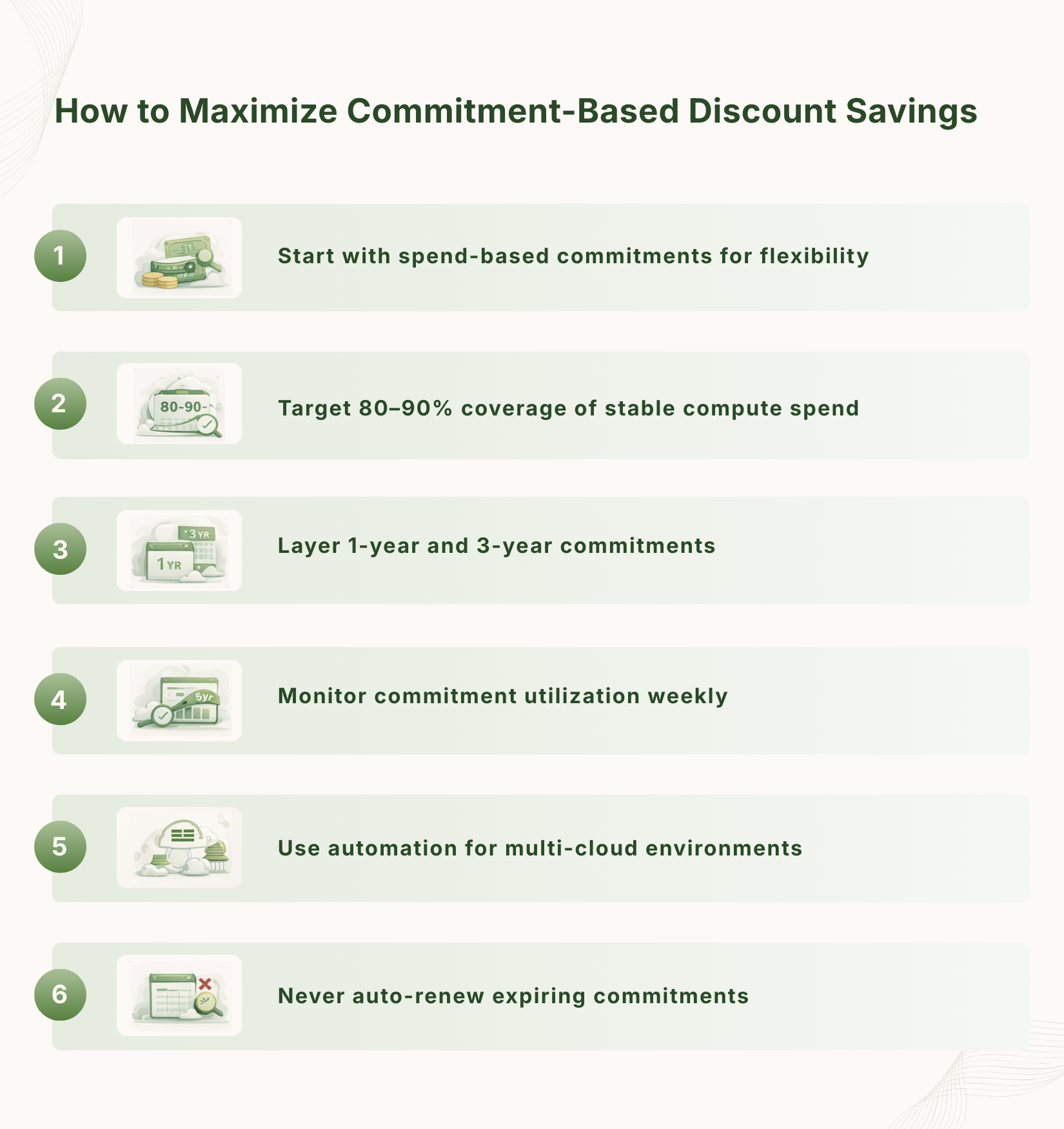
1. Start with spend-based commitments for flexibility
Unless you have very high confidence in specific instance requirements, Savings Plans and Flexible CUDs provide better risk-adjusted returns than resource-based commitments for most organizations starting out. They’re harder to strand and easier to manage.
2. Target 80–90% coverage of stable compute spend
Committing 100% of compute spend is risky because it leaves no buffer for workload changes. Most FinOps practitioners recommend targeting 80–90% coverage of your stable base load, covering the remainder with on-demand pricing.
3. Layer 1-year and 3-year commitments
Use 1-year commitments for usage you’re moderately confident about, and 3-year commitments only for the most stable, long-lived workloads. This reduces exposure to stranded capacity while still capturing deeper discounts where the confidence is warranted.
4. Monitor commitment utilization weekly
Volume discounts based on negotiated commitment levels only deliver full value when commitments are highly utilized. Review your utilization dashboards weekly and act immediately if utilization drops below 80%; this is typically a signal of workload change that requires portfolio rebalancing.
5. Use automation for multi-cloud environments
Managing commitment-based discount portfolios across multiple providers manually is not scalable. Platforms like Usage.ai automate recommendation generation, purchasing decisions, and portfolio monitoring, turning a full-time manual job into a continuous background process.
6. Never auto-renew expiring commitments
Commitment terms expire. Treat renewal as a full re-evaluation opportunity: reassess usage patterns, evaluate newer commitment types, and right-size your portfolio based on current workloads. Auto-renewing based on past commitments is one of the most common sources of stranded cloud spend.
How Usage.ai Automates Commitment-Based Discount Management
Usage.ai is built specifically to solve the hardest problems in commitment management: how to maximize savings coverage while protecting your organization from underutilization risk.
Here’s what makes Usage.ai’s approach different from both native cloud tools and generic FinOps platforms:
- Daily automated recommendations: Usage.ai analyzes your billing and usage data continuously and generates updated commitment recommendations every 24 hours. Instead of relying on periodic manual analysis, your commitment portfolio stays aligned with how your workloads actually behave, not how they behaved 90 days ago.
- Assured Commitments with cashback: Usage.ai introduced a first-of-its-kind assured commitment model. If your commitments become underutilized because workloads change unexpectedly, Usage.ai provides cashback on the unused portion, eliminating the primary reason most organizations under-commit and leave savings on the table.
- Full provider coverage: Usage.ai supports AWS (EC2, Redshift, RDS, OpenSearch, ElastiCache), Google Cloud, and Azure, including Azure App Services and Dedicated Host, allowing teams to manage commitment portfolios across all three providers from a single platform.
- No markups, no spend-based fees: Usage.ai’s pricing is performance-based. Fees apply only to realized savings. There are no markups on your cloud bill and no charges tied to the size of your cloud spend, making it a fully aligned partner rather than another vendor with conflicting incentives.
- Setup in under 5 minutes: Connecting Usage.ai to your cloud environment requires no code changes, no downtime, and no architectural modifications. The platform begins identifying commitment opportunities immediately.
Commitment-Based Discounts vs. On-Demand and Spot Pricing
Understanding where commitment-based discounts fit within the broader cloud pricing model helps FinOps teams design the right purchasing mix:
- On-demand pricing: Maximum flexibility, highest cost per hour. Best for unpredictable, short-lived, or experimental workloads.
- Commitment-based discounts: Reduced cost in exchange for a usage or spend guarantee. Best for stable, predictable base-load workloads.
- Spot/Preemptible instances: Lowest cost (up to 90% discount) but subject to interruption. Best for fault-tolerant, batch, or non-time-critical workloads.
Most optimized cloud environments use a layered strategy: commitments for the base load, on-demand for buffer capacity, and spot for opportunistic or interruptible workloads. The right mix depends on workload characteristics, organizational risk tolerance, and forecasting maturity.
Also read: Cloud Cost Analysis: How to Measure, Reduce, and Optimize Spend
Commitment-Based Discounts and FinOps Maturity
The FinOps Foundation positions commitment-based discounts as a core capability within the Optimize phase of the FinOps lifecycle. Organizations typically progress through three maturity stages:
Crawl: First Commitments, Manual Process
Teams purchase their first Reserved Instances or Savings Plans, often covering a small percentage of eligible spend. Management is manual, and mistakes are common, such as wrong instance types, over-committed regions, or commitments that expire without review. Effective savings rates tend to be below industry benchmarks.
Walk: Systematic Management
Teams establish regular review cycles for analyzing usage, purchasing commitments, and monitoring utilization. Coverage rates improve significantly. Tagging strategies and cost allocation are used to track commitment performance across workloads and teams. Commitment purchases are tied to forecasting rather than gut feel.
Run: Automated, Continuous Optimization
Mature FinOps teams automate the full commitment lifecycle. Recommendations are generated continuously, coverage rates are dynamically optimized, and the portfolio is continuously rebalanced as workloads evolve. Platforms like Usage.ai enable this level of maturity without requiring dedicated engineering or FinOps headcount to maintain it manually. Teams at this stage consistently achieve effective savings rates close to best-in-class benchmarks for each provider.
Conclusion
Commitment-based discounts remain one of the highest-impact cost levers in cloud computing. For organizations running predictable workloads at scale, they can reduce effective compute rates by 30–72%, savings that flow directly to gross margin or fund additional infrastructure capacity.
But realizing those savings isn’t a one-time decision. It requires ongoing forecasting, disciplined portfolio management, and a strategy that balances maximizing coverage against the real risk of over-commitment.
The most mature FinOps teams have solved this by moving from manual commitment management to automated, continuous optimization. They track commitment utilization as a core KPI, re-evaluate their portfolios quarterly, and use platforms that protect them from the downside risk that historically kept organizations under-committed.
Whether you’re purchasing your first Savings Plan or managing a complex multi-cloud commitment portfolio, the principles are the same: analyze your stable base load, match your commitment type to your workload profile, monitor utilization continuously, and use the right tooling to automate what would otherwise be a time-intensive, risk-prone process.
If you’re looking to increase commitment coverage and reduce your effective compute rate without taking on additional risk, Usage.ai’s Assured Commitments make it possible to capture deeper discounts, with cashback protection if your workloads change.
Book a demo to see where your environment could achieve higher commitment coverage and lower infrastructure costs.
%2024%20(14).svg)
Frequently Asked Questions
1. What is the difference between commitment-based discounts and on-demand pricing?
On-demand pricing charges for cloud resources by the second or hour, with no long-term obligation, maximum flexibility at the highest per-unit cost. Commitment-based discounts reduce that cost by 20–72% in exchange for agreeing to use or spend a minimum amount of cloud resources over 1 or 3 years. The core trade-off is flexibility versus cost efficiency.
2. Are commitment-based discounts worth it for small businesses?
For organizations with stable, predictable workloads, commitment-based discounts deliver value at almost any scale. Even a startup running $5,000/month in compute can benefit from a basic Savings Plan. The key threshold is having enough usage consistency to commit with reasonable confidence. If workloads are highly variable or early-stage, on-demand pricing may be more appropriate until patterns stabilize.
3. What happens if I over-commit on cloud resources?
If committed capacity exceeds what your workloads consume, you pay for the unused portion at the committed rate regardless. For AWS Reserved Instances, you can resell unused capacity on the RI Marketplace. For Savings Plans and GCP CUDs, there’s no direct resale mechanism; unused commitment becomes a sunk cost. Platforms that offer cashback protection, like Usage.ai’s Assured Commitments, are specifically designed to reduce this risk.
4. How do cost of commitment-based discounts management platforms differ from native cloud tools?
Native tools (AWS Cost Explorer, GCP Recommender, Azure Advisor) provide basic, relatively infrequent recommendations based on historical usage. Dedicated management platforms offer continuous recommendations, multi-cloud unified views, risk scoring, underutilization protection, and FinOps reporting. For organizations with complex cloud environments, the incremental value of these platforms typically exceeds their cost by a wide margin.
5. Can commitment-based discounts be stacked with other pricing mechanisms?
Yes, with caveats. On AWS, Savings Plans and Reserved Instances can coexist, and both stack with volume pricing tiers. On GCP, Committed Use Discounts can coexist with Sustained Use Discounts, though they apply to different usage slices. Enterprise Discount Programs (EDPs) negotiated privately can layer on top of public commitment discounts. Always verify stacking rules specific to your provider agreements before assuming additive savings.
6. How does Usage.ai help manage commitment-based discounts?
Usage.ai automates the entire commitment lifecycle: analyzing usage data daily, generating updated purchase recommendations, applying commitments automatically, and providing cashback protection if commitments become underutilized. The platform supports AWS, GCP, and Azure, and operates on a performance-based pricing model, meaning fees only apply to realized savings. Teams typically connect their cloud account and start seeing savings opportunities in under 5 minutes.