 AWS
AWS Microsoft Azure
 Google Cloud

The Short Answer
Start by identifying the type of overspend you have: unused resources, incorrectly sized resources, or stable eligible usage still billed at On-Demand rates. Address waste and sizing first, then evaluate commitment coverage where demand is predictable enough to support it.Why Cloud Cost Optimization Is So Difficult
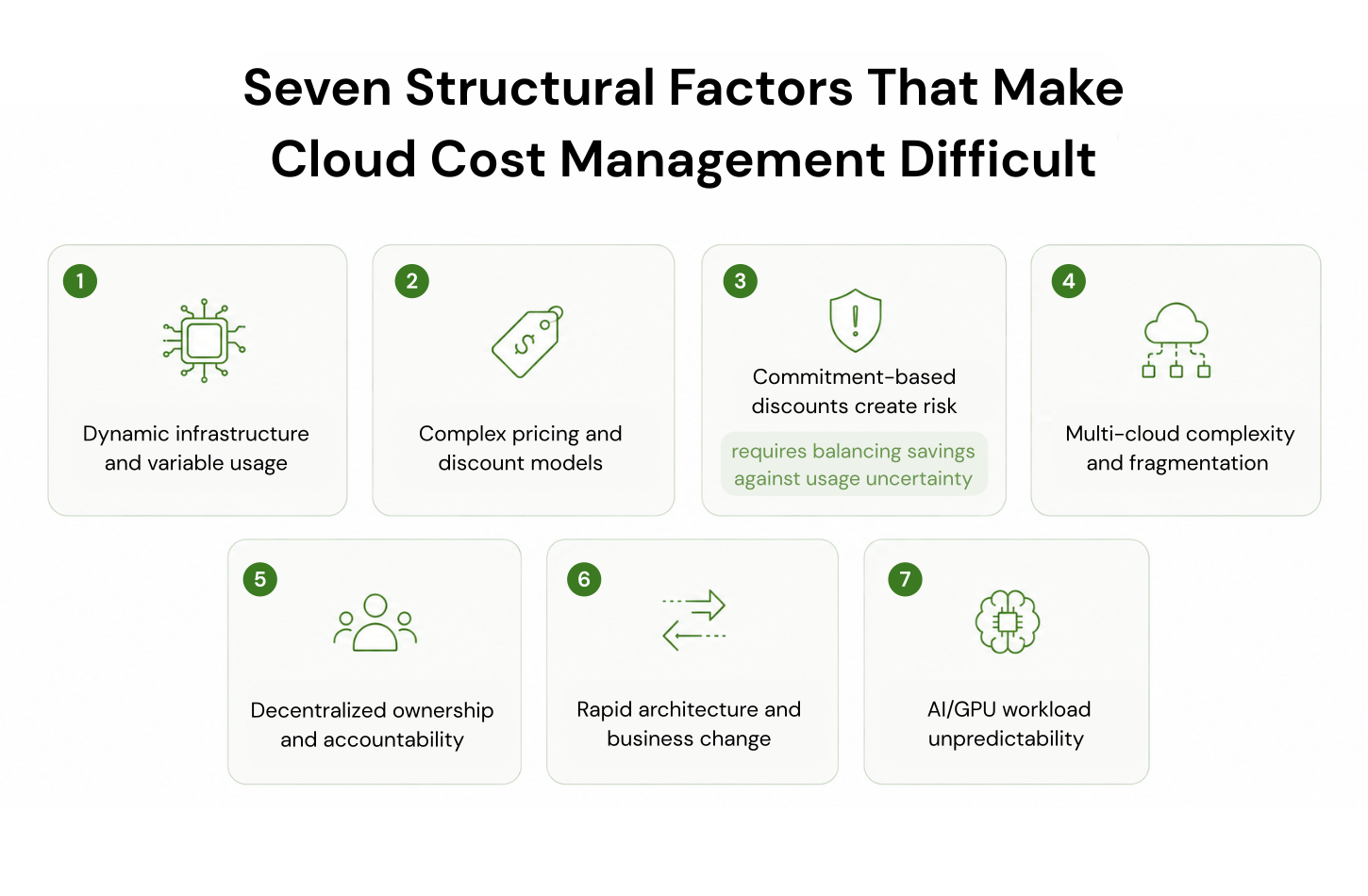
Cloud cost optimization is difficult because cloud pricing is dynamic, resources change faster than billing data does, and long-term discount programs require predicting usage that is inherently uncertain. Most organizations overspend not from ignorance but from structural gaps in visibility, tooling, and team alignment.Cloud environments scale automatically and charge on consumption. Commitment discounts add financial risk, multi-cloud fragments visibility, and decentralized ownership means no single team sees the full picture. Each challenge below traces back to one of these structural gaps.
Challenges and Fixes at a Glance
| # | Challenge | First practical step |
|---|---|---|
| 1 | No real-time cost visibility | Team-scoped dashboards and alerts |
| 2 | Forecasting long-term commitments | Incremental, baseline-driven coverage |
| 3 | Multi-cloud cost fragmentation | Normalize all three discount programs |
| 4 | Rapid infrastructure change | Continuous monitoring, not reviews |
| 5 | Overprovisioning | Rightsizing from utilization data |
| 6 | Idle and orphaned resources | Automated detection and decommissioning |
| 7 | Misaligned incentives | Tagging and cost ownership |
| 8 | Complex pricing | Pricing owners; separate AI governance |
| 9 | Stale recommendations | Automated commitment management |
| 10 | Commitment risk aversion | Cashback-protected commitments |
The 10 Biggest Challenges and Their Fixes
1. No Real-Time Cost Visibility
Cloud cost visibility is difficult because billing data is almost always behind actual infrastructure activity. EC2 instances, containers, and serverless functions can be created and destroyed within minutes, while most cost reporting tools operate on delayed data. AWS Cost Explorer, for example, refreshes cost data at least once every 24 hours, and some data updates later than that.This creates a fundamental FinOps problem: engineering deploys resources instantly while finance analyzes spending hours or days later. Anomalies from runaway workloads or misconfigured autoscaling go unnoticed until spend has accumulated.
Fix: Implement centralized dashboards aggregating billing data across services, accounts, and environments, refreshed often enough to catch anomalies before they compound. Set automated alerts scoped to individual teams, not just org-wide budgets.
Takeaway: For a DevOps lead, delayed visibility means cost anomalies are discovered in retrospect, not in time to act.
2. Forecasting Usage for Long-Term Commitments
Commitment-based discounts can reduce compute costs significantly, but they require predicting infrastructure usage months or years in advance.Modern architectures evolve too fast for confident prediction, workloads move to containers, serverless replaces traditional compute, and traffic shifts overnight.
If usage grows faster than expected, teams undercommit and miss savings. If usage declines, they overcommit and pay for unused capacity.
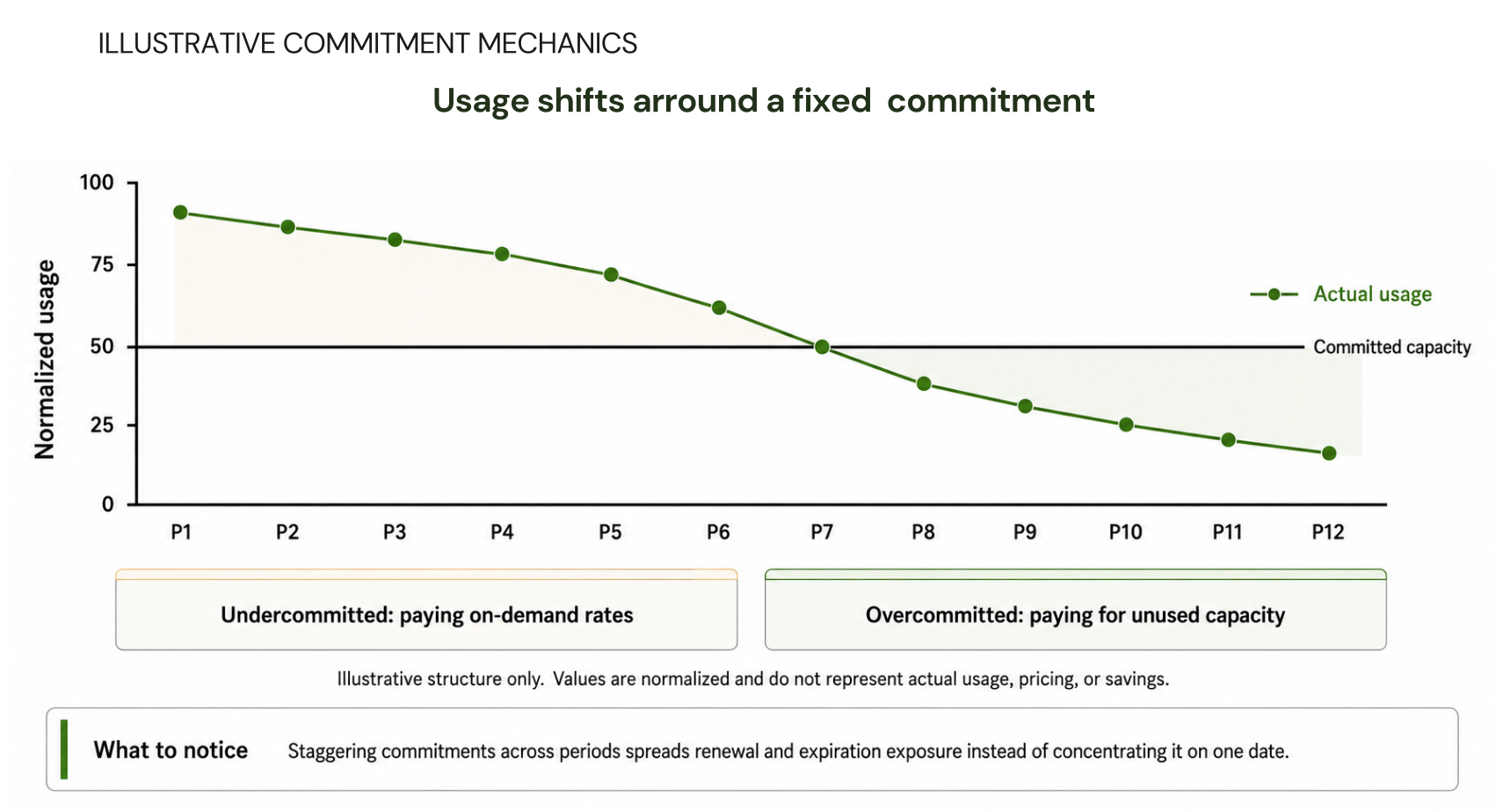
Takeaway: For stable, eligible usage that remains on-demand after waste and sizing work, commitment coverage can improve rates materially when teams manage utilization and break-even risk.
3. Multi-Cloud Cost Fragmentation
Each cloud provider runs its own pricing models, billing formats, and discount programs:- AWS offers Savings Plans and Reserved Instances
- Azure provides reservations, savings plans for compute, and Azure Hybrid Benefit
- GCP uses Committed Use Discounts
Fix: Centralize billing data from all providers in one place, and normalize coverage and savings metrics so commitments compare like for like.
Takeaway: Multi-cloud fragmentation is the reason a FinOps team can appear busy and informed while the overall bill keeps rising.
4. Rapid Infrastructure Change
Microservices, containers, and autoscaling dramatically increase infrastructure variability. Kubernetes clusters scale nodes dynamically, autoscaling absorbs traffic spikes, and CI/CD pipelines spin up temporary environments.Consumption patterns change daily or even hourly, making static optimization ineffective.
Fix: Shift from monthly or quarterly reviews to continuous monitoring that tracks resource consumption and flags anomalies as they occur.
Takeaway: If your optimization cadence is slower than your deployment cadence, you are always catching up.
5. Overprovisioning to Avoid Performance Risk
Engineers are typically incentivized to prioritize reliability over cost efficiency, so they allocate more resources than workloads need to stay stable under peak load, larger instance sizes, excess storage, and bigger Kubernetes clusters.Waste from overprovisioning, idle resources, and inefficient practices can reach up to 35% of total cloud spend, per the Cloud Security Alliance.
Fix: Rightsize continuously using actual utilization data, and pair rightsizing recommendations with autoscaling policies so capacity follows demand instead of peak-load guesses.
Takeaway: Rightsizing is the fastest lever most teams have not pulled consistently because the incentive to overprovision is built into how engineers are evaluated.
6. Idle and Orphaned Resources
Teams spin up temporary environments for testing, but these are not always decommissioned when projects end. Common examples include:- Unattached storage volumes
- Unused load balancers
- Inactive Kubernetes namespaces
- Abandoned development clusters
Fix: Automate detection of idle resources, schedule shutdowns for unused development environments, and enforce tagging so every resource has an owner.
Takeaway: Idle resources are a symptom of missing decommissioning culture, not missing tooling.
7. Misaligned Incentives Between Engineering and Finance
Engineering optimizes for velocity, reliability, and scalability; finance for predictability and efficiency. Without a structured FinOps culture, engineers deploy infrastructure rapidly while finance tries to control spending after the fact.Fix: Implement consistent tagging that maps resources to teams and cost centers. Teams that see the direct financial impact of their infrastructure decisions are far more likely to optimize. For a deeper look at why this pattern persists, see why cloud cost management fails.
Takeaway: Until engineering teams see cloud spend the same way finance teams do, optimization initiatives will stall at the recommendation stage.
8. Complex Pricing Structures
Cloud providers offer hundreds of services, each priced differently by instance type, storage tier, network transfer, region, and consumption metrics like API calls.AI workloads add another layer in 2026: GPU-hour billing, token-based inference pricing, and demand patterns far less predictable than traditional compute.
Standard rightsizing and commitment models rarely map cleanly onto these workloads, which is why teams increasingly run separate cost governance for GPU and AI spend.
Fix: Treat pricing as a domain of expertise. Assign owners to the highest-spend services, and govern AI spend separately from steady-state compute.
Takeaway: Pricing complexity requires active ownership. The teams that navigate it best treat cost management as a discipline, not a background task.
9. Slow or Stale Optimization Recommendations
Native tooling generates recommendations from billing data that can lag behind reality and they only create value when someone acts on them. Savings Plans recommendations should be reviewed against recent usage and current commitment inventory, because the environment can change between recommendation updates and purchase decisions.Between deployments and shifting traffic, a recommendation can be outdated before anyone reviews it.
Fix: Automate the loop. Continuous analysis of usage and automated commitment management remove the gap between recommendation and action.
Takeaway: Stale recommendations do not feel expensive until you calculate the compounding cost of every day the gap stays open.
10. Risk Aversion Around Commitments
For eligible, steady-state usage, commitment programs can provide discounted rates, but they introduce financial risk: if usage drops or workloads shift, teams can be left with commitments they cannot fully use.So many organizations hold coverage below the optimal level and keep paying on-demand prices instead.
Fix: Make the downside recoverable. Incremental coverage, quarterly reviews, and financial protection let teams commit with confidence. For the full picture, see cloud cost governance framework.
Takeaway: Risk aversion around commitments is rational without the right safety net. The fix is not more courage, it is making underutilization financially recoverable.
How Usage.ai Addresses These Challenges
The challenges that resist manual effort, especially commitment forecasting, multi-cloud fragmentation, and commitment risk demand continuous decisions rather than a one-time fix.That is the gap we built for: our platform analyzes usage, recommends optimal commitments, and purchases them on your approval.
We built Flex Insured Commitments for exactly that lever: teams can get the 30–50% savings of cloud commitments across AWS, Azure, and GCP with none of the commitment risk.
Flex Commitments carry no multi-year lock-in, we purchase and manage them on your behalf, and cashback protection covers any underutilization in real money, not credits.
Setup happens at the billing layer with read-only access, no infrastructure changes required, and our fee is a percentage of realized savings only: if we don’t save you anything, you pay nothing.
The remaining challenges are process problems, the checklist below shows where to start
Coverage measured
Know what share of compute spend currently runs on commitments versus on-demand.
Idle resources swept
Unattached volumes, unused load balancers, and abandoned environments identified and owned.
Rightsizing acted on
Recommendations applied, not just generated.
Cost ownership assigned
Spend traceable to a team, service, or cost center.
Review cadence matched to deploy cadence
Optimization reviewed as often as infrastructure changes.
Conclusion
The teams that close the gap treat optimization as a continuous discipline: they monitor in near-real time, commit strategically, and align engineering and finance around shared cost metrics. Start with whichever challenge is costing you the most today, then build the process to address the rest.
A practical checklist for FinOps, DevOps, and engineering teams - no form required.
Frequently asked questions
What are the biggest cloud cost optimization challenges?
The biggest challenges are limited real-time cost visibility, unpredictable usage, complex pricing across providers, and the financial risk of commitment-based discounts. These persist because cloud environments change faster than billing data.
How do FinOps teams reduce cloud costs?
FinOps teams reduce costs through real-time visibility, continuous monitoring, rightsizing, and optimized commitment coverage. Automation and governance policies prevent waste from accumulating in the first place.
What role do commitment discounts play in cloud cost optimization?
Commitment programs can materially reduce the cost of eligible, steady-state usage, but the available discount varies by provider, service, region, configuration, payment option, and one- or three-year term. The hardest part is not understanding them, it is having the confidence to increase coverage without risking stranded spend.
How can organizations manage cloud costs across multiple providers?
By centralizing cost monitoring so billing data from AWS, Azure, and GCP is aggregated and compared on consistent metrics.
What is the fastest way to reduce cloud costs without infrastructure changes?
For stable, eligible workloads with low commitment coverage, increasing coverage can reduce costs without changing the application architecture. Flex Commitments can provide cashback protection for qualifying underutilization losses, subject to eligibility and program terms.”