.png)



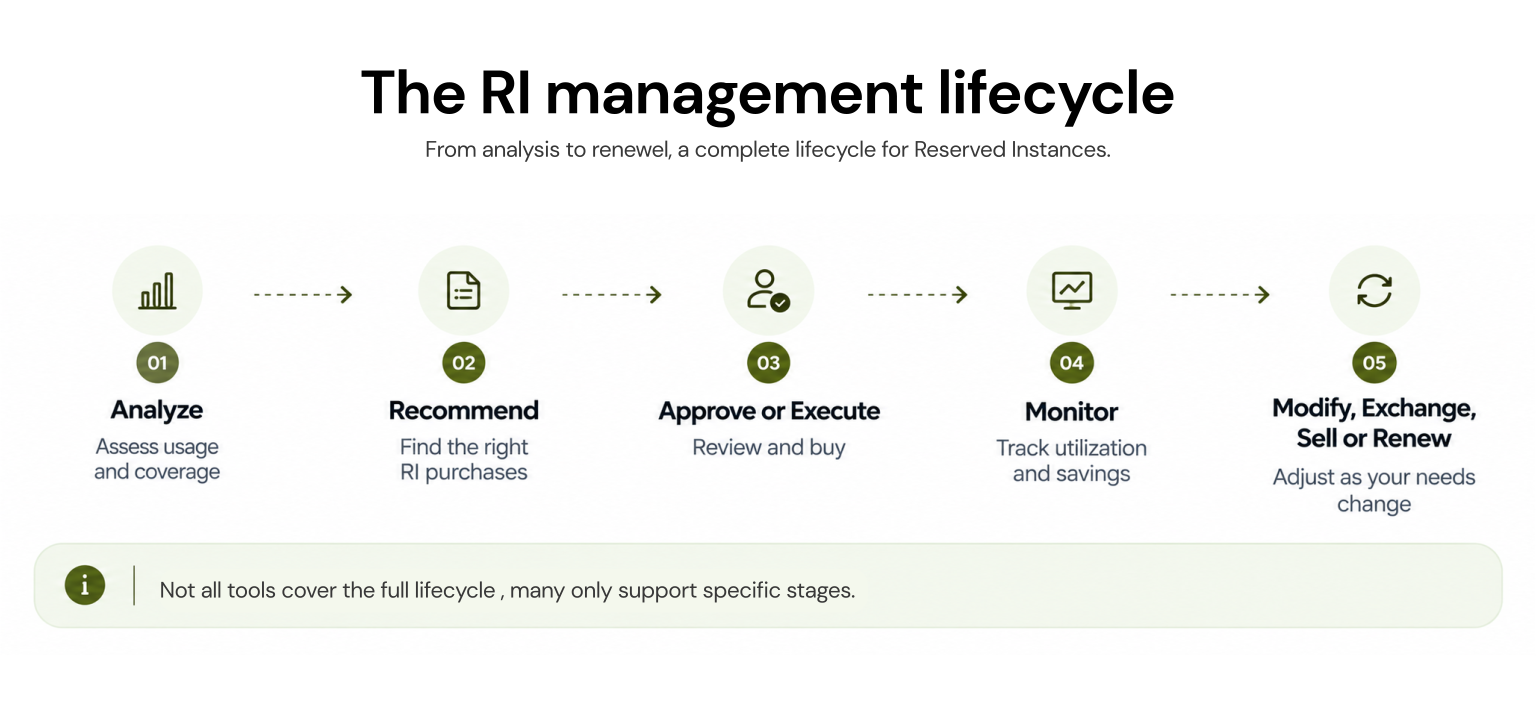
That requires distinguishing EC2 management from reservations for RDS, ElastiCache, OpenSearch, and Redshift. It also means separating recommendation engines from platforms that purchase, modify, exchange, sell, or protect commitments.
This article compares ten AWS RI management tools by service scope, automation depth, governance, risk handling, and buyer fit.
The Short Answer
The best AWS Reserved Instance management tool depends on the control, automation, and downside protection you need. Usage.ai focuses on protection for eligible commitments; AWS native tools on direct control; ProsperOps and nOps on automation; Archera, Zesty, and CloudKeeper on different flexibility mechanisms; and Harness on governed Convertible RI orchestration.IBM Cloudability and CloudHealth fit RI programs that must operate within broader enterprise FinOps governance. Compare supported services, recommendation versus execution depth, risk ownership, and fees and evaluate the best AWS Savings Plans management tools separately because their coverage is not identical.
How We Evaluated AWS RI Management Tools
We evaluated RI scope, management depth, risk or exit mechanisms, governance, implementation requirements, and commercial fit. A tool qualified only if public materials showed inventory or recommendations, execution workflows, portfolio automation, Marketplace activity, or downside protection.“Best” means best for a defined buyer need. Recommendation-only tools are not equivalent to autonomous execution. Marketplace resale is not a guaranteed exit, while buyback or cashback depends on eligibility and contract terms.
Usage.ai publishes this article and participates in the RI management category, so our inclusion is disclosed. The list is organized by buyer fit rather than presented as a universal performance ranking. Competitor capabilities were checked against public first-party materials available on September 16, 2026, and buyers should verify current product scope and commercial terms.
AWS RI Management Tools Compared
The table summarizes documented positioning; it does not imply that every tool supports the same services or actions.| Tool | Best for | Verified reservation or commitment scope | Management depth | Risk or exit approach |
|---|---|---|---|---|
| Usage.ai | Downside-risk management | EC2 RIs, including Convertible RIs; RDS Reserved DB Instances; Redshift and ElastiCache reserved nodes; OpenSearch Reserved Instances, and DynamoDB reserved capacity. | Approval followed by provider-API execution | Conditional cashback for eligible Flex commitments |
| AWS native tools | Direct control | EC2 and RDS Reserved Instances, OpenSearch Reserved Instances, Redshift, ElastiCache, and MemoryDB reserved nodes, and DynamoDB reserved capacity | Recommendations plus native actions | Customer retains risk; EC2 modification, exchange, or Marketplace options |
| ProsperOps | Autonomous optimization | EC2, RDS, Redshift, ElastiCache, OpenSearch, and MemoryDB; Savings Plans | Autonomous portfolio management | Continuous portfolio adjustment |
| nOps | Rate and compute optimization | EC2, RDS, and ElastiCache; Savings Plans | Automated commitment management | Optimization, verify protection terms |
| Archera | Flexible protection structures | All reservable AWS services | Lifecycle management with optional protection | Eligible rebate or release structures |
| Zesty | Marketplace automation | EC2 RIs | Automated purchase and resale | RI Marketplace resale, subject to demand |
| CloudKeeper Commit | Automated commitment optimization | Compute and database RIs and Savings Plans | Automated purchases and eligible exchanges | Continuous rebalancing; vendor-described savings guarantee |
| Harness | Governed Convertible RI execution | EC2 Convertible RIs and RDS Standard RIs; Compute Savings Plans | Purchase and exchange orchestration | Exchanges within AWS rules |
| IBM Cloudability | Enterprise planning | EC2, RDS, Redshift, ElastiCache, and OpenSearch | Analysis, recommendations, and workflows | Scenario planning and governance |
| CloudHealth | Cloud-management governance | Reservation recommendations across AWS reservable services | Cross-service recommendations; advanced modification and exchange tools for eligible EC2 RIs | Utilization controls and governance |
Best AWS Reserved Instance Management Tools
1. Usage.ai: Best for Managing RI Downside Risk
The comparison above shows why buyers should treat downside handling as a separate evaluation criterion. We analyze usage at the billing layer. Once a recommendation is approved, we call the cloud provider’s API to purchase the commitment. Teams can begin with read-only permissions for a savings test before enabling commitment purchases.Our Flex-Commit Program pairs commitment savings with conditional cashback protection. If an eligible Flex Insured Commitment costs more than equivalent On-Demand usage, we cover the calculated difference. For eligible Flex Insured Commitments, this provides commitment savings with none of the commitment risk, subject to current program eligibility and terms.
Existing customer-owned commitments are not automatically protected. Under our pricing model, customers pay an agreed percentage of realized savings, billed monthly in arrears after provider billing data is finalized.
Consider: Review the coverage we recommend for your portfolio, the permissions we require, the applicable commitment and cashback terms, and our documented 90-day-after-accrual payout timeline.
2. AWS Native RI Tools: Best for Direct Control
AWS gives buyers the foundational toolset: Cost Explorer reservation recommendations, coverage and utilization reporting, direct purchasing, Standard RI modification and Convertible RI exchange. Eligible Standard EC2 RIs can also be listed on the EC2 Reserved Instance Marketplace.Cost Explorer uses 7, 30, or 60 days of historical usage and does not forecast future demand. Teams must therefore account for planned migrations, rightsizing, and workload changes separately.
Consider: Native tools minimize third-party dependency, but your team still owns forecasting, approvals, execution, monitoring, and underutilization risk. Marketplace resale depends on eligibility and buyer demand.
3. ProsperOps: Best for Autonomous RI Portfolio Optimization
ProsperOps, a Flexera company, positions its AWS cost optimization service around autonomous management of RIs and Savings Plans. It suits organizations wanting continuous portfolio adjustment instead of periodic analyst-led purchases. Customers can configure guardrails for term, risk tolerance, budget, and payment preference.Consider: Evaluate supported accounts and commitment types, approval controls, fee mechanics, and how automation behaves during sharp workload changes. For additional commercial context, see our ProsperOps review.
4. nOps: Best for RI and Compute Optimization Together
nOps combines AWS rate optimization with compute optimization, making it relevant when commitment coverage and resource efficiency need a shared operating model. Its public product materials describe automated management of RIs and Savings Plans.nOps states that it rebalances commitments hourly and reports coverage, utilization, net savings, and unused-commitment risk.
Consider: Validate the exact RI services and actions included, how savings and fees are calculated, and whether any protection applies to your contract. Our nOps pricing analysis provides additional buying context.
5. Archera: Best for Flexible RI Protection Structures
Archera combines commitment lifecycle management with optional insured or guaranteed structures across AWS reservable services. Its appeal is not only automation but an alternative commercial structure intended to reduce the rigidity of native commitments.Selected commitments are executed inside the customer’s cloud organization, where the customer retains ownership and billing control.
Consider: Review premiums or fees, eligible services, rebate or release conditions, and how protection changes the net savings rate. Our Usage.ai versus Archera comparison explores the differing models.
6. Zesty: Best for Automated RI Marketplace Management
Zesty’s commitment-management documentation describes automated buying and selling of eligible Standard EC2 RIs through the AWS RI Marketplace. It fits teams comfortable using resale as the adjustment mechanism.Because the Marketplace accepts only eligible Standard EC2 RIs, Convertible and non-EC2 reservations require different adjustment mechanisms.
Consider: Marketplace registration, banking setup, IAM permissions, resale demand, and the vendor’s cancellation terms all matter. Resale is not the same as guaranteed reimbursement. See our Zesty pricing guide for commercial context.
7. CloudKeeper Commit: Best for Automated Commitment Optimization
CloudKeeper Commit describes continuous commitment optimization across compute and database services, with automated RI and Savings Plan purchases and eligible exchanges. Its public materials pair this with outcome-based pricing and a vendor-described savings guarantee.It recalculates commitment levels dynamically rather than on fixed cycles and favors incremental adjustments over large upfront purchases.
Consider: Verify supported RI types, how guaranteed savings are calculated, required account access, ownership, and what happens at renewal or termination.
8. Harness: Best for Governed Convertible RI Orchestration
Harness Commitment Orchestrator supports purchasing and exchanging EC2 Convertible RIs and managing RDS Standard RIs, with role-based access, approvals, and notification workflows. That makes it useful where execution must remain governed and reviewable.Harness states that EC2 purchase and exchange recommendations expire after 24 hours and are then regenerated.
Consider: Confirm whether its documented EC2 Convertible RI and RDS Standard RI coverage matches your portfolio, along with the supported exchange paths, prerequisites, and approval design.
9. IBM Cloudability: Best for Enterprise Commitment Planning
IBM Cloudability provides commitment recommendations and savings analysis within a wider FinOps platform. It is strongest when RI planning must connect to allocation, reporting, budgets, and enterprise operating processes. Its documented AWS planning scope includes EC2, RDS, Redshift, and ElastiCache.Consider: Confirm which analytics and automation capabilities are included, then assess implementation effort and total contract cost. See our overview of IBM Cloudability pricing for current buying considerations.
10. CloudHealth: Best for RI Governance Within Cloud Management
CloudHealth by Broadcom incorporates AWS reservation utilization, recommendations, policies, and governance into a broader cloud-management platform.Its EC2 RI Optimizer can model purchase scenarios and surface modification recommendations. It suits organizations wanting RI oversight connected to multi-account reporting and controls.
Consider: Confirm which reservation actions are recommendations, eligible EC2 modification or exchange tools, policy workflows, or Savings Plan purchase automation in your edition. Buyers primarily seeking autonomous RI portfolio management should compare specialist platforms separately.
How to Choose the Right RI Management Tool
Ask each vendor to evaluate the same accounts and billing period. Then compare:Service scope: EC2 only, or also RDS, ElastiCache, OpenSearch, Redshift, and other reservable services?
Action depth: Does the tool only recommend, or can it purchase, modify, exchange, sell, and renew?
Risk ownership: What happens if demand falls? Is relief dependent on Marketplace resale, portfolio adjustment, or contractual protection?
Economics: Compare net realized savings after fees, premiums, sharing arrangements, and uncovered usage, not headline discounts.
Controls: Review IAM access, approval policies, audit logs, account boundaries, and separation of duties.
Baseline quality: Ask how existing RIs, seasonality, migrations, planned rightsizing, and organizational changes affect recommendations.
Exit terms: Confirm commitment ownership, offboarding, data retention, buyback or cashback conditions, and contract termination.
Final Verdict: Which AWS RI Tool Should You Choose?
Use the tool profiles to build a shortlist, then ask each finalist to model the same accounts and billing period. Choose the option that delivers the strongest net value after fees while matching your required service coverage, execution controls, and treatment of unused commitments.Do not decide from headline savings or automation labels alone. Verify what the platform executes versus recommends, who retains the downside risk, and what happens when usage falls or the contract ends. If your requirements extend beyond AWS RIs, compare the best cloud commitment management platforms before deciding.
Compare RI utilization, uncovered usage, downside exposure, and potential savings before choosing a management tool.
Frequently asked questions
What is the best AWS Reserved Instance management tool?
There is no universal winner. Match each option to service scope, action depth, risk treatment, controls, and net economics.
Can RI management tools automatically exchange or sell reservations?
Some can. Convertible EC2 RIs can be exchanged under AWS rules; eligible Standard EC2 RIs can be listed on the RI Marketplace. Orchestration does not guarantee a Marketplace buyer or full recovery.
Do these tools manage RDS and other non-EC2 reservations?
Some do, but many specialize in EC2. Ask for a service-by-service matrix covering recommendation, purchase, monitoring, modification or cancellation, and protection. Do not infer non-EC2 support from a general “RI management” claim.
Are AWS native tools enough for RI management?
They can be enough for stable environments with experienced operators and disciplined approvals. Third-party tools add value when scale, workload changes, automation, governance, or downside treatment justify their cost and access requirements.
If you notice any material information that is incorrect, outdated, or no longer applicable, please contact us at [email protected]. We’ll review the information and update the article where appropriate.