 AWS
AWS Microsoft Azure
 Google Cloud


But if you’re evaluating Zesty, you probably want to know more than its headline pricing. You’d also want to understand what you could actually pay, how Zesty calculates savings and fees, what its buyback protection covers, and which contract terms could affect your costs.
We put this guide together to make that evaluation easier. It looks at Zesty pricing, savings-share fees, AWS Marketplace billing, buyback protection, additional costs, and commitment-related contract terms.
It also uses Zesty’s published documentation alongside independent customer feedback to distinguish documented pricing terms from areas buyers should investigate before signing.
The goal isn’t to tell you whether Zesty is right or wrong for your business. It’s to give you a clear, balanced view of Zesty’s pricing model and the costs that can affect your total economics, so you can decide whether it makes sense for your cloud environment.
How much does a Zesty Commitment Manager cost?
Zesty describes its Commitment Manager pricing as purely success based: if Zesty doesn’t save you anything, it says it doesn’t take a fee. Its published entry model is 25% of the savings Zesty generates. See Zesty’s pricing model.However, 25% is an entry model, not necessarily the rate every customer pays. Zesty’s billing documentation defines “Zesty Fee in %” as the applicable fee for the business as defined in its contract. Learn more about Zesty’s billing report definitions.
- Gross savings: $100,000
- Zesty fee: $25,000
- Savings retained before other applicable costs or refunds: $75,000
How does Zesty calculate its fee?
Zesty’s billing documentation defines Potential Cost as the standard On-Demand equivalent cost and Actual Cost as the AWS cost after commitment discounts. The difference is the reported savings.The 25% headline should not be interpreted as 25% of your AWS bill. Before signing, confirm what Zesty counts as savings and which percentage applies to your account.
Does Zesty have hidden fees?
There is not enough evidence to describe Zesty broadly as a hidden-fee product. Its public documentation discloses its success-based pricing model, while its customer terms identify additional commercial provisions that may apply depending on the Order and services purchased. See Zesty’s Customer Terms and Conditions.There are, however, several costs and contractual details worth checking.
1. AWS Marketplace billing
If you purchase Zesty through AWS Marketplace, Zesty says its fee appears as a line item on the AWS bill under “Advanced Reserved Instance Automation.”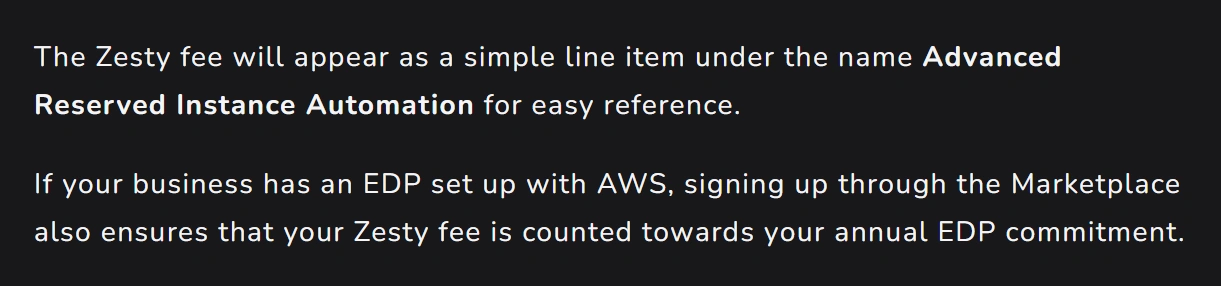
This is important because the purchasing channel can change how the charge appears and is administered.
Don’t assume the direct 25% entry model is automatically the commercial price in every Marketplace transaction. Review the actual Marketplace offer, AWS checkout information, and Order before signing.
2. Professional Services
Zesty’s terms define Professional Services to include installation, deployment, configuration, training, customization, integration, and related services.Zesty says it is not obligated to provide these services unless they are agreed to, and applicable services are charged under a separate Professional Services Statement of Work. See Zesty’s Professional Services terms.
This isn’t evidence that every Commitment Manager customer receives an additional services bill. It means procurement should verify what is included in the Order and whether any implementation or customization work is separately scoped.
3. Taxes
Zesty’s contractual terms also address applicable taxes and other governmental charges. The final amount paid by a customer can therefore depend on the customer’s jurisdiction and tax treatment.Also read: Archera Pricing & Hidden Costs Explained: What Does Archera Really Cost?
What happens if you cancel Zesty?
This is one of the more important areas to examine because ending the vendor relationship and ending the AWS commitments are not necessarily the same thing.Zesty’s current Customer Terms say Orders generally auto-renew for successive terms unless the applicable non-renewal requirements are followed.
For an annual subscription, the terms specify at least 30 days’ notice before the end of the current subscription term for non-renewal. For monthly subscriptions, notice must be provided before the end of the current subscription term. See Zesty’s renewal and termination terms.
The same terms state that, following a termination request, Zesty stops cost-optimization actions and the customer manages the existing commitments. They also state that commitments are non-tradable and cannot be sold by Zesty on the applicable cloud-provider marketplace.
That creates an important exit-economics question: If you leave Zesty while commitments are still active, what financial exposure remains with your organization?
Model that scenario before signing rather than treating cancellation as the end of all commitment-related costs.
What does Zesty’s buyback guarantee protect?
Zesty’s billing documentation includes Eligible Refunds tied to the terms of its buyback guarantee. The refund amount is incorporated into the monthly fee calculation when the applicable conditions are met.The important word is eligible.
Don’t model the buyback mechanism as an unlimited refund for every unused commitment. Before signing, ask Zesty to document:
which commitments qualify;
what triggers a refund;
what exclusions apply;
how the refund is calculated; and
how and when the refund is credited.
That gives you a more realistic estimate of downside protection.
What do customers say about Zesty’s pricing?
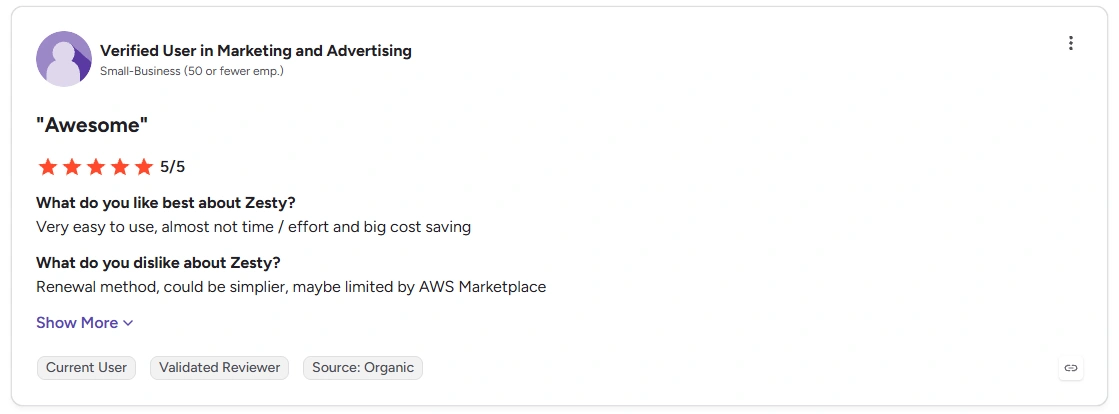
Customer feedback does not point to a broad pattern of undisclosed pricing. Zesty currently has a 4.8/5 rating from 80 G2 reviews, and reviews frequently praise its automation, onboarding, support, and savings. See Zesty’s G2 reviews.There is, however, at least one recurring commercial usability concern in the G2 feedback: a reviewer described the renewal process as complicated and potentially limited by AWS Marketplace. G2’s review summary also identifies renewal complexity as a reported disadvantage.
Learn more: Zesty Customer Reviews: Is It Worth It in 2026?
How does Zesty pricing compare with alternatives?
If you’re comparing Zesty with other commitment-optimization platforms, don’t compare the headline savings-share percentage alone. Model each option against the same usage, commitment, and downside assumptions.| What to compare | Why it matters |
|---|---|
| Savings generated | Shows the gross benefit before vendor fees. |
| Vendor fees | Shows how much of those savings you give up to the provider. |
| Commitment exposure | Shows how much future usage needs to remain predictable. |
| Downside protection | Shows what happens if usage falls and commitments become underutilized. |
| Exit economics | Shows what happens to commitments and fees if you leave. |
| Customer control | Shows who controls commitment purchases and related decisions. |
| Contract terms | Shows whether pricing, renewal, cancellation, or other obligations affect total cost. |
A platform with a lower headline fee isn’t necessarily cheaper if its pricing model, protection mechanism, or contractual terms produce a less favorable risk-adjusted outcome.
Also read: 6 Zesty Alternatives: Best Cloud Cost Optimization Platforms in 2026
Where Usage.ai takes a different approach
Usage.ai uses Flex Insured Commitments to combine commitment optimization with financial protection. The approach is designed to address a problem with conventional commitments: the customer takes on the downside when actual usage falls below the commitment.With Flex Commitments, eligible underutilization can trigger cashback for the difference between the commitment cost and the equivalent on-demand cost, subject to the program’s eligibility and protection terms. How Usage.ai cashback works
The distinction is therefore less about how aggressively commitments are optimized and more about who absorbs the downside when the forecast is wrong. That’s an important variable to include when comparing Usage.ai with Zesty, alongside fees, commitment terms, coverage, and exit economics.
Also read: Usage.ai vs Zesty: Which Commitment Optimization Approach Fits Your Cloud?
Is Zesty worth the cost?
Zesty can make economic sense when the alternative is conservative commitment purchasing, unused discount potential, or significant internal effort spent forecasting and managing commitments. Customer reviews provide evidence of value from automation and reduced manual effort.It may be less attractive if your organization already has mature commitment management and can capture comparable savings without paying a percentage of those savings to a third party.
7 Questions to Ask Before Buying Zesty Commitment Manager
Before signing up, ask Zesty to clarify the commercial and operational details that will determine your actual economics:What savings-share percentage applies to our contract?
Zesty publishes a 25% entry model, but its billing documentation says the applicable fee is defined by contract.
How exactly are savings calculated?
Ask how Potential Cost, Actual Cost, savings, and the applicable fee are calculated on your bill.
What happens if a commitment is underutilized?
Confirm which unused commitment hours qualify for Zesty's buyback guarantee and how eligible refunds affect your bill.
Which commitments can Zesty purchase or manage for us?
Zesty's Commitment Manager can manage different commitment types, including Reserved Instances and Savings Plans, depending on the environment and configuration.
What happens to commitments if you cancel?
Confirm the applicable notice period and who manages existing commitments after Zesty stops optimization activity. Zesty's documentation says 30 days' written notice is required for cancellation.
Are there any minimum-spend or purchasing requirements?
Zesty currently states that Commitment Manager requires at least $7,000 in monthly On-Demand EC2 spend.
What will you pay through AWS Marketplace versus a direct contract?
The current AWS Marketplace listing says pricing depends on contract duration and terms, with additional usage charges potentially applying. Compare the actual Marketplace offer or private offer with your negotiated Order.
Who is Zesty pricing a good fit for?
Zesty pricing can fit if you:- want automated commitment optimization and prefer a success-based pricing model;
- have enough recurring eligible cloud usage for commitment optimization to generate meaningful savings;
- want Zesty to automate commitment purchasing and ongoing optimization rather than manage it entirely in-house;
- have highly variable or uncertain cloud usage that makes long-term commitment exposure difficult to forecast;
- want a different approach to underutilization protection;
- need highly predictable vendor costs rather than a fee tied to savings generated;
- already have a mature FinOps team that can manage commitments internally at a lower total cost;
- want to compare different approaches to commitment risk before giving a vendor control over optimization decisions.
Your usage stability, commitment horizon, internal FinOps capabilities, desired level of automation, and tolerance for commitment risk should determine whether Zesty’s pricing model makes sense for your environment.
Bring your current commitment inventory, 12 months of normalized cloud usage, expected growth, and one realistic downside scenario.
Usage.ai can help you model the economics across different commitment strategies, including fees, commitment exposure, and cashback protection, so you can see the potential net savings you would retain.
Talk to an Expert
Connect in 15 minutes. No contracts, no infrastructure changes. See your savings before committing.
If you notice any material information that is incorrect, outdated, or no longer applicable, please contact us at [email protected]. We’ll review the information and update the article where appropriate.
Frequently asked questions
What is Zesty Commitment Manager's pricing?
Zesty's published entry model is 25% of the savings it generates , but the applicable fee for your business is defined by your contract.
Does Zesty charge a monthly platform fee?
Zesty's offers a success-based model. If you purchase through AWS Marketplace, Zesty says its fee appears on your AWS bill, so review the applicable Marketplace offer and Order rather than assuming a separate direct-billing structure.
Does Zesty charge if it doesn't save money?
Zesty’s Commitment Manager pricing is success based and that it does not take a fee if it doesn't save you anything.
Does Zesty offer protection against unused commitments?
Zesty's billing documentation provides for eligible refunds under its buyback guarantee. The eligibility and calculation terms should be reviewed before purchase.
What should I check before signing with Zesty?
Verify the contracted fee percentage, purchasing channel, applicable charges, refund eligibility, renewal and cancellation terms, Professional Services, taxes, and responsibility for existing commitments.