 AWS
AWS Microsoft Azure
 Google Cloud


The more useful questions are: What do customers actually like? Where does Zesty fall short? How much automation and control does it provide? What does its success-based pricing really mean? And how does it manage commitment risk when cloud usage changes?
This review looks at those questions using current customer reviews, Zesty’s product and pricing documentation, commitment-management terms, and comparisons with relevant alternatives.
What do Zesty customers actually say?
Zesty’s customer feedback is broadly positive, but the quality of the available review evidence varies by platform. G2 provides the largest relevant review sample, with 4.8/5 from 80 reviews. Customers there repeatedly praise Zesty’s automation, ease of onboarding, AWS cost savings, and support. See Zesty reviews on G2.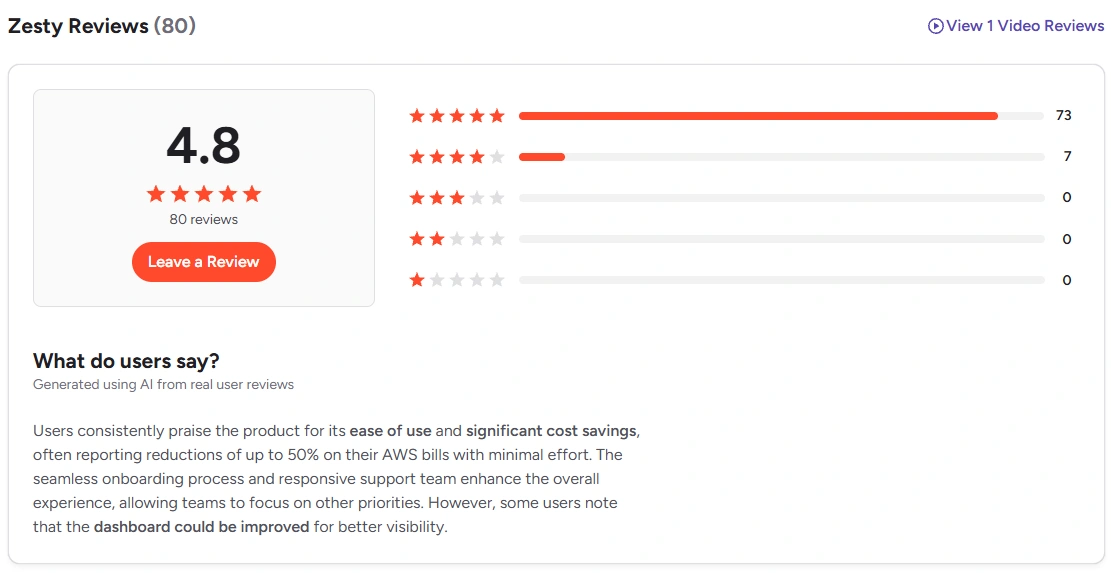
What customers like
The clearest positive theme across the relevant reviews is automation with relatively little ongoing effort.G2 reviewers describe Zesty as easy to onboard and largely “set and forget” after implementation. Customers also report meaningful AWS savings and appreciate having Zesty manage RI, CRI, and Savings Plan decisions rather than handling the commitment portfolio manually.
TrustRadius reviews reinforce this pattern, highlighting automated commitment management, simple implementation, and responsive support.
Some customers report substantial savings. For example, one G2 reviewer reported an additional 40% reduction in monthly AWS compute costs, while another reported saving about $3,000 per month.
What customers don’t like
The criticism is more useful than the overall rating because it highlights where buyers should look closely.Reporting and auditability are the clearest recurring concerns. A PeerSpot reviewer said Zesty’s reporting is not as deep as broader FinOps platforms and wanted more customized finance reporting. The same reviewer also wanted more granular monitoring and better visibility into why automated optimization decisions were made.
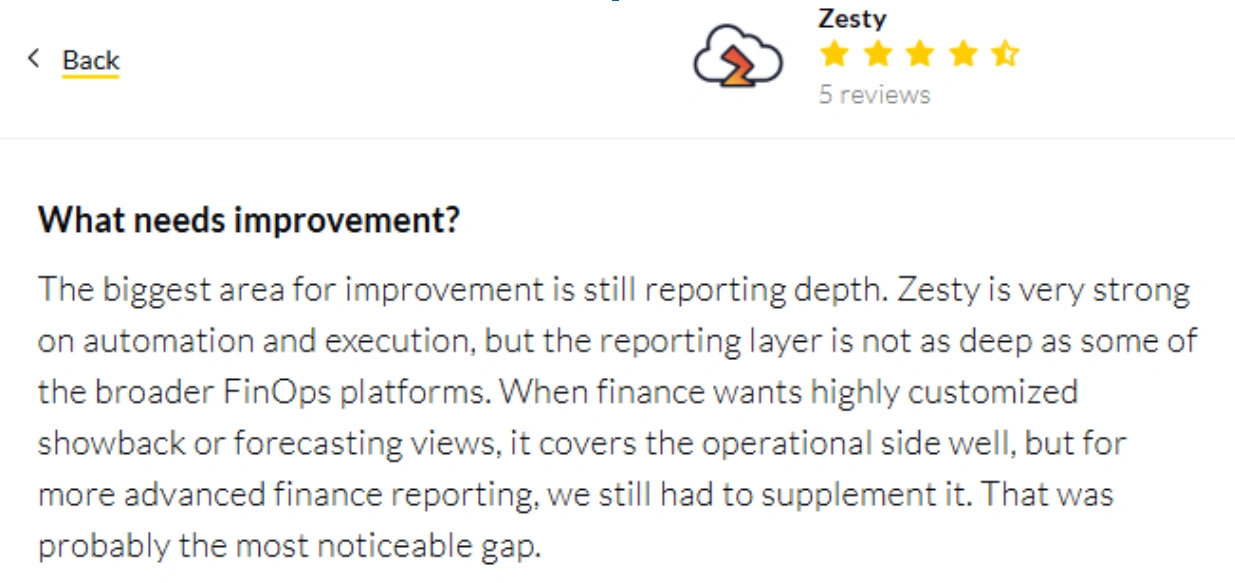
G2 feedback adds a similar signal: some customers would like more granular dashboard views and greater manual control over optimization behavior.
These aren’t necessarily deal-breakers. But they suggest three questions worth asking during an evaluation:
Can your FinOps and finance teams get the reporting they need?
Can engineers understand why Zesty made a particular optimization decision?
How much manual control do you retain when you know a workload behaves differently from the model's assumptions?
How does Zesty manage commitment risk?
Zesty manages commitment risk primarily through smaller, dynamic commitments rather than relying on long-term commitments that need to be refunded when usage falls.Its Commitment Manager uses automated portfolio management, while its Daily Micro-Savings Plans use short-lived commitment blocks that can expire rather than renew when demand decreases. Zesty’s Commitment Manager and Daily Micro-Savings Plans explain this approach.
For eligible Reserved Instances, Zesty can also sell commitments when workloads decline, subject to its applicable terms.
What does Zesty cost?
Zesty uses a success-based pricing model for Commitment Manager. Its public documentation describes the entry model as 25% of generated savings, although the applicable rate depends on the customer’s contract.The economics are easier to understand with a simple example.
- Gross savings: $100,000
- Applicable fee: 25%
- Zesty fee: $25,000
- Savings remaining: $75,000
So the better question is: How much incremental, net savings does Zesty create compared with what your team already achieves?
That’s the number buyers should model, not Zesty’s gross savings percentage in isolation.
What happens if you leave Zesty?
Zesty’s current documentation says Commitment Manager does not require a fixed contract period, but customers must provide 30 days’ written notice before cancellation.The more important issue is what happens to commitments Zesty has already purchased. Leaving Zesty does not automatically eliminate those AWS commitments.
Buyers should therefore understand the status of any active RIs or other commitments, how eligible RIs can be sold, and what happens to Zesty-managed automation after cancellation.
Zesty’s documentation confirms that Commitment Manager can purchase and sell RIs on a customer’s behalf.
Don’t just ask about the cancellation notice period. Ask for a clear exit scenario showing which commitments remain, who manages them, and what your AWS costs look like after Zesty stops optimizing them.
How does Zesty compare with alternatives?
The useful comparison is not simply whether another platform automates commitments. Several do.The more important question is how each platform handles commitment risk, automation, financial protection, and customer control.
| If your priority is... | Platform to investigate |
|---|---|
| Autonomous commitment optimization | ProsperOps |
| Incremental commitment management | nOps |
| Explicit commitment guarantees | Archera |
| Commitment optimization with cashback protection | Usage.ai |
ProsperOps: autonomous optimization
ProsperOps is a relevant option for teams primarily looking for autonomous commitment optimization. The comparison should focus on how each platform handles control, commitment exposure, fees, and exit terms, not automation alone.Also read: ProsperOps Reviews: Is It Worth It in 2026?
nOps: incremental commitment management
nOps emphasizes continuous optimization and incremental commitment layering, adapting coverage as usage changes rather than relying solely on large, infrequent purchases. See the nOps commitment management approach for its current model.Also read: nOps Reviews: Is It Worth It in 2026?
Archera: financial guarantees
Archera takes a more explicit financial-protection approach through its Insured Commitments. Buyers should compare the protection offered, associated premiums or fees, eligibility requirements, and contractual terms, not just the headline savings.Also read: Archera Reviews: Is It Worth It in 2026?
Usage.ai: commitment optimization with cashback protection
At Usage.ai, we combine automated commitment optimization with cashback protection. Teams can use Autopilot for automated management or Copilot when they want more control over individual decisions.Eligible Flex Commitments can receive cashback when defined downside occurs, subject to program terms. See how cashback works for details.
Also read: Usage.ai vs. Zesty
Who should consider Zesty?
Zesty is worth evaluating if you:- have meaningful AWS EC2 spend;
- manage a sizeable RI or Savings Plan portfolio;
- operate Kubernetes or EKS environments;
- spend significant engineering or FinOps time managing commitments and infrastructure efficiency;
- want optimization to happen continuously rather than through periodic manual reviews.
- already capture most available commitment savings internally;
- have relatively little eligible AWS spend;
- require extensive human approval or audit workflows for automated changes;
- prioritize explicit financial protection over autonomous portfolio management;
- need commitment optimization across clouds that Zesty does not currently cover.
Verdict: Is Zesty worth it in 2026?
Yes, for the right organization.Zesty is worth considering for teams that want to automate AWS commitment and infrastructure optimization while reducing the manual work involved in cloud cost management.
Customer reviews consistently praise the ease of onboarding, automated commitment management, support, and reported AWS savings.
The caveats are important, too.
Some reviewers want deeper reporting, more granular visibility, and greater auditability into automated decisions. There is also a learning curve for some users.
And while Zesty’s micro-commitment approach can reduce exposure when usage changes, buyers should understand exactly how commitments are managed and what happens to them when they leave the platform.
The best way to compare platforms
Don’t ask vendors to show you their best-case savings percentage.Give each vendor the same:
current commitment inventory
recent usage history
expected growth
realistic downside scenario
cancellation scenario
That gives you a much better basis for deciding whether Zesty is worth it in 2026 than a review score alone.
Connect in 15 minutes. No contracts, no infrastructure changes. See your savings before committing.
Frequently asked questions
Is Zesty highly rated?
Yes. Zesty has a strong overall review profile. G2 currently rates it 4.8/5 from 80 reviews, while PeerSpot shows 4.4/5 from five reviews. The larger G2 sample provides the stronger signal, while the smaller PeerSpot sample should be interpreted more cautiously
How much does Zesty cost?
Zesty's Commitment Manager uses success-based pricing, with the public entry model described as 25% of generated savings. The applicable rate depends on the customer's agreement.
Does Zesty eliminate commitment risk?
No. Zesty reduces commitment exposure through dynamic management and has a buy-back mechanism for eligible commitments. However, refunds depend on the applicable buy-back terms.
Is Zesty worth it?
It can be, particularly for AWS-heavy teams with significant commitment-management or Kubernetes optimization workloads. The deciding factor should be incremental net savings after Zesty's fees and applicable refunds, compared with what your existing FinOps process can achieve.
If you notice any material information that is incorrect, outdated, or no longer applicable, please contact us at [email protected]. We’ll review the information and update the article where appropriate.