
RDS Proxy is an optional, fully managed connection pooler for RDS and Aurora databases. It pools application connections — intercepting thousands of short-lived connections from your application and funneling them into a smaller set of persistent connections to the database. The promised benefit: prevent connection exhaustion, reduce connection overhead, speed up failover, and improve security through IAM and Secrets Manager integration.
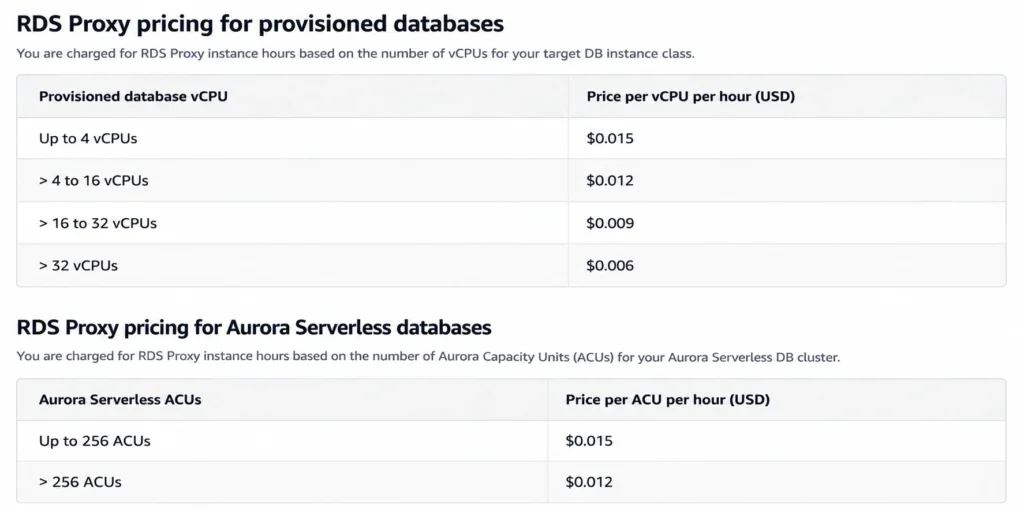
The cost: $0.015 per vCPU-hour of the underlying database instance, charged on top of the database’s own instance cost. Source: AWS official RDS Proxy pricing page (aws.amazon.com/rds/proxy/pricing/), verified June 2026.
Whether that cost is worth paying depends entirely on your architecture. For Lambda-heavy serverless workloads, RDS Proxy pays for itself within the first week of production traffic. For a traditional monolithic application with a connection pool already built into the framework, it may be optional overhead. This guide covers the exact cost formula, the break-even against self-managed alternatives, the critical scenarios where RDS Proxy is essential versus optional, and the limitations that affect whether you can use it at all.
See exactly what you’re overpaying in under 60 seconds. Try the Calculator for free →
RDS Proxy Pricing: The Complete Rate Table
All rates: US East (N. Virginia), June 2026. Source: AWS official RDS Proxy pricing page and multiple consistent independent sources. Verify at aws.amazon.com/rds/proxy/pricing/ — rates change.
| Component | Rate | Notes |
| Provisioned instances (Aurora, RDS MySQL, PostgreSQL, MariaDB, SQL Server) | $0.015/vCPU-hr | Per vCPU of the underlying DB instance. 2 vCPU = $0.03/hr = $21.90/month min. |
| Aurora Serverless v2 | $0.015/ACU-hr consumed | Minimum 8 ACUs. At 8 ACU minimum: $0.015 x 8 x 730 = $87.60/month. Higher than provisioned minimum. |
| Minimum charge (provisioned) | 2 vCPUs per proxy | Even on a 1-vCPU instance, the proxy charges at minimum 2 vCPUs. |
| Default proxy endpoint | $0.00 | No additional charge for the default endpoint created with each proxy. |
| Additional read-only or read-write endpoints | PrivateLink rates | Each additional endpoint provisions an AWS PrivateLink interface endpoint. See aws.amazon.com/privatelink/pricing/. |
| Billing granularity | Per second, 10-min min | 10-minute minimum after creating, starting, or modifying a proxy. |
| Oracle | Not supported | RDS Proxy does not support Oracle. Oracle teams cannot use RDS Proxy. |
| SQL Server 2022 | Not supported | SQL Server 2014, 2016, 2017, 2019 supported. SQL Server 2022 is not. Source: AWS official docs. |
Source: AWS official RDS Proxy pricing page, cloudzero.com (April 2026), go-cloud.io (February 2026), pump.co. All citing consistent $0.015/vCPU-hr rate. Verify at aws.amazon.com/rds/proxy/pricing/ — rates change.
RDS Proxy vs PgBouncer vs ProxySQL: Side-by-Side Comparison
The three connection pooling options for RDS/Aurora are: RDS Proxy (AWS managed), PgBouncer (open-source, PostgreSQL only), and ProxySQL (open-source, MySQL/MariaDB). Each has a different cost structure, feature set, and operational overhead.
| Factor | RDS Proxy | PgBouncer | ProxySQL |
| Cost model | $0.015/vCPU-hr of underlying DB | EC2 instance cost only. From $7.59/month on t3.micro. | EC2 instance cost only. Similar to PgBouncer. |
| Management | Fully managed — no patching, HA config, or monitoring setup | Self-managed. You provision, patch, monitor, and ensure HA. | Self-managed. More configuration complexity than PgBouncer. |
| Supported engines | Aurora, RDS MySQL, PostgreSQL, MariaDB, SQL Server (2014+). Not Oracle. | PostgreSQL only. | MySQL, MariaDB. Some PostgreSQL support (limited). |
| Pooling modes | Transaction (default). Session mode available. Pin mode auto-activates when needed. | Session, Transaction, Statement. More granular control. | Connection multiplexing with advanced query routing. |
| IAM + Secrets Manager | Native integration. Credentials never in app code. | Manual configuration required. | Manual configuration required. |
| Failover speed improvement | Up to 66% faster (RDS/Aurora). Up to 83% for SQL Server Multi-AZ. | Application-dependent. No native failover awareness. | Better MySQL failover handling than PgBouncer but not AWS-native. |
| High availability | Built-in Multi-AZ HA. No config needed. | Requires 2+ EC2 instances with failover mechanism (load balancer or keepalived). | Same as PgBouncer — requires HA setup. |
| Secrets rotation support | Native — proxy handles credential rotation transparently. | Requires application restart or custom rotation logic. | Requires custom rotation logic. |
| Oracle support | No | No | Limited (via plugins) |
| Break-even vs RDS Proxy | RDS Proxy baseline | Cheaper for small DBs. Management costs offset at scale. | Similar economics to PgBouncer. |
Source: AWS official RDS Proxy documentation, PgBouncer documentation (pgbouncer.org), ProxySQL documentation (proxysql.com). EC2 t3.micro $7.59/month from AWS official EC2 pricing.
Also read: RDS Serverless (Aurora Serverless v2): The Complete 2026 Guide
The Break-Even Analysis: RDS Proxy vs PgBouncer by Instance Size
The cost comparison between RDS Proxy and a self-managed PgBouncer setup changes significantly with instance size. Here is the analysis across four common configurations:
All rates June 2026. EC2 rates from AWS official EC2 pricing. Verify before building cost models.
| Database Instance | DB vCPUs | RDS Proxy/month | PgBouncer HA/month | Verdict |
| db.t4g.medium | 2 | $21.90 | $15-25 (2x t3.nano-micro + LB) | Break-even. PgBouncer slightly cheaper but requires management. |
| db.r8g.large | 2 | $21.90 | $20-30 (2x t3.small + LB) | Break-even. Management overhead makes RDS Proxy competitive. |
| db.r8g.xlarge | 4 | $43.80 | $20-30 (same HA setup) | PgBouncer cheaper by $15-25/month. Manage if you have the capacity. |
| db.r8g.2xlarge | 8 | $87.60 | $20-30 (same HA setup) | PgBouncer cheaper by $60+/month. Significant saving at scale. |
| db.r8g.4xlarge | 16 | $175.20 | $20-30 (same HA setup) | PgBouncer $150/month cheaper. ROI calculation heavily favors PgBouncer for PostgreSQL. |
PgBouncer HA setup: 2x t3.small ($0.0208/hr each = $30.38/month combined) plus Network Load Balancer ($16.43/month) = approximately $46.81/month for a proper HA PgBouncer setup. At db.r8g.4xlarge, RDS Proxy ($175.20) vs PgBouncer HA ($46.81) = $128.39/month saving for PgBouncer. But: PgBouncer HA requires engineering time for setup (~8 hours), maintenance (~2 hr/month), and incident response. At an engineering hourly cost of $100+, 2 hours/month of PgBouncer maintenance = $200/month in engineering cost — more than the $128.39/month proxy saving. Source: math from verified EC2 rates and RDS Proxy rate.
The management cost often makes RDS Proxy worth it at larger instances: a db.r8g.4xlarge team that saves $128.39/month by running PgBouncer but spends 2 hours/month on PgBouncer maintenance at $100/hr is net negative by $71.61/month. RDS Proxy cost = $175.20/month. PgBouncer total cost including management = $246.81/month. RDS Proxy wins when management time is valued honestly. For teams with dedicated infrastructure engineers who manage connection poolers across many databases already, PgBouncer’s cost advantage compounds across the fleet.
When RDS Proxy Delivers Clear ROI
Lambda and Serverless Architectures: The Primary Use Case
This is the scenario where RDS Proxy is not optional — it is essential. AWS Lambda can scale to thousands of concurrent executions simultaneously. Each execution attempts to open its own database connection. Standard RDS connection limits — typically 500-2,000 depending on instance size and RAM — are exhausted almost instantly under Lambda-scale concurrency, causing connection timeouts and application errors.
RDS Proxy solves this at the architecture level: all Lambda executions connect to the proxy, which maintains a small, stable pool of connections to the database. A Lambda function scaling from 0 to 10,000 concurrent executions presents as perhaps 50-200 connections to the database through the proxy — well within the connection limit.
Dollar example: a Lambda-powered API experiencing connection exhaustion failures. Each failure causes a user-visible error and often triggers an expensive retry or circuit-breaker response. At $0.015/vCPU-hr for a db.r8g.xlarge proxy ($43.80/month), RDS Proxy eliminates connection exhaustion failures entirely for this architecture. The cost of a 1-hour outage due to connection exhaustion — engineering time, user impact, incident response — typically exceeds a full year of RDS Proxy costs.
Applications With Many Short-Lived Connections
Web frameworks that do not implement persistent connection pools — older PHP applications, some Ruby on Rails configurations, serverless microservices — open a new database connection per request and close it when the request completes. At moderate traffic levels, this creates hundreds of connection open/close cycles per second, consuming significant database CPU and memory.
RDS Proxy caches the established connections to the database and serves new application requests from the pool without opening a new database connection each time. For a web application receiving 500 requests per second, the connection open/close overhead can be reduced from 500 connection operations per second to near zero, with the proxy maintaining a stable 50-100 database connections regardless of request rate.
Failover Speed Requirements
RDS Proxy improves RDS and Aurora failover times by up to 66%. For SQL Server Multi-AZ configurations, the improvement reaches up to 83%. Source: AWS official RDS Proxy overview page.
Standard RDS Multi-AZ failover: 60-120 seconds. Applications that hold long-lived database connections experience failures during this window. With RDS Proxy, the proxy detects the failover, connects to the new primary, and preserves application-layer connections — reducing the application-visible outage window from 60-120 seconds to under 20 seconds for RDS, and under 10 seconds for Aurora.
For applications with strict SLAs where database failover time directly impacts user-visible availability, the failover improvement alone may justify the proxy cost. At $21.90/month for a 2-vCPU instance, the cost to cut database failover time by two-thirds is less than $0.03/hr.
Security: IAM Authentication and Secrets Manager Integration
RDS Proxy integrates natively with AWS Secrets Manager and IAM for database credential management. Applications connect to the proxy using IAM authentication — the actual database username and password never appear in application code or environment variables. The proxy handles credential rotation transparently: when Secrets Manager rotates a database password, the proxy picks up the new credentials without any application restart or connection interruption.
Without RDS Proxy, IAM-based database authentication to RDS requires custom application code to generate IAM authentication tokens, handle token expiration (15-minute validity), and manage credential rotation. RDS Proxy eliminates all of this at the application layer. For compliance-sensitive environments (SOC 2, HIPAA, PCI-DSS) where credential management is audited, the security benefit of RDS Proxy may justify the cost independent of any connection pooling benefit.

When RDS Proxy Does NOT Deliver ROI
Monolithic Applications With Persistent Connection Pools
Traditional server-side applications — Java Spring applications with HikariCP, Python Django applications with connection pooling middleware, .NET applications with connection pooling — maintain a persistent pool of database connections at the application layer. Each application server holds 10-50 database connections open continuously. The total number of database connections is bounded by (number of app servers x connections per server), which is a manageable, predictable number.
For this architecture, connection exhaustion is not a problem. The application already pools connections effectively. RDS Proxy would multiplex the 10-50 connections from each application server into… 10-50 connections to the database. There is minimal connection reduction. The proxy adds latency to every query (an extra network hop through the proxy endpoint) and adds $21.90-175.20/month in cost for no meaningful benefit. This is the architecture where RDS Proxy costs money without earning it back.
Oracle and SQL Server 2022 Users
RDS Proxy does not support Oracle database. Teams running Oracle RDS cannot use RDS Proxy regardless of their architecture. For Oracle connection pooling, the options are self-managed application-layer pooling or DRCP (Database Resident Connection Pooling) in the Oracle engine itself. Source: RDS Proxy supported engines — Oracle not listed.
RDS Proxy does not support SQL Server 2022. SQL Server 2014, 2016, 2017, and 2019 are supported. If you are running SQL Server 2022 (the latest major version), RDS Proxy is not available for your workload. Source: AWS official RDS Proxy documentation: ‘Currently, RDS Proxy does not support RDS for SQL Server DB instances that run on major version SQL Server 2022.’
The Pin Mode Problem: When Pooling Stops Working
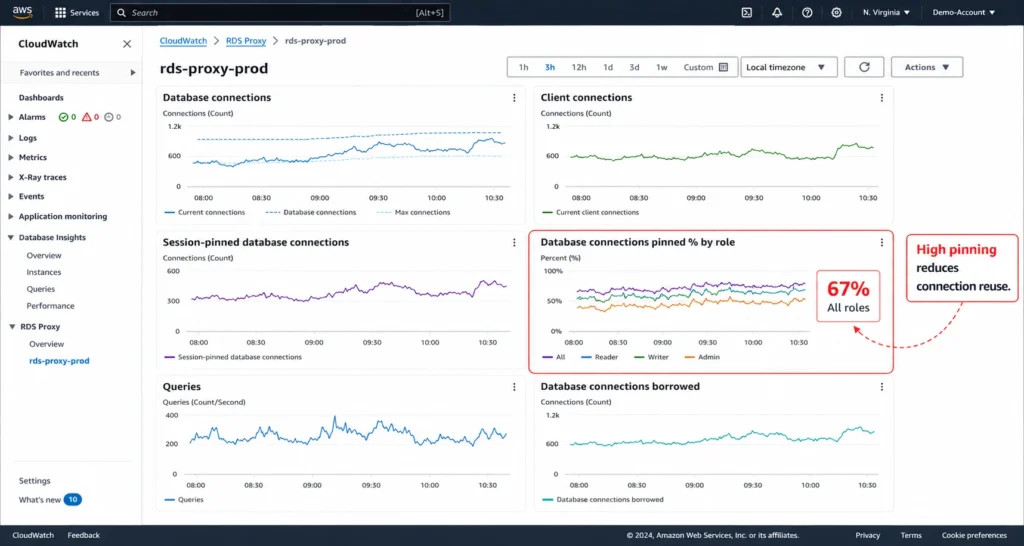
RDS Proxy can operate in two modes: multiplexing mode (the beneficial mode that pools connections) and pin mode (a fallback mode that creates a one-to-one mapping between application and database connections). When RDS Proxy enters pin mode for a client connection, that connection is no longer shared with other clients, defeating the connection pooling benefit entirely.
Pin mode is triggered by specific SQL operations and features. Common triggers: SET statements that change session state (SET @@variable, SET LOCAL), temporary tables (CREATE TEMPORARY TABLE), user-defined locks (GET_LOCK()), cursors that are left open, and prepared statements in certain configurations.
The cost impact: an application that heavily uses session variables, temporary tables, or cursors will spend most of its time in pin mode. The proxy still charges $0.015/vCPU-hr, but provides no connection pooling benefit because each application connection is pinned to its own database connection. The application is effectively paying for a pass-through proxy with an extra network hop.
How to detect pin mode usage: check the CloudWatch metric Proxied SQL statements that caused pinning. If this metric is consistently high relative to total connections, your application is triggering pin mode frequently. Review your application’s use of SET statements, temporary tables, and cursors before deploying RDS Proxy in production. Applications that must use these features can often be refactored to use transaction-scoped alternatives that do not trigger pinning.
Aurora Serverless v2 and RDS Proxy: The Higher Minimum Charge
Aurora Serverless v2 with RDS Proxy uses a different pricing model: $0.015 per ACU-hour consumed by the database, with a minimum of 8 ACUs per proxy. Source: pump.co (November 2025) citing AWS official.
At minimum consumption (0.5 ACU, the Aurora Serverless v2 floor): the proxy charges at the 8 ACU minimum = 8 x $0.015 x 730 = $87.60/month. This is significantly higher than the provisioned instance minimum ($21.90/month for a 2-vCPU instance).
At higher ACU consumption (for example, a database averaging 16 ACUs): proxy = 16 x $0.015 x 730 = $175.20/month. The proxy cost scales with the database’s average ACU consumption, not the maximum.
The Aurora Serverless v2 + RDS Proxy combination makes most sense for Lambda architectures where the Lambda concurrency would exhaust database connections if the proxy were absent. The Serverless v2 auto-scaling provides the correct database capacity; the Proxy prevents connection exhaustion from Lambda bursts. Both the auto-scaling and the proxy cost are justified by the Lambda architecture requirement. For Aurora Serverless v2 workloads that are not Lambda-driven (variable traffic but with persistent application connections), the $87.60+ monthly proxy minimum requires careful ROI evaluation.

Also read: Amazon Aurora DSQL Pricing: The Complete 2026 Guide
Complete Cost Scenarios: Calculating Your Monthly RDS Proxy Bill
Scenario 1: Small PostgreSQL API (Lambda Architecture)
Setup: db.t4g.medium PostgreSQL (2 vCPUs, 4 GB RAM), Lambda-powered REST API, us-east-1, Single-AZ for development.
RDS Proxy cost: 2 vCPUs x $0.015 x 730 hrs = $21.90/month. Instance cost: db.t4g.medium on-demand approximately $0.068/hr x 730 = $49.64/month. Total with proxy: $71.54/month. Proxy overhead: 44% of instance cost.
ROI case: Lambda function making 50,000 requests/day to the database. Without proxy: connection exhaustion above 50 concurrent Lambda executions. With proxy: zero connection failures regardless of Lambda concurrency. For a production API, the cost of connection exhaustion incidents far exceeds $21.90/month. Source: math from verified rates.
Scenario 2: Production MySQL (Traditional Web Application)
Setup: db.r8g.xlarge MySQL (4 vCPUs, 32 GB RAM), Java Spring Boot application with HikariCP connection pool (20 connections per app server, 5 app servers = 100 total connections), Multi-AZ, us-east-1.
RDS Proxy cost: 4 vCPUs x $0.015 x 730 hrs = $43.80/month. Instance cost: db.r8g.xlarge Multi-AZ approximately $0.900/hr x 730 = $657/month. Total with proxy: $700.80/month. Proxy overhead: 6.7% of instance cost.
ROI case: 100 persistent connections from HikariCP across 5 app servers never approaches the 2,000+ connection limit for an r8g.xlarge. No connection exhaustion risk. HikariCP already handles reconnection after failover. The primary RDS Proxy benefit here is: (1) reduced failover visible time (66% faster) and (2) IAM authentication. At $43.80/month additional, the failover benefit alone may justify it for this production application.
Scenario 3: Large Aurora Cluster (Compliance Requirement)
Setup: Aurora PostgreSQL db.r8g.4xlarge (16 vCPUs), PCI-DSS compliant, requiring IAM-based authentication and Secrets Manager rotation. Multi-AZ cluster with 2 read replicas. 3 instances total.
RDS Proxy cost per proxy: 16 vCPUs x $0.015 x 730 = $175.20/month. If deploying one proxy per cluster (covering all 3 instances through the single proxy’s read/write and read-only endpoints): $175.20/month. If deploying separate proxies for each instance: 3 x $175.20 = $525.60/month — unlikely to be necessary.
ROI case: mandatory IAM authentication under PCI-DSS means credentials cannot appear in application code. Without RDS Proxy, the team implements a custom Secrets Manager integration with token refresh logic. Engineering time: approximately 20 hours of implementation + 2 hours/month of maintenance = $2,200/month in engineering cost at $100/hr. RDS Proxy at $175.20/month delivers the same outcome at a fraction of the cost.
How to Decide: RDS Proxy vs Self-Managed Pooler
Use this decision framework to determine the right connection pooling approach for each database.
Choose RDS Proxy when:
You use AWS Lambda or other serverless compute that creates short-lived connections at scale. Connection exhaustion is a production risk or has occurred before. Your engine is Aurora, MySQL, PostgreSQL, MariaDB, or SQL Server (2014-2019). You need IAM authentication or Secrets Manager rotation without custom application code. You need managed HA for the proxy without infrastructure maintenance. Database failover speed is a monitored SLA metric. Your team does not have dedicated infrastructure capacity to manage self-hosted proxies.
Choose PgBouncer (PostgreSQL only) when:
You run PostgreSQL and have existing infrastructure operations experience. Connection counts are high and instance sizes are large (8+ vCPUs), making RDS Proxy costs significant. Your application uses session-level features (temporary tables, session variables, cursors) that trigger RDS Proxy pin mode, eliminating the pooling benefit. You need statement-level pooling, which RDS Proxy does not support. Your security model does not require Secrets Manager integration and custom IAM auth handling is acceptable.
Also read: RDS Reserved Instances: The Complete Guide
Choose ProxySQL (MySQL/MariaDB only) when:
You run MySQL or MariaDB and need advanced query routing (read/write splitting, query caching, query rewriting). Your connection count is high and RDS Proxy costs are material. You have infrastructure operations capacity and are willing to manage HA for the proxy tier.
Use no proxy when:
Your application already has an application-layer connection pool (HikariCP, pgBouncer in the framework, connection pooling middleware). Connection counts are bounded and predictable. You are not using Lambda. Your instance is large and persistent connections never approach the limit. Source: AWS official RDS Proxy documentation on when to use RDS Proxy.
How RDS Proxy Costs Interact With the Broader RDS Cost Picture
RDS Proxy cost scales directly with the vCPU count of your database instance. This creates a meaningful interaction with the rest of your RDS cost optimization strategy: right-sizing your database instance reduces both the instance cost AND the proxy cost simultaneously.
A db.r8g.2xlarge (8 vCPUs) that CloudWatch shows running at 30% average CPU could likely be right-sized to a db.r8g.xlarge (4 vCPUs). Cost impact: instance drops approximately $0.478/hr, proxy drops from $87.60/month to $43.80/month — $43.80/month saved on the proxy alone. When right-sizing a proxied database, the proxy cost reduction is an additional 15-20% savings on top of the instance cost reduction. Run the CloudWatch analysis on the database instance first and right-size before adding a proxy on an oversized instance.
Similarly, migrating to Graviton (which offers lower per-vCPU on-demand rates) does not reduce RDS Proxy cost because the proxy pricing is a flat $0.015/vCPU-hr regardless of instance family. A db.r8g.xlarge (Graviton4, 4 vCPUs) and a db.r6i.xlarge (Intel, 4 vCPUs) both cost $43.80/month for the proxy. The Graviton migration reduces instance cost but proxy cost stays constant per vCPU. Source: consistent with AWS official proxy pricing mechanics.
RDS Proxy Cost Optimization Tactics
1. Remove proxies from non-production databases
Development, staging, and QA databases do not need RDS Proxy. They are not Lambda-driven in production, do not have SLA failover requirements, and do not need Secrets Manager rotation for compliance. Removing RDS Proxy from 5 non-production db.t4g.medium instances saves 5 x $21.90 = $109.50/month with zero production impact.
2. Right-size the database before adding the proxy
Every vCPU you remove from an oversized instance saves $0.015/hr = $10.95/month in proxy cost in addition to the instance savings. Right-size first, deploy proxy second.
3. Use a single proxy for a cluster where feasible
RDS Proxy supports read-only and read-write endpoints within a single proxy for Aurora clusters. You do not need a separate proxy per cluster instance. One proxy with multiple endpoints serves both writer and reader traffic from a single proxy configuration. Additional endpoints incur PrivateLink charges — use read-only endpoints only when the routing benefit justifies the cost.
4. Audit for pin mode
If CloudWatch shows high ‘Proxied SQL statements that caused pinning’, your application is spending time in pin mode. Profile the pin mode triggers (SET statements, temp tables, cursors) and refactor where possible. An application that spends 80% of time in pin mode is paying $0.015/vCPU-hr for a proxy that provides connection pooling benefits only 20% of the time.
5. For Aurora Serverless v2, evaluate the 8-ACU minimum
The Aurora Serverless v2 proxy minimum of 8 ACUs = $87.60/month is high for databases that spend significant time at low ACU levels (0.5-4 ACUs). If the database idles frequently and connection exhaustion is not a risk during low-utilization periods, consider whether RDS Proxy is justified for the entire uptime or only for peak windows. Proxy creation and deletion are fast operations — some teams create proxies before expected traffic spikes and delete them afterward for variable workloads.
See exactly what you’re overpaying in under 60 seconds. Try the Calculator for free →

Frequently Asked Questions
1. How much does RDS Proxy cost?
$0.015 per vCPU-hour of the underlying provisioned database instance. Minimum 2 vCPUs per proxy. A 2-vCPU instance (db.t4g.medium, db.r8g.large) costs 2 x $0.015 x 730 = $21.90/month. A 4-vCPU instance: $43.80/month. An 8-vCPU instance: $87.60/month. A 16-vCPU instance: $175.20/month. For Aurora Serverless v2: $0.015/ACU-hour consumed, minimum 8 ACUs = $87.60/month minimum. No charge for the default endpoint. Additional endpoints incur PrivateLink charges. Source: AWS official pricing page, verified June 2026.
2. Is RDS Proxy a connection pool?
Yes. RDS Proxy is a fully managed connection pooler that multiplexes thousands of application connections onto a smaller set of persistent database connections. It uses transaction-level multiplexing by default: when a transaction completes, the database connection is returned to the pool and reused for another application request. This is equivalent to transaction-mode pooling in PgBouncer. The proxy also supports session-mode pooling. Source: AWS official RDS Proxy overview.
3. What are the limitations of RDS Proxy?
Key limitations: (1) Oracle not supported. (2) SQL Server 2022 not supported (2014, 2016, 2017, 2019 are supported). (3) RDS Custom SQL Server not supported. (4) Pin mode activated by SET statements, temporary tables, cursors, and user locks — prevents multiplexing when triggered. (5) 20 proxies per account default quota. (6) Additional endpoints (beyond the default) incur PrivateLink charges. (7) No statement-level pooling (only transaction and session). Source: AWS official RDS Proxy quotas and limitations documentation.
4. Does RDS Proxy reduce costs?
Not directly — RDS Proxy adds $0.015/vCPU-hr to your bill. It can reduce costs indirectly by: (1) allowing smaller database instances to handle higher connection counts (reducing instance size requirements); (2) eliminating connection exhaustion incidents that cause application errors and engineering escalations; (3) reducing Secrets Manager rotation engineering costs through native integration. The direct cost reduction from right-sizing due to proxy connection management typically ranges from $0 to $50/month per instance, depending on how much the instance was oversized for connection handling. Source: AWS official RDS Proxy benefits and pricing documentation.
5. Can I use RDS Proxy with Oracle?
No. RDS Proxy does not support Oracle databases. The supported engines are: Aurora MySQL, Aurora PostgreSQL, Amazon RDS for MySQL, RDS for PostgreSQL, RDS for MariaDB, and RDS for SQL Server (version 2014 through 2019). Oracle connection pooling on RDS requires application-layer connection pools (JDBC connection pooling, Oracle UCP) or DRCP (Database Resident Connection Pooling) within the Oracle engine. Source: AWS official RDS Proxy documentation.
6. Is RDS Proxy worth the extra cost for Lambda functions?
Yes, for any Lambda function connecting to RDS. Lambda can scale to thousands of concurrent executions, each attempting a new database connection. Standard RDS connection limits (500-2,000 depending on instance size and RAM) are exhausted almost instantly under Lambda concurrency, causing connection timeouts and application errors. RDS Proxy solves this at the architecture level by multiplexing all Lambda connections into a small pool. At $21.90-43.80/month for a 2-4 vCPU database, the proxy cost is insignificant relative to the cost of connection exhaustion incidents. Source: AWS official RDS Proxy use cases.
7. Does RDS Proxy pricing double for Multi-AZ?
No, not directly. RDS Proxy pricing is based on the vCPU count of the underlying database instance, not on the deployment type. A Single-AZ db.r8g.xlarge (4 vCPUs) and a Multi-AZ db.r8g.xlarge (4 vCPUs) both cost $43.80/month for the proxy. However, a Multi-AZ database has a higher instance cost (approximately 2x Single-AZ), and since proxy pricing scales with the database’s vCPU count rather than deployment type, the proxy adds the same absolute amount to both. Source: AWS official pricing mechanics and AI Overview correction.
8. How does RDS Proxy compare to PgBouncer for cost?
For small databases (2-4 vCPUs), PgBouncer on EC2 (t3.micro to t3.small) is $7.59-15.18/month for single-instance, or $20-30/month for a properly HA setup — comparable to RDS Proxy at $21.90-43.80/month. For large databases (8+ vCPUs), PgBouncer HA stays at $20-30/month while RDS Proxy scales to $87.60-175.20/month. PgBouncer is cheaper for large PostgreSQL databases, but requires infrastructure management, patching, monitoring, and incident response — costs that are often $100-200+/month in engineering time. Source: analysis from verified rates.