

New See exactly what you're overpaying AWS in under 60 seconds. Try the Calculator for free

Redshift Reserved Nodes: 1-Year vs 3-Year — The Actual Math Behind Which Term to Choose and When the Longer Commitment Backfires

Updated July 2, 2026
21 min read
On this page

Every Redshift cost guide eventually reaches the 1-year versus 3-year question and answers it the same way: 3-year saves more, choose 3-year if you’re confident in the workload. That answer is correct in isolation and incomplete in practice. It leaves out the specific conditions under which a 3-year Redshift commitment backfires, and those conditions are common enough that they deserve their own section.

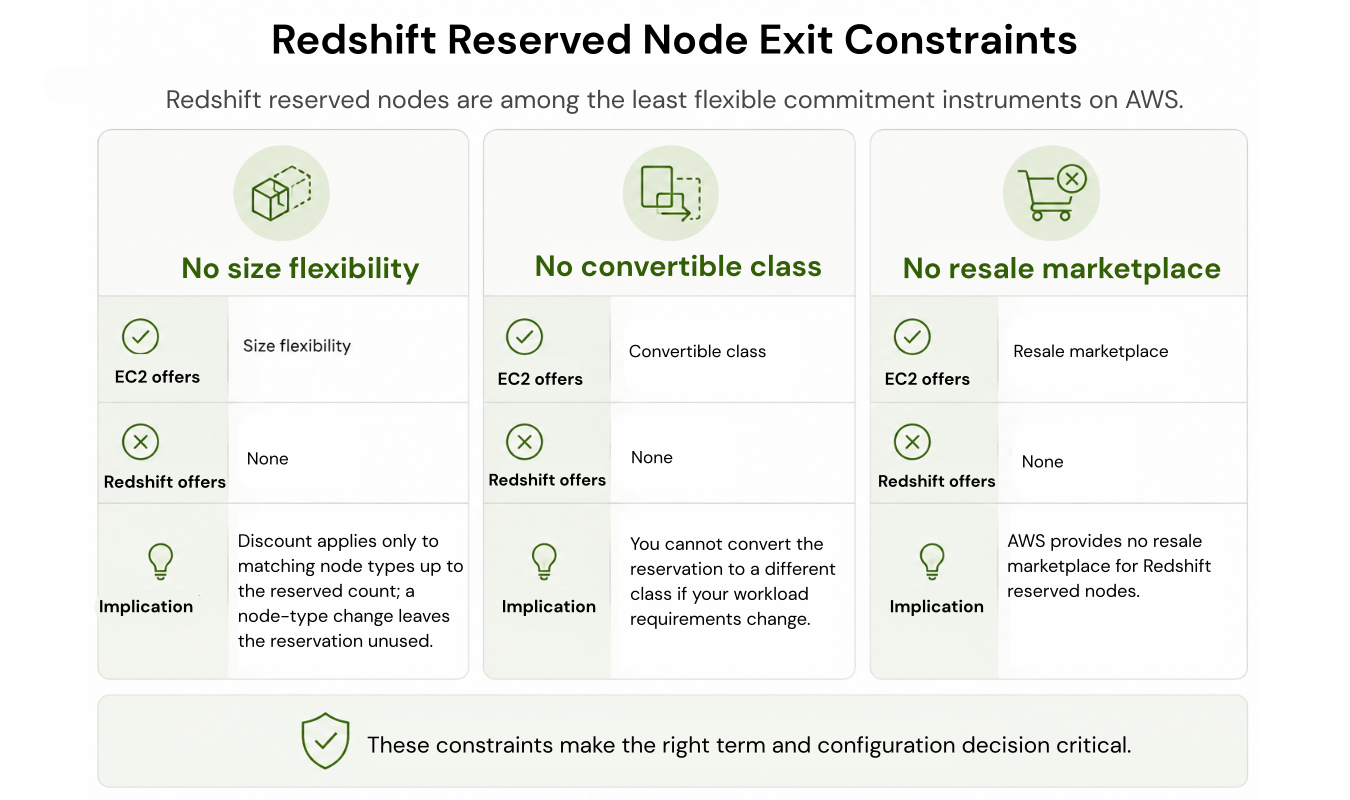
Redshift reserved nodes are among the least flexible commitment instruments on AWS. There is no size flexibility across the node family, no convertible offering class to swap node types mid-term, and no Reserved Instance Marketplace to sell commitments you no longer need. The 3-year discount is real. But so is the risk of being committed to 36 months of the wrong node type with no exit.

This guide walks through the actual discount math, the conditions that favor each term, the specific scenarios where 3-year goes wrong, and the sequencing strategy that most teams should use before locking in a multi-year commitment.

Banner

The Discount Comparison: What the Numbers Actually Show

The starting point is the discount structure across terms and payment options. Reserved node discounts on Redshift are quoted as a percentage off on-demand pricing, and the actual percentage depends on three variables: the node type, the region, and the combination of term length and payment option you choose.

Rather than publishing rates that will age poorly, this guide describes the discount structure qualitatively with the ranges AWS’s own documentation and pricing pages support, and asks you to verify the exact numbers at aws.amazon.com/redshift/pricing/ before making any purchase. The rate tables for ra3.xlplus, ra3.4xlarge, ra3.16xlarge, the RG family, and DC2 nodes are all listed by payment option and region on the AWS pricing page. Use those numbers, not general guidance.

1-year No Upfront

No Upfront is only available on 1-year terms for Redshift. It is not offered for 3-year commitments. You pay nothing at purchase and commit to a fixed hourly rate for 12 months. Savings relative to on-demand are typically in the 20-30% range depending on the node type. The appeal is straightforward: you start saving immediately with no capital outlay, and your exposure is capped at 12 months if the configuration turns out to be wrong.

No Upfront is the correct default for a team making its first Redshift reservation, particularly when the cluster is relatively new, when the team has not yet had 60 or more days of stable utilization at the same node type and count, or when there is any meaningful probability of resizing in the next 12 months.

1-year Partial Upfront

Partial Upfront on a 1-year term splits the cost between a payment at purchase and a lower ongoing hourly rate. Savings are typically in the 35-45% range. The upfront component is real capital committed, and if you need to reduce the reservation mid-term, the upfront portion is not refunded. That said, the 12-month maximum exposure means the worst-case scenario for a wrong commitment is much smaller than on a 3-year term.

1-year All Upfront

All Upfront on a 1-year term delivers the deepest 1-year discount, typically in the 40-50% range. You pay the full year’s cost at purchase. The advantage over Partial Upfront is usually only a few percentage points, which for most teams does not justify paying the entire year’s cost upfront when Partial Upfront captures most of the same savings.

3-year Partial Upfront

3-year Partial Upfront is the most commonly chosen multi-year option. Savings are typically in the 55-65% range, representing a meaningful step up from the 1-year equivalent. The upfront portion commits real capital for a 36-month term. The ongoing hourly commitment adds to that. This is the option most teams land on when they decide to extend from 1-year to 3-year after proving out stable utilization.

3-year All Upfront

3-year All Upfront delivers the deepest available discount, typically approaching 60-75% depending on node type and region. You pay the full 3-year cost at purchase. The incremental discount over 3-year Partial Upfront is usually only 2-4 percentage points — similar to what is observed across other AWS reserved pricing structures. For most teams, that gap is not sufficient to justify the full upfront capital outlay, particularly given the 36-month exposure and the lack of a marketplace exit if the configuration changes. Verify exact current rates for your specific node type at aws.amazon.com/redshift/pricing/ — rates change.

The discount gap between 1-year and 3-year on Redshift is real but smaller than people often assume. On many node types in US East, the difference between 1-year All Upfront and 3-year All Upfront is roughly 15-25 percentage points. That sounds large until you factor in 24 additional months of commitment risk on a reservation that cannot be sold, modified across sizes, or converted to a different node family. The question is not just ‘how much more does 3-year save’ but ‘what is the probability the configuration stays exactly the same for 36 months, and how much would it cost if it doesn’t.’ Verify exact current rates at aws.amazon.com/redshift/pricing/ before building your model.

Also read: RDS Reserved Instances: the complete guide to commitment mechanics across all RDS engines

The Break-Even Analysis: When Does 3-Year All Upfront Actually Win?

If you are comparing 3-year All Upfront against 1-year No Upfront (the most conservative alternative), the break-even calculation is not simply ‘which one is cheaper at 36 months.’ It is: given the upfront capital required for the 3-year option, at what point in the 36-month period has the additional saving recovered the opportunity cost of that upfront payment?

The actual break-even depends on your specific cost of capital and the exact rates for your node type and region. But as a structural observation: for most node types, 3-year All Upfront reaches break-even against a series of three consecutive 1-year No Upfront terms somewhere between month 14 and month 20. Before that point, the accumulated savings of 3-year All Upfront have not yet exceeded the accumulated savings you would have collected on the cheaper No Upfront hourly rate plus the interest value of not paying a large upfront sum.

The practical implication: if there is any material probability that your Redshift cluster will be resized, migrated to a different node type, or decommissioned within the first 14-20 months of a 3-year term, the 3-year option does not come out ahead even on pure dollar terms, before accounting for the capital locked in the upfront payment.

The comparison shifts differently when you compare 3-year Partial Upfront against 1-year No Upfront (renewing after each year). Here the upfront capital is smaller and the ongoing discount is still materially better than the 1-year rate. For teams confident in a 3-year-stable configuration and willing to pay some upfront, 3-year Partial Upfront often delivers the best risk-adjusted outcome.

AWS Redshift console Reserved Node Offerings page for ra3.4xlarge showing 1-year and 3-year options with on-demand rate, upfront cost, reserved hourly rate, and savings percentage for each payment option.

The Three Exit Constraints That Change the Math

The 1-year vs 3-year comparison looks different from the discount table alone versus in the context of Redshift’s specific reservation constraints. These three constraints are the reason the 3-year term carries more risk on Redshift than it does on EC2 or RDS.

No instance size flexibility

EC2 and most open-source RDS engines support size flexibility within a Reserved Instance family — an r6g.xlarge RI can cover two r6g.large instances. Redshift has no equivalent. A reservation for an ra3.4xlarge covers only ra3.4xlarge nodes. If your cluster grows and you need to step up to ra3.16xlarge, the existing ra3.4xlarge reservation is stranded. You pay the stranded reservation rate plus the on-demand rate on the larger nodes until the term expires.

On a 1-year term, a sizing mistake strands you for up to 12 months. On a 3-year term, the same mistake strands you for up to 36 months. For a cluster on a high-cost node type, the dollar difference between a stranded 1-year and a stranded 3-year reservation can be substantial.

No convertible offering class

EC2 Reserved Instances have a Convertible type that lets you exchange one instance type for another at equal or greater value during the reservation term. If you move from memory-optimized to compute-optimized instances, the Convertible RI follows. Redshift has no Convertible offering class. Once you purchase an ra3.4xlarge reservation, there is no mechanism to convert it to an RG node reservation or to any other node type if your infrastructure decisions change. A 3-year commitment is truly 36 months on the exact type purchased.

This becomes particularly relevant given that AWS now recommends RG nodes for new deployments. If you commit to 3 years of RA3 today and then determine six months later that RG would deliver better price-performance, the RA3 reservation does not follow you. You would either run RG nodes at on-demand rates or RA3 nodes under the reservation, but not both optimally. The flexibility to evaluate RG before committing to a multi-year RA3 reservation is worth taking.

No Reserved Instance Marketplace

For EC2, if you have reserved capacity you no longer need, you can list it on the AWS Reserved Instance Marketplace and potentially recover some remaining value. Redshift reserved nodes are explicitly excluded from the marketplace. There is no third-party buyer for a stranded 3-year Redshift reservation. The only paths are to continue running the reserved node type until the term expires, or to accept that the committed spend runs as sunk cost while you run different capacity on top.

The combination of no size flexibility, no convertible class, and no marketplace means a wrong 3-year Redshift reservation has no practical exit. A wrong 1-year reservation costs at most 12 months of suboptimal configuration. A wrong 3-year reservation costs at most 36 months. When evaluating the additional discount from 3-year versus 1-year, factor in your honest assessment of how much architectural certainty you actually have for the next 36 months, including cluster resizes, node type migrations, and potential decommissions. The discount is guaranteed. The stability of the configuration over 36 months is not. Source: AWS official reserved node documentation.

Choose 1-Year When These Conditions Apply

The case for starting with a 1-year term is not about pessimism about your workload. It is about the right sequencing of commitment evidence.

The cluster is less than 6 months old

A cluster that has been running for less than 6 months has not established a stable utilization pattern. You may still be adding tables, onboarding users, adjusting the WLM configuration, or discovering that your initial node count is either too high or too low. Committing to 3 years on a configuration that is still in flux is premature. A 1-year term with renewal rights is the correct holding position while the cluster settles.

Your team is evaluating RG migration

If you are currently on RA3 nodes and have not yet evaluated whether RG is the right choice, do not commit to a 3-year RA3 reservation before completing that evaluation. AWS now recommends RG for new clusters. RG runs data warehouse workloads up to 2.4x as fast as RA3 at 30% lower price per vCPU, and includes a built-in data lake query engine that eliminates Redshift Spectrum charges for supported formats. A 3-year RA3 reservation made before an RG evaluation might lock you into 36 months of a configuration you would have moved off of in year one. A 1-year RA3 reservation gives you time to run the evaluation and migrate before the next commitment.

You have a seasonal or non-24/7 workload

Redshift’s Pause and Resume feature is available for on-demand provisioned clusters. During the time a cluster is paused, you pay only for backup storage — no compute charges. If your Redshift cluster runs on a schedule — daily reporting jobs, weekly data processing, monthly executive dashboards — and spends significant time paused, on-demand with Pause and Resume may be more cost-effective than any reserved configuration. Reserved node billing runs continuously whether or not the cluster is actually processing queries. Verify whether your cluster’s usage pattern is genuinely 24/7 before purchasing any term commitment.

You are migrating to Redshift Serverless

If your organization is actively evaluating or planning a migration from provisioned Redshift to Redshift Serverless, a 3-year provisioned reserved node is a commitment in the opposite direction of your architecture plan. Redshift Serverless uses RPU-based pricing and has its own reservation mechanism (Serverless reservations, available at payer account level, can reduce Serverless compute costs by up to 45% according to AWS official pricing). A 3-year provisioned reservation purchased before a Serverless migration adds a stranded commitment liability on top of the migration.

Also read: Redshift Reserved Nodes: the no-marketplace, no-flexibility commitment that requires getting the purchase right

Choose 3-Year When These Conditions Apply

The case for a 3-year commitment is strong when a specific set of conditions has been verified, not assumed.

You have 12 or more months of stable utilization data

The most defensible 3-year commitment is one that follows a 1-year or 12-month observation period at the same node type and count. If a cluster has run the same ra3.4xlarge configuration for 12 months without a resize, without a node type evaluation, and without meaningful changes in workload volume or query patterns, the evidence for 3-year stability is real rather than projected. That evidence is the foundation for a 3-year commitment. Without it, the commitment is based on a forecast rather than a pattern.

Your data architecture is not in a migration phase

Organizations in the middle of a data architecture evolution — consolidating data warehouses, adopting a lakehouse architecture, evaluating RG nodes, adding new data sources — are not good candidates for 3-year commitments. The architecture changes that come with those initiatives often require cluster resizes or node type changes. A 3-year commitment during an active migration phase creates an expensive constraint on an already complex project.

3-year commitments are right for production clusters that have reached a steady state: the node type is correct, the cluster count is stable, the workload volume is predictable, and there are no major architectural changes on the roadmap for the next 36 months. Those conditions exist in fewer clusters than most FinOps teams assume when they make the initial 3-year decision.

Your FinOps team has commitment management processes in place

A 3-year Redshift reservation purchased without a formal commitment management process is a risk even for stable configurations. The reservation will need renewal evaluation at month 30 or earlier. The cluster needs to be monitored continuously for utilization signals that would indicate a sizing problem. If utilization drops because a workload is migrated or reduced, someone needs to notice and adjust plans accordingly — even though there is no adjustment mechanism for the existing reservation.

Teams with a FinOps function that tracks commitment utilization, surfaces expiring reservations 90 days in advance, and monitors for utilization changes are better positioned to manage the operational risk of a 3-year commitment. Teams without those processes are taking on commitment risk without the tooling to manage it.

AWS Cost Management Reserved Instance utilization dashboard showing a 1-year ra3.4xlarge reservation at 95 percent utilization and a 3-year ra3.16xlarge at 67 percent, illustrating under-utilization risk on longer terms.

The Recommended Sequencing Strategy

Rather than framing the decision as 1-year versus 3-year in isolation, the approach that produces the best outcomes is a sequenced one that uses each term for what it is actually good for.

Start with 1-year No Upfront

For any Redshift cluster that is less than 12 months old, that has not been evaluated against RG nodes, or for which you do not have concrete utilization data over a full workload cycle, 1-year No Upfront is the right first reservation. You capture 20-30% savings immediately with no capital required, and you have 12 months to observe actual utilization before the renewal decision.

The downside risk of this choice is small: if the cluster is unexpectedly decommissioned mid-term, the loss is bounded by the months remaining on the term, and there is no upfront capital at risk because No Upfront has no purchase payment.

At renewal, evaluate three things before extending to 3-year

When the 1-year term approaches expiration, three questions determine whether to renew at 1-year or extend to 3-year.

First: has the node type and count been stable for the entire 12-month term? If there were any resizes, configuration changes, or migrations during the year, the configuration is not stable enough to commit to 3 more years without a further observation period.

Second: have you evaluated RG nodes? If not, do that evaluation before committing to a 3-year RA3 reservation. The evaluation is low-friction — AWS provides snapshot and restore migration tools and Elastic Resize for minimal-downtime transitions. A 3-year RA3 reservation after a clean RG evaluation is a well-informed commitment. A 3-year RA3 reservation instead of that evaluation is a potentially unnecessary constraint.

Third: are there any architecture changes on the roadmap for the next 36 months? Data warehouse consolidations, Serverless migrations, major workload additions or removals — any of these should push the decision toward another 1-year term rather than a 3-year extension.

If all three answers are favorable, 3-year Partial Upfront is the natural next step. It delivers most of the 3-year discount with a smaller upfront payment than All Upfront, and 12 months of prior stable utilization data provides genuine evidence for the 36-month commitment.

Layer incrementally, not all at once

Even with strong evidence for a 3-year commitment, purchasing the full cluster reservation in one block is not the only approach. Staggering reservations across the cluster node count — committing some nodes to 3-year and keeping others at 1-year, with staggered expiration dates — reduces the renewal cliff risk and provides some ongoing flexibility to adjust the reservation count at each renewal point.

This laddering approach is the same principle that applies to EC2 and RDS reservation management. A data warehouse with 10 nodes committed in 3-year blocks all expiring at the same time creates a large renewal decision with a short window. The same 10 nodes committed in batches of 2-3 with staggered expirations creates smaller, more manageable renewal decisions and prevents the cluster from being unprotected in a single window if the renewal is delayed.

Also read: AWS Database Savings Plans: the flexible alternative to per-engine reserved instances

A Note on RG Nodes Before Any Multi-Year Commitment

AWS’s official pricing page states directly: we recommend choosing RG. RG nodes run data warehouse and data lake workloads up to 2.4x as fast as RA3 at 30% lower price per vCPU. They include a built-in data lake query engine, which means Redshift Spectrum charges (five dollars per terabyte scanned) do not apply to RG nodes querying supported formats. Source: AWS official Redshift pricing page.

The implications for a 3-year term decision are significant. A team on RA3 that purchases a 3-year reservation before evaluating RG has committed to 36 months of a configuration that AWS’s own recommendation already favors over. Migration from RA3 to RG is supported via snapshot and restore and Elastic Resize. It is not a painful migration. But once a 3-year RA3 reservation is purchased, the economics of running that migration change — you would be paying for the RA3 reservation and potentially adding cost if the migration results in a different node configuration.

The right order is evaluate RG before committing to any multi-year RA3 term. Even if you ultimately decide to stay on RA3, the evaluation itself validates that decision. A 3-year RA3 commitment that bypasses the RG evaluation is a commitment made with incomplete information.

How Usage.ai Manages the 1-Year vs 3-Year Decision

Usage.ai approaches Redshift reserved node purchasing through the same Insured Flex commitment model it applies across AWS services, adapted for Redshift’s specific constraints.

Utilization validation before term recommendation: before recommending either a 1-year or 3-year term, Usage.ai verifies a minimum observation window of stable configuration at the target node type and count. A cluster that has not established stable utilization at its current configuration does not receive a 3-year recommendation, regardless of how long it has been running in total. This prevents the common mistake of committing 3 years to a configuration that is still being tuned.

RG migration check: for clusters currently on RA3, Usage.ai surfaces the RG evaluation opportunity before any reservation recommendation is generated. The platform models the expected savings at equivalent RG configuration versus committing to RA3 at the current node type, so the term decision is made with full information about the node type question.

Term recommendation grounded in evidence: when all conditions are met for a 3-year recommendation, Usage.ai generates the recommendation. When conditions favor 1-year, 1-year is the recommendation — even if the 3-year discount is larger. The goal is to avoid stranded commitments, not to maximize paper savings.

Buyback guarantee: this is the most direct answer to the core risk in Redshift reserved node purchasing. Because Redshift reservations cannot be sold on the Reserved Instance Marketplace and have no size flexibility or convertible class, a stranded commitment has no recovery path under standard AWS terms. Usage.ai Insured Flex Reserved Nodes include a buyback guarantee on Redshift commitments. If a reserved node becomes stranded — because the cluster is resized to a different node type, migrated to RG, or decommissioned — the unused commitment is bought back and the value returned as cashback in real money, not credits. That changes the risk calculation for a 3-year commitment: teams can commit at the accurate term length for their workload rather than defaulting to 1-year indefinitely out of fear of what happens if the architecture changes.

$91M+ in savings delivered to 300+ enterprise customers across AWS, Azure, and GCP. Fee is a percentage of realized savings only. No savings, no fee. 30-minute setup, billing-layer access only.

Banner

Frequently Asked Questions

1. Is a 3-year Redshift reserved node always cheaper than 1-year?

Over a full 36-month period, yes — the effective hourly rate on a 3-year All Upfront reservation is lower than on three consecutive 1-year reservations. The actual savings difference depends on the node type and region but is typically in the range of 15-25 percentage points compared to 1-year All Upfront. However, that comparison only holds if the reserved configuration is fully utilized for the full 36 months. If the cluster is resized, migrated to a different node family, or decommissioned before the 36-month term ends, the stranded reservation cost can eliminate the discount advantage and result in a higher effective cost than the 1-year alternative.


2. Can I switch from a 1-year to a 3-year Redshift reservation mid-term?

No. A reservation term cannot be modified after purchase. If you want to move from a 1-year to a 3-year commitment, you purchase the 3-year reservation as a new purchase and run it alongside the remaining 1-year term, which effectively means you have overlapping reservations for the remainder of the 1-year period. The correct sequencing is to evaluate the 3-year decision at the renewal point of the 1-year term, not mid-term.


3. Is No Upfront available on 3-year Redshift reserved nodes?

No. The No Upfront payment option is only available on 1-year Redshift reserved node terms. For 3-year terms, the available payment options are Partial Upfront and All Upfront. If preserving capital is a priority, the 1-year No Upfront option is the only reserved node path that requires no upfront payment.


4. What happens if I resize my Redshift cluster while a reserved node is active?

If you resize to a larger or different node type, the existing reservation no longer matches the running configuration. The reserved nodes become stranded — you continue paying the reserved node rate for the now-unused node type, while the actual running nodes are billed at on-demand rates. The stranded reservation continues billing at the committed rate until the term expires. Redshift reserved nodes have no size flexibility (unlike EC2 Reserved Instances) and cannot be sold on the Reserved Instance Marketplace.


5. Should I evaluate RG nodes before committing to a multi-year RA3 reservation?

Yes. AWS’s official documentation and pricing page recommend RG for new Redshift deployments. RG delivers up to 2.4x the performance of RA3 at 30% lower price per vCPU and includes a built-in data lake query engine that eliminates Redshift Spectrum charges for supported formats. Committing to a multi-year RA3 reservation before evaluating RG means locking in 36 months of a configuration that AWS’s own recommendation already points beyond. Migration from RA3 to RG is supported via snapshot and restore and Elastic Resize. Completing the evaluation before any 3-year reservation purchase is the right sequencing.


6. What is the right starting point for most Redshift reservation buyers?

For most teams that have not yet purchased Redshift reserved nodes, or for clusters less than 12 months old, 1-year No Upfront is the right starting point. It captures 20-30% savings immediately with no capital required, no upfront payment at risk, and 12 months of real utilization data to inform the next decision. At renewal, the question of whether to extend to 3-year is better answered with 12 months of stable utilization evidence than with a pre-commitment forecast.

Cut cloud cost with automation
Latest from our blogs