 AWS
AWS Microsoft Azure
 Google Cloud

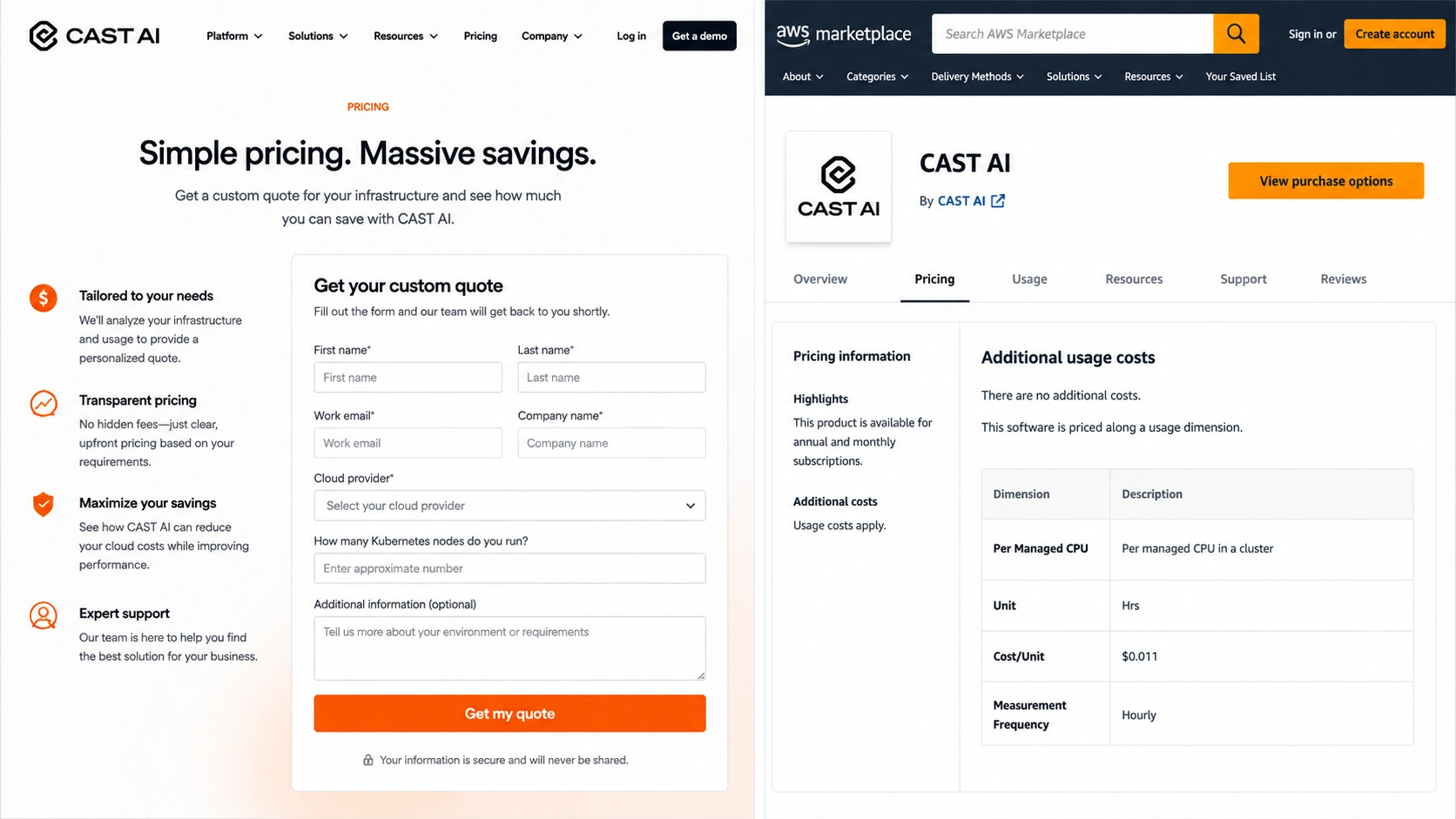
Public sources make that difficult. CAST AI’s pricing page is a quote-request form, not a rate card, and the figures that do exist publicly sit elsewhere.
This guide covers what CAST AI publishes, how its billing works, which contract terms affect total cost, and which costs sit outside the platform fee.
The goal isn’t to tell you whether CAST AI is right or wrong for your business. It’s to show how the pricing works, so you can judge whether it fits your environment.
CAST AI pricing at a glance
There is no rate card on CAST AI’s website. Its pricing form segments by product line workload, cluster and Karpenter optimization, GPU (OMNI), database, storage, and Kimchi. A quote covers only the products you select.Published figures do exist on its AWS Marketplace listing. Two limits apply:
- It is CAST AI’s EKS listing.
- These are its one-month dimensions; twelve-month contracts and other environments may differ.
| Dimension | Entitlement | Cost / month |
|---|---|---|
| Free | Kubernetes monitoring and cost-reduction insights | $0 |
| Cost Monitoring | Spend breakdowns by workload, namespace, allocation group | $200 |
| Growth | Up to 4 managed clusters, up to 500 CPU | $1,000 |
| Growth 700 CPUs | Up to 5 managed clusters, up to 700 CPU | $1,000 |
| GrowthPro | Unlimited managed clusters, up to 2,000 CPU | $1,000 |
| Enterprise | Unlimited managed clusters, unlimited CPU | $5,000 |
| Additional usage | Hourly charge per managed CPU, "as defined at cast.ai/pricing" | $0.00694444 |
One detail deserves attention. Three dimensions sit at $1,000 per month, ranging from 500 CPU across 4 clusters to 2,000 CPU across unlimited clusters. Buyers should confirm which dimension they are offered, what features it includes, and how usage beyond its entitlement is charged.
Two fee bases, one vendor
Here is the central complication for a business case.Basis one: per managed CPU. The Marketplace listing prices an additional hourly charge per managed CPU at $0.00694444, on top of the contract dimension. That works out to roughly $5 per managed CPU per month at 720 hours.
Basis two: a share of savings. CAST AI’s July 2026 comparison with Kubecost states it operates on a savings-share model of approximately 15–20% of generated savings, across Growth and Enterprise tiers.
Its worked example: a $20,000 monthly cluster bill cut by 50% produces a $1,500–$2,000 fee and $8,000–$8,500 in net savings.
Both are first-party sources, and neither figure appears on the pricing page.
This isn’t evidence of a hidden fee. Two current first-party sources describe different pricing structures, but do not explain whether this reflects purchasing channel, product, contract type, or customer-specific terms. Some third-party pricing trackers publish rates matching neither source, so treat only CAST AI’s own materials and your Order Form as reliable.
Get one sentence in writing before modeling: which fee basis applies, and at what rate? A savings-share quote and a per-CPU quote produce very different bills for the same cluster.
What you are actually billed for
Under the per-CPU basis, the billable unit is the managed CPU.The listing defines that rate by pointing to cast.ai/pricing, which is now a form carrying no definition. CAST AI’s Platform Usage documentation defines one billable CPU as one provisioned CPU running continuously for the full month, with partial-month use prorated. Your contract still determines how included credits and additional usage interact.
Two further mechanics are documented:
- The free tier is monitoring only. Under CAST AI’s Terms of Service, Free Services carry no SLA, warranties, or indemnification, and may be terminated at any time, with or without notice.
- Service levels vary by plan. The Service Level Agreement sets different availability objectives for Growth and Enterprise, with remedies routed through a cure plan rather than automatic credits.
Two ways to model your cost
Because the basis varies, so does the arithmetic. Model the one you are quoted.Quoted a share of savings? The fee moves with results.
Quoted per managed CPU? The fee moves with your footprint, turning the analysis into a break-even test.
platform fee ÷ compute spend = efficiency gain needed to break even
If the dimension includes CPU credits, only usage beyond that entitlement may attract an additional charge. Illustrative arithmetic, not a CAST AI quote.
This is the part buyers miss. Under a per-CPU basis, the fee is set by how much infrastructure you run, not by how much waste there was to remove. Overprovisioned clusters clear that bar easily. Efficient ones may not.
What are CAST AI’s hidden costs?
“Hidden costs” would be misleading if it implied undisclosed fees, and the evidence does not establish that. The useful question is which costs are not obvious from the headline rate.Cloud charges incurred on your behalf
This is the most consequential item, and it lives in the contract rather than the pricing page.CAST AI’s Terms of Service state that the Services integrate across your cloud providers. CAST AI may therefore incur charges with those providers on your behalf. Any such charges are solely your obligation.
The mechanism is ordinary automation behavior:
- When Spot capacity is unavailable, CAST AI can create temporary on-demand fallback nodes if the Node Template permits them.
- Rebalancing and node consolidation create churn, and churn creates compute hours.
Ask for an estimate of fallback and rebalancing spend at your Spot ratio, and agree how it gets reported. This lets you reconcile your net-savings figure with CAST AI’s.
Implementation, security review, and exit
Capturing the advertised savings takes more than a connection. It requires:agents deployed, with cloud and Kubernetes permissions granted;
workloads prepared (Spot tolerations, for example);
an autoscaling layer your platform team then owns.
Leaving can involve engineering work to migrate off that autoscaling layer, not just contract cancellation.
Spend outside the tool’s scope
The EKS optimization offering covered by this Marketplace listing primarily optimizes Kubernetes infrastructure.Other cloud spending may require separate CAST AI products or remain outside that product’s scope; for example, CAST AI offers Database Optimizer separately for supported PostgreSQL and MySQL environments.
Its Commitments feature imports and steers usage toward commitments you already own. The cited commitments documentation focuses on importing, assigning, tracking, and utilizing commitments.
It does not document automatic purchasing or financial protection against underutilization; confirm separately whether commitment-sizing capabilities are advisory or transactional.
Contract terms that affect cost
CAST AI’s Terms of Service (effective 6 February 2025) carry several provisions with direct cost consequences:Term and renewal: unless the Order Form specifies different terms, the initial term is one year and it renews for additional one-year periods unless a party gives written notice at least 60 days before expiry.
Nonrefundable fees: fees are nonrefundable except where specifically provided, and exclusive of taxes. The Marketplace listing states refunds are not currently offered.
Payment and interest: invoices due within 30 days unless the Order Form says otherwise, with 1% monthly interest on overdue amounts.
Suspension: CAST AI may suspend access if an amount is unpaid 30 days after it was due.
Acceleration: if CAST AI terminates for breach, insolvency, or non-payment, all amounts under all Order Forms become immediately due.
New functionality: CAST AI may charge an additional fee for new features you elect to activate.
Liability cap: capped at fees paid in the preceding twelve months.
What customers say about pricing
Independent feedback is broadly positive. As of September 2026, CAST AI holds 4.6 out of 5 from 216 ratings on its AWS Marketplace listing, including 207 external reviews sourced from G2, with cost savings and automation the most cited strengths.Pricing draws two narrower criticisms: predictability, and the fee basis itself.
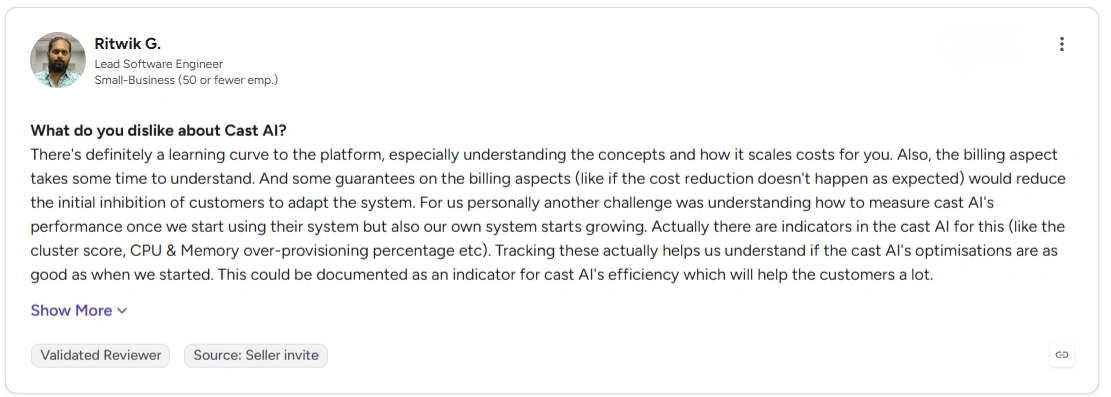
One reviewer describes the model as tied to what you save. That makes sense in principle, but makes forecasting your own spend harder than a flat per-cluster figure would.
Others call the billing and pricing models complex, and ask for better cost forecasting across projects.
A G2 reviewer objects to the basis itself: charging on total cluster size rather than money saved means the bill gets expensive quickly as you scale.
Where Usage.ai differs
These platforms work on different layers of the same bill, so this is a contrast, not a substitution.CAST AI reduces the resources you run. Usage.ai reduces the rate you pay on the usage that remains, through Flex Insured Commitments.
Cashback protection applies when an eligible commitment costs more than equivalent on-demand usage. We charge a percentage of realized savings, billed monthly in arrears.
One caution: never compare headline percentages across these categories. CAST AI’s figures measure resource-efficiency gains; commitment-platform figures measure rate discounts on covered usage. They are percentages of different things.
Also read: Usage.ai vs CAST AI: Which Fits Your Savings Strategy?
Verdict: who the pricing fits
The automation CAST AI sells is real and its pricing is defensible on its merits. Whether the economics work depends less on company size than on two variables: how inefficient your clusters are, and how much of your bill Kubernetes represents.The pricing tends to work when:
- Kubernetes is the center of your spend and clusters are visibly overprovisioned.
- You want continuous automation rather than recommendations, and a platform team can own the autoscaler.
- Adjacent capabilities such as GPU optimization carry weight.
- Your clusters are already efficient, so the break-even gain approaches the waste actually available.
- Kubernetes is a small share of a large bill.
- You are quoted a per-CPU basis while your footprint grows quickly.
- Predictable vendor costs matter more than automation depth.
7 questions to ask before signing
Which fee basis applies per managed CPU or share of savings and at what rate?
How many billable CPU credits are included, which products consume them, and what rate applies after the entitlement is exhausted, or how are generated savings measured against the baseline?
Which dimension are we offered, and what is charged beyond its entitlement?
Which products are included, and which are quoted separately?
Can you estimate our fallback and rebalancing cloud spend, and how is it reported?
What is our non-renewal notice date, and can the rate change at renewal?
What does exiting involve, contractually and for our platform team?
Connect in 15 minutes. No contracts, no infrastructure changes. See your savings before committing.
Frequently asked questions
How much does CAST AI cost?
There is no single public price. Its Marketplace listing shows dimensions from $200 to $5,000 per month plus an hourly charge per managed CPU; direct pricing is quoted per environment.
Is CAST AI free?
There is a free monitoring tier. It excludes automated optimization and carries no SLA, warranties, or indemnification.
Does CAST AI charge a percentage of savings?
Its July 2026 blog describes a savings share of roughly 15–20% of generated savings; its Marketplace listing prices per managed CPU instead. Confirm which applies to your Order Form.
Does CAST AI offer refunds?
Its Terms of Service state fees are nonrefundable except where specifically provided, and the Marketplace listing states refunds are not offered.
What are CAST AI's hidden costs?
No undisclosed fees are documented. The costs outside the headline rate are cloud charges incurred on your behalf, implementation and security-review effort, exit work, and spend outside the EKS optimization offering's scope.
If you notice any material information that is incorrect, outdated, or no longer applicable, please contact us at [email protected]. We’ll review the information and update the article where appropriate.