 AWS
AWS Microsoft Azure
 Google Cloud

Short Answer
This article focuses on the cost and capacity dimension of cloud resource optimization. Broader cloud optimization also involves performance, reliability, security, governance, and architectural modernization, which require separate technical reviews.That distinction explains why a technically efficient cloud environment can still have a stubborn bill. Optimization asks, “Are we using the right amount of infrastructure?” Cost optimization also asks, “Are we paying an appropriate rate for the infrastructure we consistently need?”
What cloud resource optimization fixes
Cloud resource optimization aligns infrastructure capacity with actual workload demand. Typical actions include:Rightsizing virtual machines, containers, and managed resources
Removing idle or orphaned resources
Tuning autoscaling policies
Improving CPU, memory, and storage utilization
Reviewing usage trends and eliminating avoidable capacity
The limitation is scope. Resource optimization changes consumption. It does not, by itself, change the billing model applied to that consumption.
For a broader view of the measurement layer, see cloud cost analysis.
Why optimization hits a cost ceiling
Early optimization can produce visible gains because the easiest waste is also the easiest to remove. Once those resources are cleaned up and workloads are reasonably sized, the remaining infrastructure is more likely to support real production demand.At that point, another round of rightsizing may produce smaller gains while introducing operational tradeoffs. Aggressive sizing can reduce headroom. Autoscaling can handle variable demand, but it does not eliminate the cost of the baseline capacity that remains.
The bigger issue is that utilization and price are different variables.
Consider an illustrative example. A workload needs 100 units of compute every month. Rightsizing might reduce unnecessary capacity from 130 units to 100. That is a real efficiency improvement. But if all 100 units are still billed at on-demand rates, the unit price has not changed.
The next question is therefore not “How can we remove another 10 units?” It is “How should the stable 100-unit baseline be priced?”
Where capacity planning breaks down
Commitment decisions depend on expected future usage, so capacity planning introduces a different problem: uncertainty.A team may have a stable baseline today but still expect migrations, product changes, seasonality, or architecture changes. If it commits too aggressively and usage falls, some commitment programs can leave the organization paying for capacity it no longer needs. If it stays entirely flexible, it may continue paying on-demand rates for usage that was predictable enough to discount.
A practical planning process separates baseline demand from variable demand:
Identify usage that has remained consistently high.
Remove obvious waste and oversized resources first.
Review planned changes that could affect the baseline.
Check the provider's eligibility, scope, term, and pricing rules.
Model expected savings alongside the downside if usage falls.
AWS Savings Plans offer lower prices in exchange for a one- or three-year compute commitment. AWS currently lists savings of up to 66% for Compute Savings Plans and up to 72% for EC2 Instance Savings Plans, depending on the plan and eligible usage. AWS Savings Plans documentation
Google Cloud resource-based Committed Use Discounts require a one- or three-year commitment to specified resources. Current documentation lists discounts of up to 55% for vCPUs and memory for most machine types, with higher maximums for some machine types. Google Cloud CUD documentation
Azure Reservations use one- or three-year terms for eligible resources. Microsoft states that reservations can reduce eligible resource costs from pay-as-you-go prices. Microsoft Azure Reservations documentation
These are provider-published maximums, not guaranteed savings for every workload.
Why teams stay on on-demand pricing
The economic case for commitments can be strong, but the risk is real. Standard commitment products have provider-specific terms, eligibility rules, and limited flexibility. AWS, for example, says Savings Plans cannot be cancelled during the term; eligible plans with an hourly commitment of $100 or less, purchased in the same calendar month, can be returned within seven days. AWS Savings Plans termsThat creates a common decision pattern:
Engineering optimizes resources for flexibility.
FinOps identifies stable usage.
Finance worries about what happens if that usage changes.
The organization commits less than it could.
The remaining eligible usage stays on on-demand pricing.
For a broader look at the structural issues behind this pattern, see why cloud cost management fails.
When commitment risk is not explicitly managed, organizations often optimize consumption while leaving pricing efficiency untouched.
A better optimization framework
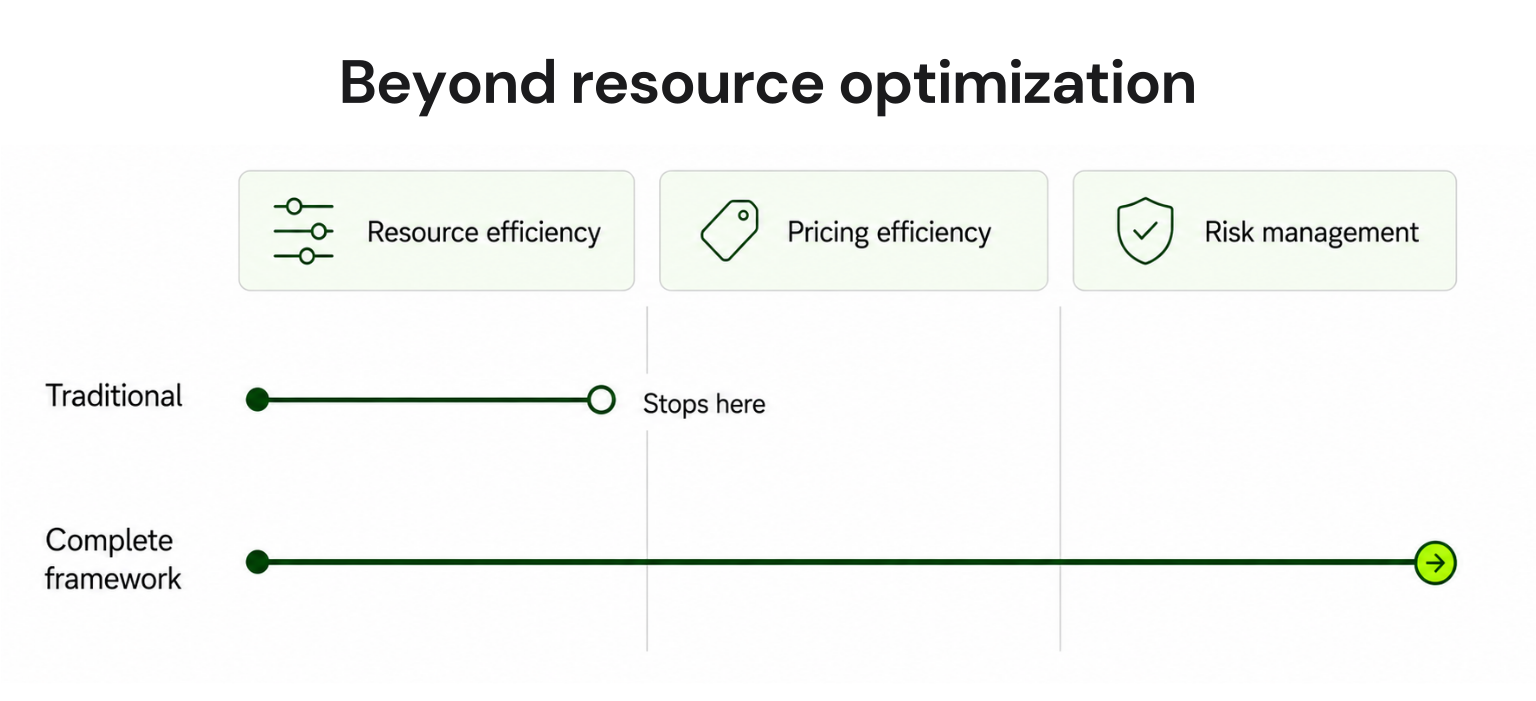
For the cost-and-capacity scope of this article, the optimization framework has three layers:| Layer | Primary question | Typical action |
|---|---|---|
| Resource efficiency | Are we consuming more than needed? | Rightsizing, cleanup, autoscaling |
| Pricing efficiency | Are stable workloads priced efficiently? | Evaluate eligible commitments |
| Risk management | What happens if usage changes? | Scenario analysis and monitoring |
This framework also helps avoid a common mistake: continuing to chase technical efficiency after the biggest remaining opportunity has moved into pricing.
For example , suppose a team has eliminated idle resources and rightsized its production fleet. If its baseline remains stable, the next review should include commitment coverage. If the workload is volatile, keeping more usage flexible may be appropriate.
The right decision depends on the actual usage pattern, not a blanket target for commitment coverage.
Measuring the optimization ceiling
Before increasing commitment coverage, teams need evidence that the underlying resource baseline is both efficient and predictable. A small set of measurements can show whether the next opportunity is still consumption reduction or has moved into pricing.Utilization: Shows how much of the provisioned capacity workloads actually use.
Idle-resource rate: Shows the portion of resources producing little or no useful workload activity.
Baseline variability: Shows how consistently the workload stays around its normal demand level.
Commitment coverage: Shows how much eligible usage is already covered by discounted commitments.
Commitment utilization: Shows whether existing commitments are being consumed effectively.
Effective savings rate: Shows the realized reduction against the comparable on-demand cost rather than relying only on advertised maximum discounts.
Commitment readiness checklist
A workload is more suitable for commitment evaluation when the answers to these questions are clear:Is obvious waste already removed?
Is the baseline usage consistently high enough to model?
Do planned migrations or architecture changes threaten that baseline?
Does the workload meet the provider's eligibility and scope requirements?
Can the organization support the commitment if future usage falls?
A practical 30-day operating cadence
Resource optimization and commitment management work better as a recurring process than as a one-time purchase decision. A simple monthly cadence can keep the two connected:Week 1 — Identify waste
Review idle resources, utilization, rightsizing opportunities, and avoidable capacity.
Week 2 — Validate the baseline
Check workload changes, seasonality, migrations, and performance requirements that could affect stable usage.
Week 3 — Review pricing
Evaluate eligible commitment coverage, existing commitment utilization, provider terms, and the financial impact of additional coverage.
Week 4 — Approve and monitor
Approve only the coverage supported by the evidence, then monitor usage and exceptions so the decision can be revisited when workloads change.
This keeps optimization continuous while preventing a short-term usage snapshot from becoming a long-term pricing assumption.
What risk-adjusted optimization changes
Risk-adjusted optimization does not replace rightsizing or waste removal. It adds a financial layer to the same operating model.The workflow is straightforward:
Optimize the infrastructure baseline.
Separate stable and variable usage.
Evaluate provider-specific commitment options.
Model the downside of lower future demand.
Approve only the coverage level the organization can support.
Monitor utilization and revisit the decision when workloads change.
The distinction matters. A commitment solution should not replace removing idle resources, rightsizing workloads, or fixing poor architecture. Those actions still come first.
For a broader checklist covering visibility, waste, pricing, and commitment challenges, see 10 cloud cost optimization challenges and their fixes.
Optimization creates a cleaner, more predictable baseline. Risk management determines how confidently that baseline can be priced.
Get a personalized view of eligible commitment opportunities based on your actual cloud usage.
Frequently asked questions
What is cloud resource optimization?
Cloud resource optimization is the process of matching cloud infrastructure capacity to actual workload demand. It commonly includes rightsizing, removing idle resources, tuning autoscaling, and improving utilization. Its main purpose is to reduce unnecessary consumption, not to change the pricing model applied to the remaining usage.
Why can cloud costs stay high after optimization?
Optimization can remove waste without changing the unit price of the resources that remain. Once infrastructure is reasonably sized, a large portion of spend may come from steady production usage that is still billed at on-demand rates. At that point, pricing strategy and commitment coverage become important parts of the optimization process.
What is the difference between resource and cost optimization?
Resource optimization focuses on how much infrastructure you consume. Cloud cost optimization is broader. It includes resource efficiency, pricing choices, commitment coverage, and ongoing review as usage changes. A team can therefore have well-optimized infrastructure while still missing savings available through appropriate pricing options.
When should a team consider cloud commitments?
Consider commitments after removing obvious waste and identifying a stable usage baseline. Review forecast confidence, planned migrations, seasonality, provider eligibility, commitment scope, term, and the financial impact of lower usage. Do not use a generic coverage percentage without testing it against actual workload history.
How can teams reduce commitment risk?
Start with a conservative, evidence-based baseline and separate predictable usage from variable demand. Then use the flexibility and protection available in the specific pricing program you choose. Standard provider commitments still have their own terms and risks. Risk-protected approaches can change the downside, but teams should verify exact eligibility and protection terms before purchasing.