 AWS
 Microsoft Azure
 Google Cloud


This guide explains the main rates and free-tier limits, works through three monthly estimates, and shows how changing one assumption affects the same application’s bill. It also explains where discounts help and what you commit to in return.
Google Cloud pricing by service
Google Cloud is a platform of services for running applications, storing information and processing data. Google Cloud pricing follows the resources each service meters; there is no infrastructure subscription covering everything.Reference prices checked November 17, 2026. These reference rates use USD on-demand list pricing for Iowa (us-central1), except the Gemini example, which uses Global Standard PayGo pricing. Prices exclude free allowances, negotiated discounts, credits and taxes.
| Category and service | What it does | Reference rate |
|---|---|---|
| Compute · Compute Engine | Runs applications on VMs | e2-medium: ~$0.0335/hour |
| Compute · GKE | Manages Kubernetes containers | $0.10/cluster-hour + compute |
| Compute · Cloud Run | Runs containers without server management | Request-based: $0.000024/vCPU-s + $0.40/M requests |
| Storage · Cloud Storage | Stores files as objects | $/GiB-month: Standard 0.020; Archive 0.0012 |
| Databases · Cloud SQL | Managed MySQL, PostgreSQL and SQL Server | Shared-core db-f1-micro: $0.0105/hour |
| Databases · Firestore | Stores documents | Standard: $0.03/100K document reads; $0.09/100K writes |
| Analytics · BigQuery | Analyzes data using SQL | On-demand: $6.25/TiB processed |
| Networking | Transfers data | Premium Tier internet: $0.12/GiB to North America |
| AI · Gemini APIs | Generates AI responses | $0.30/M input; $2.50/M output tokens |
Cloud Run rates cover request-based active time; memory adds $0.0000025/GiB-second. Nearline and Coldline storage cost $0.010 and $0.004/GiB-month, respectively. Gemini figures apply to Gemini 3.5 Flash-Lite under Global Standard PayGo.
Cloud SQL figures apply to MySQL/PostgreSQL; Enterprise General Purpose dedicated compute costs $0.0413/vCPU-hour for CPU and $0.007/GiB-hour for memory. BigQuery active logical storage costs approximately $0.023/GiB-month. The network rate covers VM internet transfer from Iowa in the first paid band through 1,024 GiB/month.
These are component rates. Additional charges include VM disks and networking, Cloud Run minimum-instance idle time, and Firestore index reads, storage and transfer.
A vCPU is a virtual processor; a vCPU-second measures one allocated vCPU for one second. A GiB-second measures one GiB of allocated memory for one second. One TiB equals 1,024 GiB.
These binary storage units differ from decimal TB and GB. Tokens are pieces of model input or output.
Serverless describes infrastructure management; Cloud Run, Firestore and BigQuery still have different meters. GKE Standard usually bills VM nodes; general-purpose Autopilot bills requested CPU, memory and ephemeral storage.
Instance-based Cloud Run bills the full instance lifecycle at different rates. BigQuery alternatively offers capacity pricing per slot-hour, a measure of compute capacity.
What changes your cloud bill
A useful Google Cloud pricing estimate distinguishes resources you provision from activity you consume. A running VM is billed for allocated capacity, even when CPU utilization is low. Retained disks can remain billable after compute stops.Availability also matters. Database standbys and read replicas can add resources; a development configuration is not an equivalent substitute for production resilience.
Storage adds another trade-off. Colder classes lower the storage rate but introduce retrieval charges and minimum billing durations of 30, 90 or 365 days. Cloud Storage pricing also depends on operations, retained copies and location.
Networking needs its own route: service, source, destination, direction (inbound or outbound), tier and volume. Same-region traffic is not universally free. Include applicable disks, backups, public IPv4, logging, software licenses and supporting services; load-balancer charges are another possible addition.
Free tiers and trial credits
Google Cloud pricing includes introductory credit and recurring free allowances with different rules. The Free Trial provides eligible new customers $300 for 90 days. Paid billing requires manual activation.Selected monthly allowances per billing account
| Service | Free allowance |
|---|---|
| Compute Engine | e2-micro: 1 month's runtime; 30 GiB-months disk; 1 GiB outbound |
| GKE | $74.40 management credit |
| Cloud Storage | 5 GiB-months Standard; 5K Class A + 50K Class B operations |
| Cloud Run request-based | 180K vCPU-s; 360K GiB-s; 2M requests |
| BigQuery | 1 TiB on-demand queries; 10 GiB storage |
The 1 GiB outbound allowance covers transfer from North America, excluding China and Australia. GKE credit covers only Autopilot or zonal Standard management fees, not workload compute.
Cloud Storage also offers 100 GiB of qualifying transfer from North America per destination, excluding China and Australia. Firestore Standard has daily operation quotas, not monthly request grants.
Trial exclusions matter: GPUs and Marketplace are restricted. For trial signups or paid upgrades on or after November 16, 2026, the $300 credit cannot pay for Gemini platform services. Partner-model managed APIs are also excluded.
Google Cloud pricing examples
These Google Cloud pricing examples are independent modeled estimates, not invoices or deployed tests. They use Iowa list rates, no commitments, and exclude taxes, support and unlisted services. A 730-hour month is a planning convention; storage figures use published monthly rates. Totals are rounded after calculation.A small development application
Start with a Linux e2-medium VM and a MySQL db-f1-micro database connected privately in the same zone. Both run 730 hours. Relevant free allowances are already consumed.| Component | Monthly calculation | Cost |
|---|---|---|
| VM compute | 730 × $0.03350571 | $24.46 |
| Standard Persistent Disk | 20 GiB × $0.04 | $0.80 |
| Cloud SQL instance | 730 × $0.0105 | $7.67 |
| Database SSD | 10 GiB × $0.17 | $1.70 |
| Standard backups | Average 10 billable GiB × $0.08 | $0.80 |
| Standard objects | Average 100 billable GiB × $0.020 | $2.00 |
| Bucket operations | 10,000 Class A ÷ 1,000 × $0.005 + 100,000 Class B ÷ 1,000 × $0.0004 | $0.09 |
| VM internet transfer | 100 billable GiB × $0.12 | $12.00 |
| Ephemeral external IPv4 | 730 × $0.005 | $3.65 |
| Total | Sum before rounding | $53.16 |
This development setup has no high availability or paid logging; load balancers and gateways are excluded. The shared-core database has no uptime service-level agreement, and its instance charge does not receive committed use discounts (CUDs). Backup volume is an assumption, not a retention forecast.
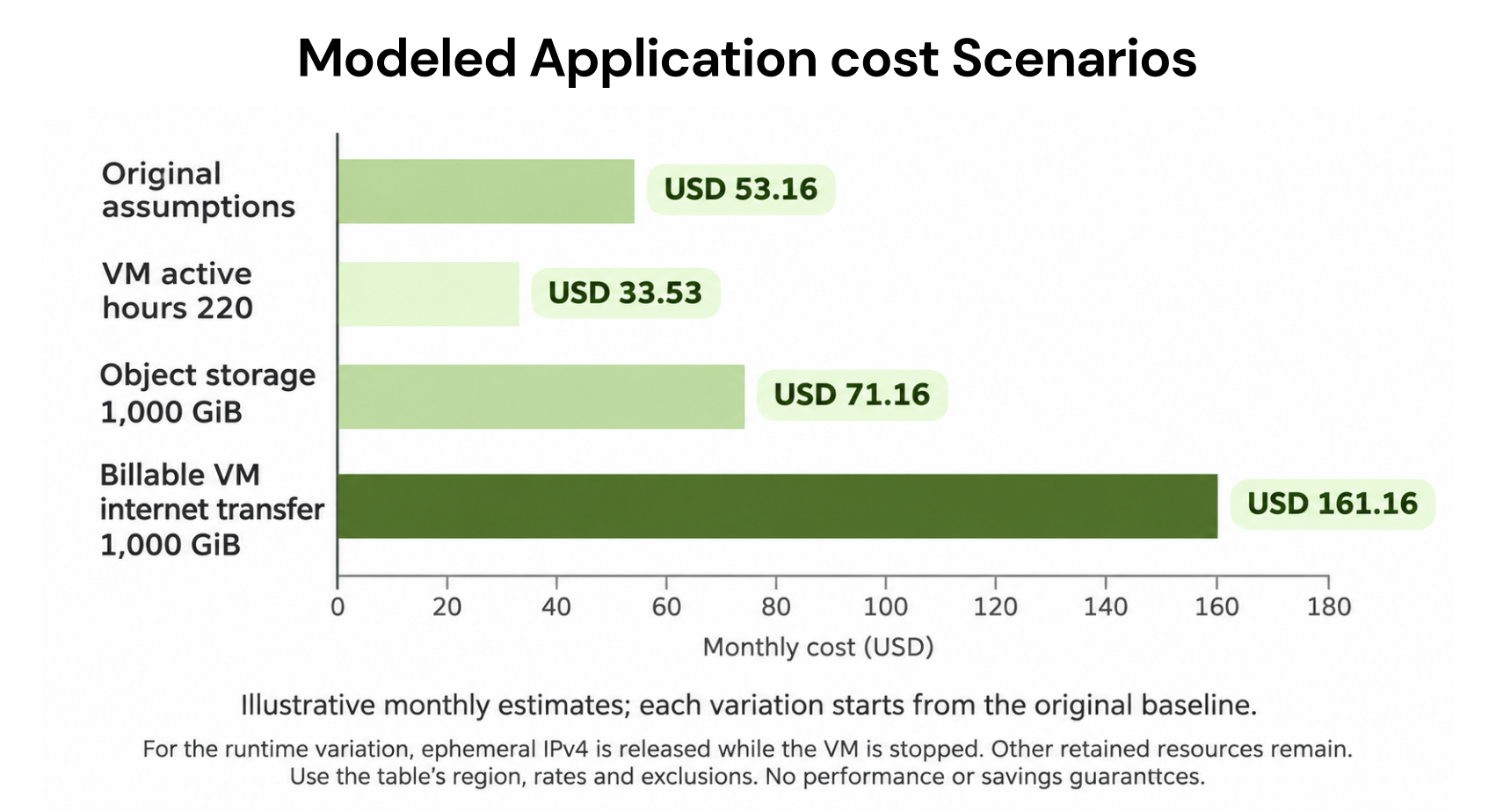
Now change one input at a time. Reducing VM hours to 220 produces $33.53; increasing object storage to 1,000 GiB produces $71.16; increasing billable transfer to 1,000 GiB produces $161.16.
The runtime case releases ephemeral IPv4 while stopped; database, disk and storage remain. Each change starts from the baseline. This comparison identifies cost sensitivity, not whether shorter runtime meets your application’s needs.
A request-based Cloud Run API
Assume three million requests, 1 vCPU, 0.5 GiB memory, no minimum instances, startup CPU boost disabled and 600,000 aggregate active billable instance-seconds covering request processing, startup and shutdown. Relevant allowances are unused. Memory usage is 0.5 GiB × 600,000 seconds = 300,000 GiB-seconds.Using Cloud Run’s request-based rates:
| Component | After available allowance | Cost |
|---|---|---|
| CPU | (600,000 − 180,000) × $0.000024 | $10.08 |
| Memory | max(0, 300,000 − 360,000) × $0.0000025 | $0.00 |
| Requests | (3 − 2) million × $0.40 | $0.40 |
| Subtotal | $10.48 |
A BigQuery analytics workload
Assume 10 TiB of query processing and an average 1 TiB of active logical storage. With unused allowances, BigQuery’s published rates give:| Component | Calculation | Cost |
|---|---|---|
| Analysis | (10 − 1) TiB × $6.25 | $56.25 |
| Storage | (1,024 − 10) GiB × $0.023 | $23.32 |
| Subtotal | $79.57 |
Discounts and commitment trade-offs
Google Cloud pricing models reward different usage patterns. A discount helps only when its conditions fit.| Option | When it fits | Main limitation |
|---|---|---|
| On-demand | New or changing demand | No long-term commitment discount |
| Sustained use discounts | Longer-running eligible Compute Engine resources | Automatic, but E2 is excluded; no stacking with CUDs on the same usage |
| Spot VMs | Restartable, interruption-tolerant work | Google can reclaim capacity; advertised discounts reach up to 91% |
| Resource-based CUDs | Predictable eligible VM resources in a region | Resource-matching requirements and continuing payments |
| Spend-based CUDs | Sustainable eligible spending | Coverage and discounts vary by service and billing item |
For eligible AI spending, Flexible Savings Plans use a monthly spending commitment over a one- or three-year term. They are distinct from hourly compute commitments.
Unused commitments remain payable. Size coverage after planned reductions and existing discounts. Cloud Storage bucket charges and BigQuery on-demand scans do not become eligible merely because related compute is covered.
Estimate and control your costs
Before opening the Google Cloud pricing calculator, collect the inputs your workload needs:- Configuration: Region, machine or database edition, billing mode, availability and replica counts.
- Consumption: Running hours, allocated CPU/memory, average stored GiB, operations, billable query processing or tokens, and transfer routes and volumes.
- Adjustments: Available allowances, existing commitments, backups, licenses and supporting services.
Then act on the largest relevant meter: schedule suitable idle development compute, test resource sizing, review storage access and retention, reduce avoidable transfer, or reduce BigQuery scans. Preserve availability and performance requirements.
Compare estimates with actual billing. Budget alerts notify you; they do not by themselves stop services. Revisit commitments when workloads shrink or migrate.
How Usage.ai manages GCP commitments
Once you identify steady usage, the next question is how much to commit and what happens if demand falls.At Usage.ai, we start with a read-only review of your billing, usage and existing commitments. Through our Flex Insured Commitment Program, we purchase and manage supported GCP commitments in your own billing account, with your authorization.
If your usage drops and an eligible Flex Insured Commitment costs more than the same covered usage on demand for 30 consecutive days, we pay back the qualifying difference. This does not cancel the underlying commitment or automatically cover existing customer-owned commitments.
We charge an agreed percentage of realized savings we generate, excluding savings from commitments you already had. The fee applies when verified savings are generated.
Build your Google Cloud budget
Build your Google Cloud pricing estimate around resources the workload actually needs. Keep supporting charges visible and compare purchasing options against sustainable demand.Once your estimate identifies steady eligible spend, request a read-only Savings Test to review existing coverage and potential additional commitment savings.
Request a read-only assessment of existing coverage, potential additional savings, projected fees and net savings.
Frequently asked questions
How much does Google Cloud cost?
Google Cloud pricing has no universal monthly total. An always-running VM, a request-driven API and an analytics workload use different meters. Add the services your workload needs, then apply available allowances and relevant discounts.
Is Google Cloud free?
Some eligible usage fits recurring free allowances. The $300, 90-day trial is separate and restricted. Exceeding one meter’s allowance can generate charges even while another remains unused.
How much is Google Cloud Storage?
At Iowa Standard rates, storing one decimal TB throughout a month costs approximately $18.63; one TiB costs $20.48. These are storage-only estimates before allowances. Requests and applicable transfer add charges. Personal Drive/Photos storage uses Google One plans.
What adds to advertised cloud prices?
Google Cloud pricing tables often quote one component. Disks, backups, logging, public IPv4, licenses, networking and other resources may sit outside that rate. Check what the selected price includes.
Do commitments discount every GCP charge?
No. Coverage depends on the commitment and eligible resource or billing item. Compute discounts do not automatically cover storage or transfer. Unused native commitments remain payable even when workloads stop using them.