
 AWS
 Microsoft Azure
 Google Cloud


AWS Lambda Pricing Breakdown
AWS Lambda runs applications without requiring developers to manage servers directly. Its pricing now varies across several compute options.| Compute model | How billing works | Best suited for |
|---|---|---|
| Event Functions | Requests + execution duration | Event-driven applications |
| Web Functions | Requests + active CPU + memory | HTTP and streaming workloads |
| Managed Instances | Requests + EC2 + management fee | Steady, high-volume workloads |
| MicroVMs | Running compute + snapshots | Isolated execution environments |
Event Function Rates
These are the standard first-tier On-Demand rates in US East (N. Virginia).| Component | x86 | Arm (Graviton) |
|---|---|---|
| Requests | $0.20/million | $0.20/million |
| Duration | $0.0000166667/GB-second | $0.0000133334/GB-second |
| Monthly free requests | 1 million | 1 million |
| Monthly free compute | 400,000 GB-seconds | 400,000 GB-seconds |
Arm’s lower compute rate does not guarantee a 20% lower total bill. Actual savings depend on execution performance, compatibility, request charges, and other services.
Source: AWS Lambda Pricing
How Lambda Billing Works
Traditional Event Functions have two primary billing dimensions.Request cost:
At the x86 rate:
AWS measures execution duration in milliseconds. Memory allocation also determines available CPU capacity, so increasing memory can sometimes reduce execution time.
For continuously running applications, compare serverless costs with AWS EC2 pricing.
AWS Lambda Free Tier
Eligible Event Functions receive the following monthly allowances:| Resource | Free allowance |
|---|---|
| Requests | 1 million |
| Duration | 400,000 GB-seconds |
These allowances do not eliminate charges from API Gateway, CloudWatch Logs, networking, or other connected services.
Provisioned Concurrency capacity and execution have separate billing rules. Check AWS’s current free-tier eligibility when estimating these configurations.
AWS Lambda Pricing Examples
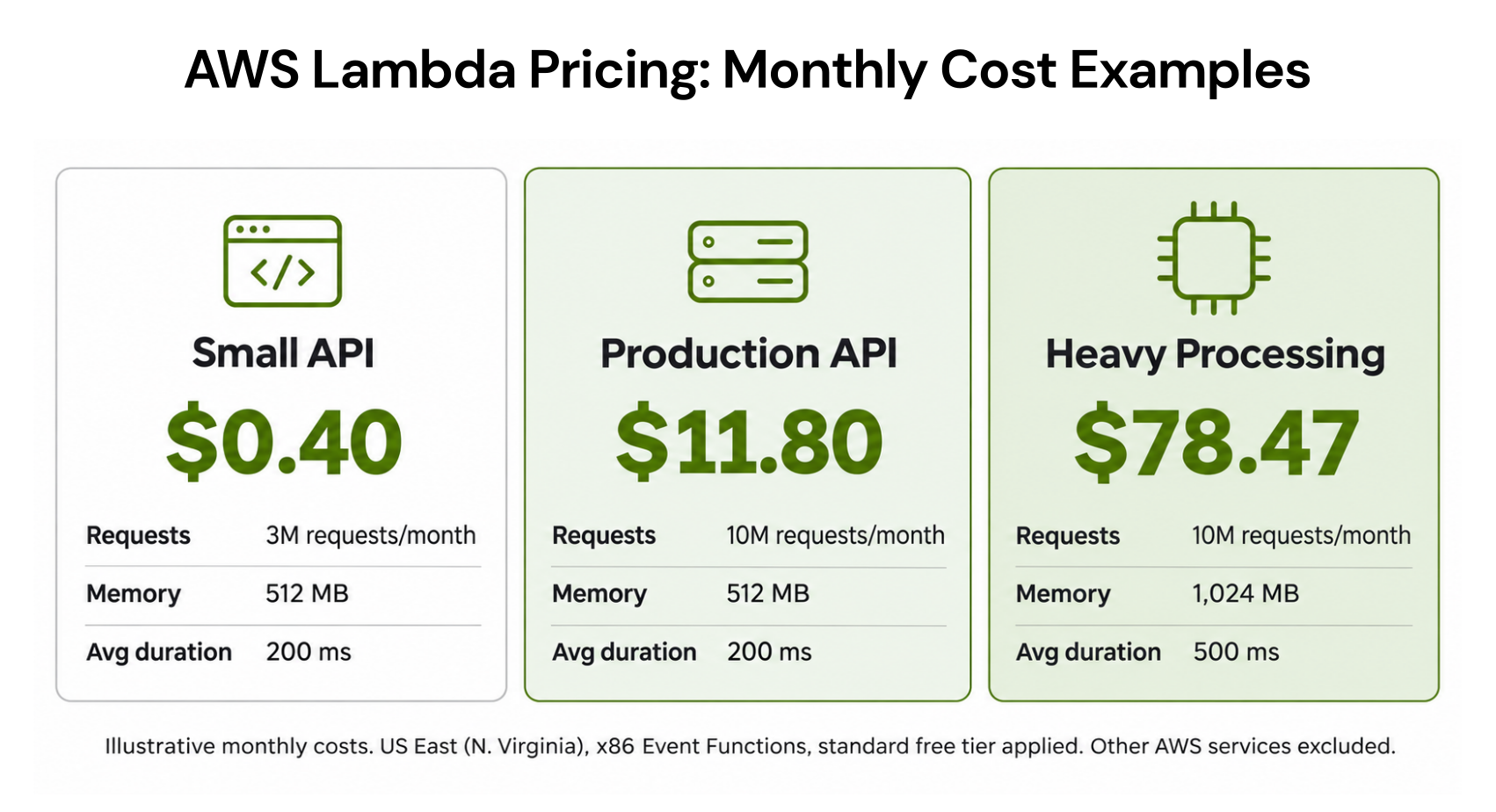
The following examples use x86 Event Functions in US East (N. Virginia), the standard free tier, and no other eligible Lambda usage consuming the allowances.Example 1: Small API
A small application processes 3 million requests monthly.| Metric | Value |
|---|---|
| Requests | 3 million |
| Memory | 512 MB |
| Average duration | 200 ms |
| Compute usage | 300,000 GB-seconds |
| Compute charges | $0.00 |
| Request charges | $0.40 |
| Monthly total | $0.40 |
Example 2: Production API
A production API handles 10 million monthly requests with 512 MB of memory and 200 ms average duration.| Component | Calculation | Cost |
|---|---|---|
| Compute usage | 10M × 0.5 GB × 0.2 seconds = 1M GB-seconds | Usage only |
| Billable compute | 1M − 400,000 free GB-seconds = 600,000 GB-seconds | $10.00 |
| Billable requests | 10M − 1M free requests = 9 million | $1.80 |
| Monthly total | Compute + requests | $11.80 |
Example 3: Heavy Processing
Now consider 10 million requests using 1,024 MB of memory for 500 milliseconds each.| Component | Calculation | Cost |
|---|---|---|
| Total compute usage | 5M GB-seconds | Usage only |
| Billable compute | 4.6M GB-seconds | $76.67 |
| Billable requests | 9 million | $1.80 |
| Monthly total | Compute + requests | $78.47 |
Monthly Cost Comparison
| Workload | Requests | Memory | Duration | Monthly cost |
|---|---|---|---|---|
| Small API | 3M | 512 MB | 200 ms | $0.40 |
| Production API | 10M | 512 MB | 200 ms | $11.80 |
| Heavy processing | 10M | 1,024 MB | 500 ms | $78.47 |
Memory Versus Duration
Choosing the smallest memory allocation does not always produce the lowest Lambda bill.Higher memory also provides additional CPU resources, potentially shortening execution time.
| Metric | Configuration A | Configuration B |
|---|---|---|
| Memory | 512 MB | 1,024 MB |
| Duration | 400 ms | 180 ms |
| Compute per request | 0.20 GB-seconds | 0.18 GB-seconds |
| Compute for 5M requests | 1M GB-seconds | 900K GB-seconds |
The difference is approximately $1.67 in gross x86 compute charges for five million invocations, before free-tier allowances.
Benchmark actual latency and total compute consumption rather than optimizing memory size alone.
Provisioned Concurrency Pricing
Provisioned Concurrency keeps execution environments initialized to reduce startup latency.Unlike ordinary On-Demand execution, configured capacity is billed while provisioned, even when traffic is low.
Suppose an application provisions 10 environments, each with 1 GB of memory, continuously for 720 hours.
This excludes execution-duration and request charges.
| Feature | Reserved concurrency | Provisioned concurrency |
|---|---|---|
| Additional capacity fee | No | Yes |
| Controls concurrency | Yes | Yes |
| Keeps environments initialized | No | Yes |
| Main purpose | Capacity limits | Startup latency |
Lambda Web Functions Pricing
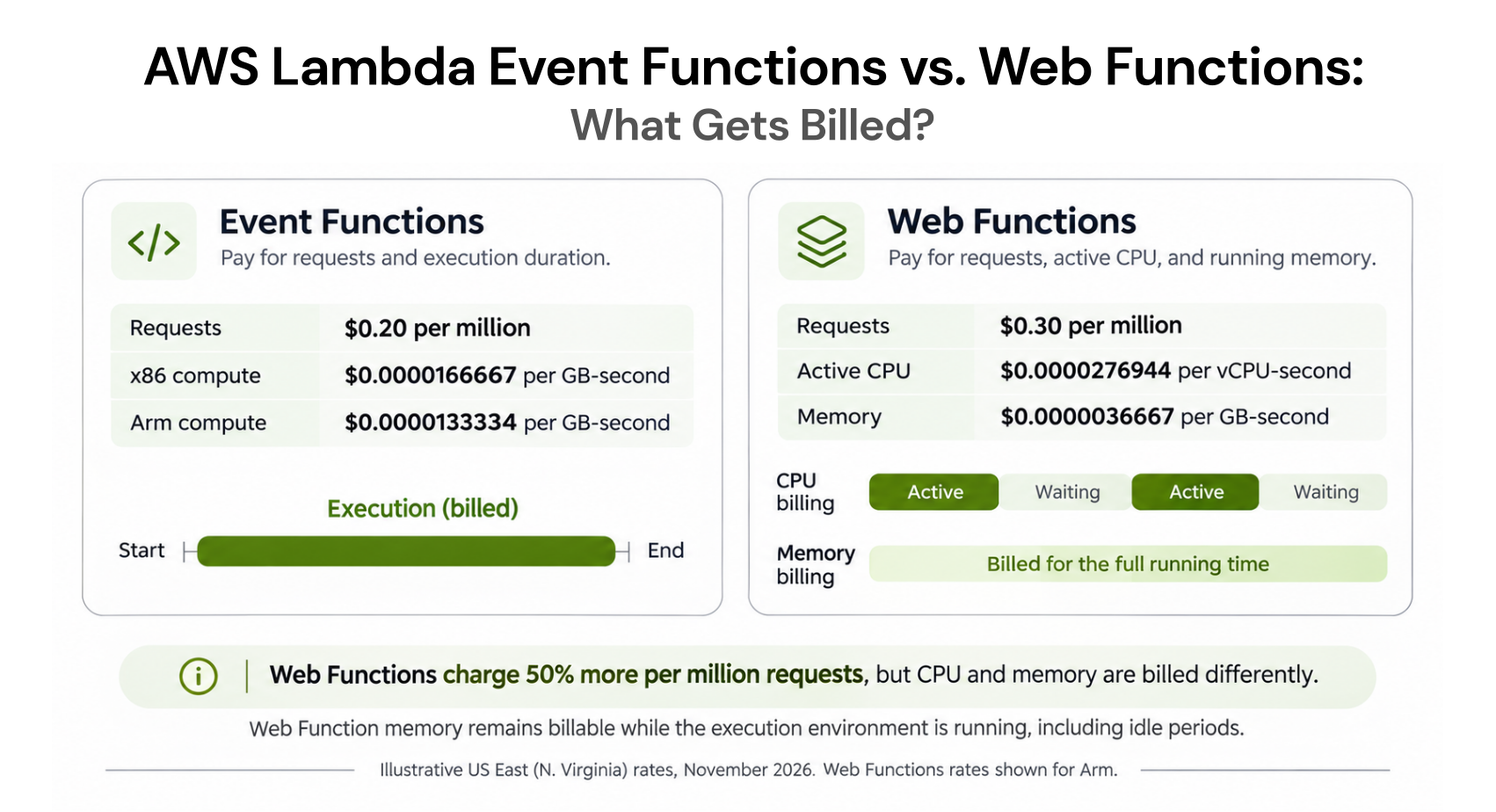
Introduced in October 2026, Lambda Web Functions support conventional HTTP applications with a billing model different from Event Functions.Instead of charging for the entire request duration, Web Functions charge for active CPU usage and the memory consumed by running environments.
Web Function Rates
The following rates are verified from AWS’s official US East (N. Virginia) Arm pricing examples.| Billing component | Rate |
|---|---|
| Requests | $0.30 per million |
| Active CPU | $0.0000276944 per vCPU-second |
| Memory | $0.0000036667 per GB-second |
| Data transfer | Standard applicable AWS rates |
However, request charges are only one part of the comparison.
A Web Function that spends most of its time waiting for a database or an AI model may use relatively little active CPU.
The important caveat is that memory is billed throughout the execution environment’s running lifetime, including time between requests.
AWS does not specify a universal idle-environment lifetime on the pricing page. Consequently, actual costs depend on traffic patterns and how Lambda scales execution environments.
Event vs. Web Functions
| Cost factor | Event Functions | Web Functions |
|---|---|---|
| Requests | $0.20/M | $0.30/M |
| Compute billing | Execution GB-seconds | Active vCPU-seconds |
| Memory billing | During execution | While environment runs |
| Waiting on external services | Included in execution duration | Little active CPU, but memory remains billed |
| Concurrent requests | Separate invocations | Can share an environment |
Real Web Function Example
AWS provides an I/O-heavy API example with these assumptions:
- 10 million monthly requests
- 200 ms end-to-end request duration
- 50 ms active CPU time
- Approximately 300 MB memory consumption
- One running environment throughout a 30-day month
| Component | Monthly cost |
|---|---|
| Active CPU | $13.85 |
| Memory | $2.76 |
| Requests | $3.00 |
| Total | $19.61 |
Importantly, Web Functions are not automatically cheaper.
For example, AWS’s illustrative LLM streaming endpoint costs approximately $33.94 as a Web Function because its requests spend most of their time waiting rather than actively using CPU.
The best choice depends on CPU utilization, request concurrency, memory lifetime, and traffic patterns.
Source: AWS Lambda Pricing
Lambda Managed Instances
Lambda Managed Instances run Event Functions on Lambda-managed EC2 instances.Unlike standard Event Functions, they do not separately charge for each request’s execution duration.
Instead, billing includes:
| Component | Charge |
|---|---|
| Requests | $0.20 per million |
| EC2 compute | Applicable instance price |
| Management fee, CPU instances | 15% of EC2 On-Demand instance price |
| Management fee, supported GPU G-series | 9.75% of EC2 On-Demand instance price |
Managed Instances are worth evaluating for steady, high-volume workloads that can utilize instance capacity efficiently.
They are not necessarily cheaper for intermittent applications because provisioned EC2 capacity can remain billable during low traffic.
Hidden Lambda Costs
Lambda’s execution charges do not represent the complete cost of most serverless applications.| Additional cost | What creates it |
|---|---|
| CloudWatch Logs | Log ingestion and retention |
| API Gateway | HTTP and API requests |
| NAT Gateway | Hourly charges and data processing |
| S3 | Storage and object requests |
| SQS | Queue operations |
| Ephemeral storage | Configured storage beyond 512 MB |
| Retries | Additional executions |
| Data transfer | Applicable networking traffic |
Retries Increase Usage
Suppose an application receives 10 million events but averages 1.1 execution attempts per event.That creates 11 million invocations, increasing both request and duration consumption.
Track retries, errors, and invocation counts together.
Logging Adds Charges
High-volume functions can produce substantial CloudWatch log ingestion charges.Reduce unnecessary debug output and configure retention appropriately.
Networking Adds Charges
Lambda VPC connectivity does not automatically create a separate Lambda networking fee, but NAT gateways, endpoints, and data transfer may incur charges.See our AWS data transfer pricing guide for more detail.
Reduce AWS Lambda Costs
The best optimization strategy depends on the main billing driver.| Main cost driver | Recommended action |
|---|---|
| High GB-seconds | Benchmark memory and execution duration |
| Excessive invocations | Review triggers, batching, and retries |
| Provisioned capacity | Adjust concurrency schedules |
| High log ingestion | Reduce unnecessary logging |
| Network charges | Review NAT and transfer patterns |
| Stable eligible compute | Evaluate Compute Savings Plans |
| I/O-heavy HTTP traffic | Compare Event and Web Functions |
Optimize Before Discounts
Start by reducing unnecessary invocations, improving code efficiency, and benchmarking memory allocations.Then assess the remaining predictable compute usage.
Evaluate Compute Savings Plans
AWS Compute Savings Plans can discount eligible Lambda duration and Provisioned Concurrency usage.AWS advertises savings of up to 17% for eligible Lambda usage, depending on the commitment.
Learn more in our Compute Savings Plans guide and Lambda and Fargate coverage guide.
Request charges and unrelated CloudWatch or networking fees are not covered by those Lambda discounts.
Where Usage.ai Fits
AWS Lambda cost optimization combines engineering improvements with eligible compute discounts. Reducing invocation volume, memory consumption, and execution time addresses usage costs, while commitment management can reduce rates on qualifying usage.At Usage.ai, we help organizations identify and manage supported AWS commitment savings opportunities. For eligible Lambda usage, Compute Savings Plans can provide discounts without requiring changes to application code.
Our AWS Savings Plans guide explains commitment coverage, flexibility, and potential savings. Organizations should assess existing commitments and net savings before purchasing additional coverage.
Explore potential savings on eligible AWS compute commitments.
Final Thoughts
AWS Lambda pricing depends on much more than request volume. Event Functions charge for requests and execution duration, while Web Functions separate active CPU from memory billing. Managed Instances use EC2-based economics.Estimate the complete application cost, including retries, logging, networking, and concurrency. Then optimize for the lowest cost per successful request rather than the lowest advertised rate.
Frequently asked questions
How much does AWS Lambda cost?
Standard Event Functions in US East (N. Virginia) start at $0.20 per million requests and $0.0000166667 per GB-second for x86 compute.
Is AWS Lambda free?
Eligible Event Functions receive 1 million free requests and 400,000 GB-seconds monthly. Connected AWS services may still incur charges.
Is Lambda Arm cheaper than x86?
Arm compute starts at $0.0000133334 per GB-second versus $0.0000166667 for x86, approximately 20% lower. Actual savings depend on performance and workload compatibility.
Are Web Functions cheaper?
Not always. Web Functions can benefit workloads with substantial waiting time, but they charge more per request and bill memory while execution environments remain running.
Does Lambda charge for idle time?
Standard Event Functions generally do not charge for idle execution environments. Provisioned Concurrency and running Web Function environments have different capacity and memory billing rules.