
 AWS
 Microsoft Azure
 Google Cloud


The distinction is important. A recommendation engine can identify a savings opportunity, but an agentic system can evaluate that opportunity against defined policies, execute an approved action, and measure the outcome.
This article explains what Agentic FinOps means, where it is being applied today, and the controls organizations should have in place before enabling autonomous cost optimization.
The Short Answer
Agentic FinOps describes FinOps systems that can investigate cloud-cost conditions, make decisions within defined policies, and take action with limited human intervention.Unlike dashboards, chatbots, or recommendation engines that only surface insights, an agentic system can execute approved optimization actions and verify the results. The key distinction is not whether AI is involved, but whether the system can move from recommendation to execution.
As the FinOps Foundation’s discussion of agentic AI in FinOps notes, agentic systems move FinOps beyond observation toward orchestration, where software can investigate, decide, and in some cases execute actions within defined guardrails.
What makes FinOps agentic?
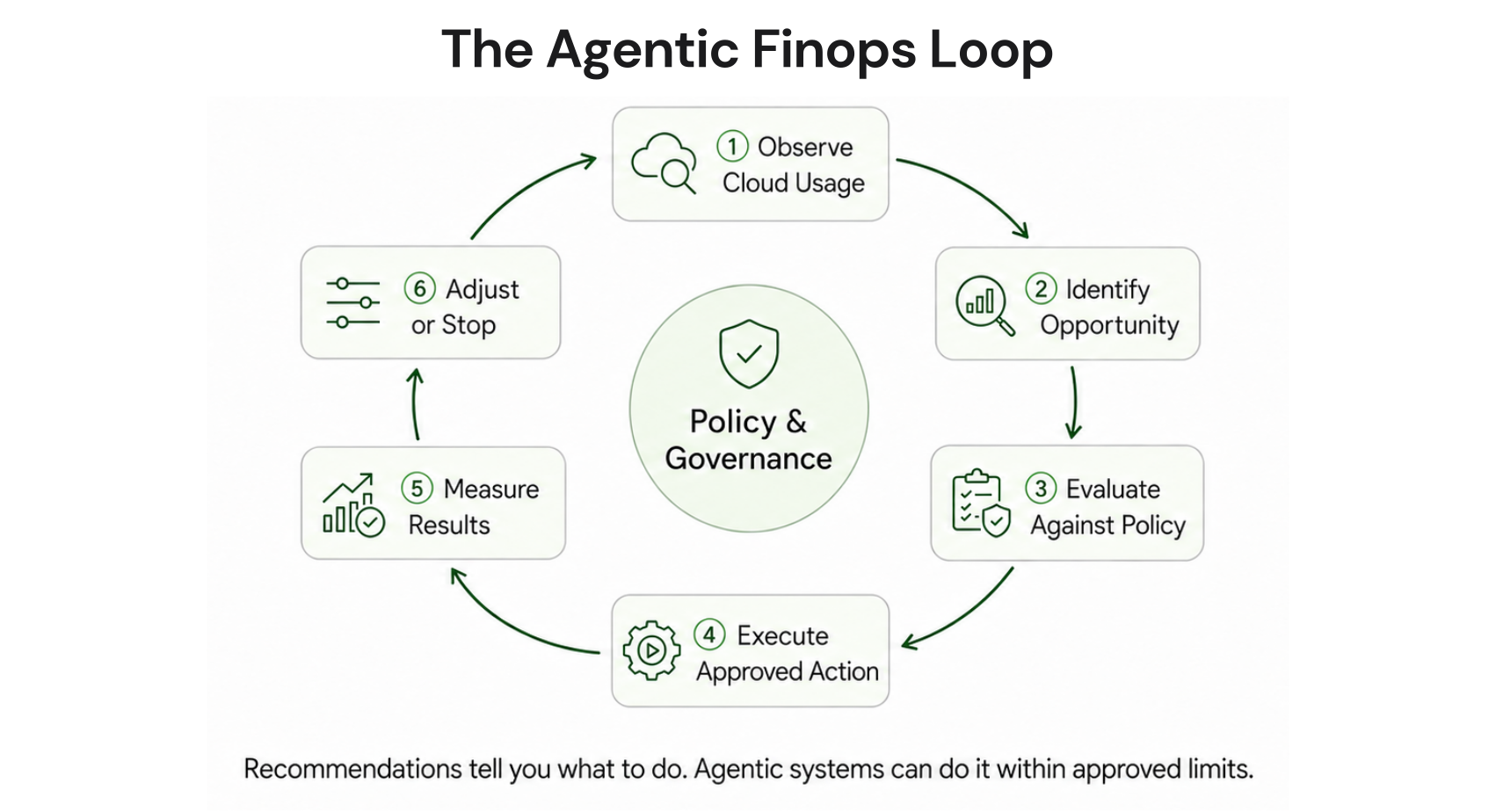
Observe → Decide → Act → Measure → Adjust
Traditional FinOps tools often stop after identifying an opportunity. For example, it usually says, “your commitment coverage is below target. Consider purchasing additional Savings Plans.”
An agentic system can continue the process within approved policies.
Coverage is below the defined threshold. Usage supports additional commitment coverage, so purchase within the approved limit, monitor utilization, and pause future purchases if conditions change.
The key difference is not better recommendations. It is the ability to take approved actions and continuously evaluate the results while operating within predefined financial and governance guardrails.
| Operating level | What the system does | Typical control |
|---|---|---|
| Observe Cloud Usage | Collects and analyzes cloud usage, cost, commitment, and utilization data. | Read-only access, data-scope restrictions, audit logging. |
| Identify Opportunity | Detects optimization opportunities such as commitment gaps, idle resources, or anomalous spending. | Approved optimization policies, anomaly thresholds, recommendation review criteria. |
| Evaluate Against Policy | Compares the opportunity against predefined business, financial, and governance rules. | Coverage targets, commitment limits, utilization thresholds, budget constraints. |
| Execute Approved Action | Performs actions that fall within approved policies and authority limits. | Approval requirements, spending limits, role-based permissions, change controls. |
| Measure Results | Verifies whether the action delivered the intended outcome and tracks realized impact. | Savings validation, utilization monitoring, reporting, audit trails. |
| Adjust or Stop | Modifies future actions or pauses automation when conditions change or policies are no longer met. | Exception triggers, rollback rules, review cadence, automated stop conditions. |
Also read: Autonomous Commitment Management: The End of Manual RIs
Why commitment management is a useful agentic use case
Cloud commitments are a natural candidate for automation because the decision repeats over time.AWS Savings Plans provide discounted pricing in exchange for a commitment to a specified amount of eligible usage for one or three years.
AWS currently documents Compute Savings Plans, Database Savings Plans, EC2 Instance Savings Plans, and SageMaker AI Savings Plans. The eligibility and flexibility differ by plan type. The AWS Savings Plans types documentation provides the provider-specific details.
The mechanics also differ across cloud providers, so these instruments should not be treated as interchangeable.
- AWS: Savings Plans use an hourly commitment. EC2 Instance Savings Plans additionally specify an instance family and Region.
- Azure: Savings Plans use a fixed hourly spend commitment for eligible usage. Microsoft describes the model as a one- or three-year spend commitment.
- Google Cloud: Committed Use Discounts can be resource-based or spend-based depending on the service and commitment program.
Analyze recent eligible usage.
Identify a stable usage or spend baseline.
Check existing commitments and coverage.
Determine whether another commitment fits the organization’s policy.
Execute only when the purchase falls within authorized limits.
Monitor utilization after purchase.
Stop or adjust future purchasing when the underlying usage changes.
AWS recommendations are based on past usage and existing commitment information. They help estimate an opportunity, but they do not guarantee that future usage will remain unchanged.
The AWS Savings Plans recommendation methodology should therefore be considered when designing automated purchasing policies.
What should an agent be allowed to do?
Before enabling autonomous FinOps actions, define the authority-to-act boundary.At minimum, the policy should specify:
Maximum commitment amount: How much can be purchased without additional approval?
Term: Are one-year commitments allowed? Are three-year commitments allowed?
Product scope: Which Savings Plans, Reservations, or CUDs can be purchased?
Account or billing scope: Where can the system act?
Utilization threshold: What level of utilization is required before additional coverage is considered?
Exception triggers: What workload changes should stop automated purchasing?
Approval threshold: At what dollar value must a human review the action?
Audit evidence: What inputs, reasoning, and resulting action must be recorded?
Pause mechanism: Who can stop autonomous activity?
Where to start?
A practical adoption path is to increase autonomy gradually.- Observe: Start with billing, utilization, and operational data. Establish what the system can see and whether the underlying data is reliable enough for automated decisions.
- Recommend: Allow the system to identify opportunities and explain why an action is being proposed.
- Approve: Introduce explicit financial policies. Humans approve purchases while the system records the reasoning and expected outcome.
- Automate bounded actions: Allow autonomous execution only for actions that fall within defined financial, technical, and organizational limits.
- Review outcomes: Measure actual utilization, effective cost, realized savings, and exceptions. Use those results to refine the policy.
How should you measure an agent after it acts?
Automation should not be judged by the number of actions an agent completes. In the case of commitment management, measure whether the action produced the intended financial result. Useful metrics include:- Commitment utilization
- Eligible usage coverage
- Effective cost versus the applicable on-demand baseline
- Realized savings
- Unused commitment
- Purchases outside policy
- Exceptions and manual overrides
- Forecast savings versus realized savings
Where Agentic FinOps goes beyond commitments
Commitment automation is only one application. Agentic systems can also support workload-level optimization, such as identifying idle resources, investigating anomalies, or coordinating actions across infrastructure and data platforms. For example, an agent could identify an idle data warehouse and recommend suspension, or detect an unusual increase in compute consumption and investigate the workload responsible. These actions require different safeguards. Stopping a development warehouse is not equivalent to purchasing a multi-year commitment, and automatically changing a production workload can introduce operational consequences beyond the bill.The right automation policy depends on reversibility, financial exposure, operational blast radius, and the quality of available telemetry.
How provider commitment models differ
| Provider | Commitment model | Key consideration |
|---|---|---|
| AWS | Savings Plans use hourly commitments; plan types have different eligibility and flexibility. | Historical usage helps size commitments, but future workload changes still create risk. |
| Azure | Savings Plans use fixed hourly spend commitments for eligible usage. | The commitment is consumed through eligible usage and does not simply roll forward as unused credit. |
| Google Cloud | CUDs can be resource-based or spend-based depending on the service. | Commitment structure and applicable terms vary by CUD type. |
How Usage.ai applies Agentic FinOps
We apply this model specifically to cloud commitment management. With Usage.ai Autopilot, we automate eligible commitment management across AWS, Azure, and GCP. The platform continuously analyzes usage, evaluates commitment opportunities against defined policies, executes approved actions, and monitors outcomes over time.For teams that want more control over execution, we offer CoPilot, a review-oriented mode that allows teams to review projected savings before a purchase is executed.
At Usage.ai, we focus on the pricing and commitment layer after eligible usage has been identified. Rather than stopping at recommendations, the platform can continuously evaluate changing cloud usage, determine whether an action remains aligned with policy, and take approved commitment-management actions on the customer’s behalf.
Through our Flex Insured Commitment Program, teams can achieve up to 50% savings on covered cloud spend, on average, without taking on a three-year commitment risk. Our fee is a percentage of realized savings, and eligible commitments include cashback protection for underutilization.
The cloud provider still controls the underlying commitment products, pricing, eligibility rules, and billing mechanics. We operate the optimization and management layer around eligible commitments.
This is what Agentic FinOps looks like in practice: a system that continuously observes conditions, evaluates options, executes approved actions, measures results, and adapts as cloud usage changes.
What does a practical Agentic FinOps implementation require?
Before turning on autonomous actions, teams should be able to answer five questions:- What can the system see?
- What decisions can it make?
- What financial limit applies?
- What happens when conditions change?
- How can a human pause or override it?
The objective is to move humans toward policy, governance, exception handling, and strategic decisions while software handles repeatable actions within those boundaries.
Conclusion
Agentic FinOps is best understood as a shift from FinOps that recommends to FinOps that can act within policy.The most useful systems do not simply add an AI interface to an existing dashboard. They connect observation, decision-making, execution, and measurement while keeping financial authority bounded.
Commitment management is one of the clearest areas to apply this model because the decisions recur and the financial impact can be measured. But autonomous action should always be matched to the risk of the action, the quality of the underlying data, and the controls surrounding it.
Learn how Usage.ai applies autonomous decision-making to cloud commitment management.
Frequently asked questions
What is Agentic FinOps?
Agentic FinOps is the use of software agents to investigate cloud-cost conditions, make decisions, and execute defined optimization actions within organizational policies. It goes beyond dashboards and recommendations by connecting analysis with controlled execution.
How is Agentic FinOps different from FinOps automation?
Traditional automation can execute a predefined rule, while an agentic system can assess the current state, determine an appropriate action within its objectives and policies, execute it, and evaluate the result. The distinction is not absolute, however. The level of autonomy depends on the system and the controls surrounding it.
Is autonomous commitment purchasing safe?
It can be controlled, but it is not inherently risk-free. Commitments can create financial obligations, so autonomous purchasing should operate within limits covering commitment size, term, eligible products, utilization expectations, exceptions, and human override.
Does Agentic FinOps only apply to AWS?
No. The underlying concept applies across cloud providers and can extend to workload-level optimization. AWS Savings Plans, Azure Savings Plans, and Google Cloud CUDs have different mechanics, so an agent should apply provider-specific rules rather than treating commitments as identical.
What does Usage.ai Autopilot automate?
Autopilot automates eligible cloud commitment management across AWS, Azure, and GCP. It operates at the commitment and billing layer rather than making changes to production infrastructure.