
 AWS
 Microsoft Azure
 Google Cloud


This comparison follows the buying decision: what each platform covers, what it actually does with a recommendation, who carries the downside, and what implementation and exit would require. We are Usage.ai, this article’s publisher and one of the platforms evaluated.
Usage.ai vs Finout at a Glance
| Decision point | Usage.ai | Finout |
|---|---|---|
| Main job | Manage eligible AWS, Azure, and Google Cloud commitments | Consolidate and allocate cloud, Kubernetes, data, and AI costs |
| Cost ownership | Commitment and savings visibility; limited broader allocation | MegaBill, Virtual Tags, shared-cost allocation, unit economics |
| Commitment insight | Recommendations and active-commitment views | CostGuard recommendations and My Commitments views |
| Execution | CoPilot approvals or configured Autopilot; provider-API purchases | CostOptimizer is listed and described for RI management; verify purchase actions by plan and cloud |
| Underutilization | Cashback for qualifying Flex Commitment losses | Tracks utilization; dollar-based waste appears in supported AWS views, not Azure Reservations; confirm contractual protection, if any |
| Fee basis | Agreed share of realized savings under the documented model | Quoted flat contract fee tied to a committed spend tier and scope |
What Each Platform Covers
The largest difference is the breadth of the bill each platform helps you understand. Finout’s MegaBill consolidates sources such as AWS, Azure, Google Cloud, Kubernetes, Snowflake, and AI providers.Virtual Tags and shared-cost rules can assign spend to a team, product, or customer even when provider tags alone are insufficient. If the question is which product absorbed the shared platform cost?, that allocation model is material.
We analyze usage at the billing layer to find commitment opportunities. Our dashboard shows recommendations, active commitments, and savings across supported cloud accounts.
We do not replace Finout’s broader allocation, AI spend, budgeting, or unit-economics workflows. Conversely, connecting a source to Finout for reporting does not establish that its optimizer buys every type of commitment for that source.
There is overlap: Finout’s CostGuard scans for idle resources, rightsizing, and commitments. Its My Commitments feature examines coverage and utilization; supported AWS views also show savings and unused value.
The choice becomes less about whether both can see a commitment opportunity and more about what happens next.
From Recommendation to Purchase
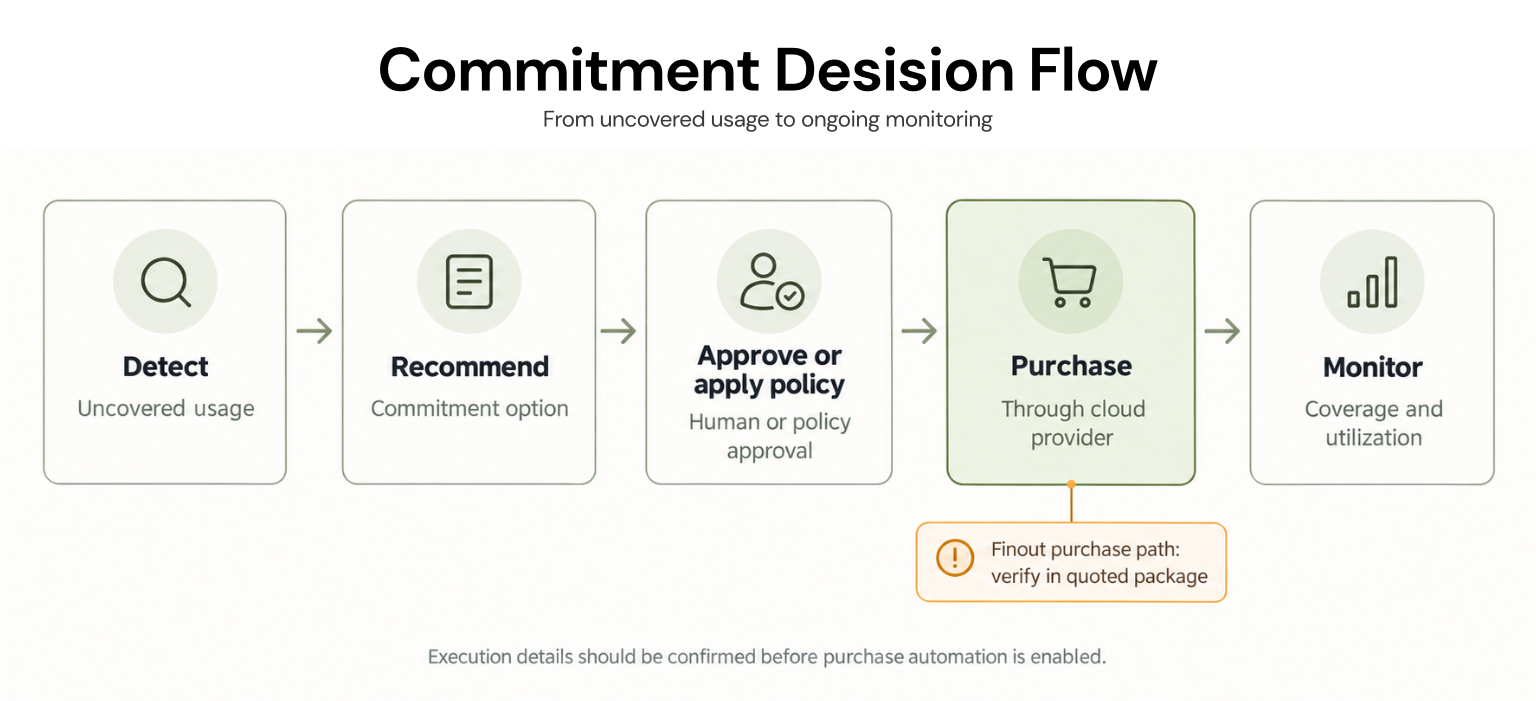
Take uncovered AWS compute spend. A buyer needs to know whether the tool identifies that spend, recommends a commitment, gets approval, purchases it through AWS, and monitors the result.Ask for a demonstration of the entire sequence with an existing Savings Plan in the account; otherwise a recommendation may appear more actionable than it is.
With us, recommendations can go through CoPilot for customer approval or through Autopilot for configured accounts, regions, services, and commitment types. We call provider APIs to execute approved purchases; an Autopilot action runs within the scope the customer has authorized.
Purchased Flex Commitments remain visible alongside commitments the customer already owned.
Finout’s CostGuard documents commitment scans, and its My Commitments views extend beyond an AWS RI summary. Finout also names CostOptimizer on its pricing page, says it manages Reserved Instances, and features a customer account of automatic commitment management. That is meaningful execution overlap.
Its public guidance does not give a sufficiently complete instrument-by-instrument description to claim that a new buyer’s package autonomously purchases AWS Savings Plans, Azure Savings Plans, and Google Cloud CUDs. Ask Finout to show the supported purchases, approval policy, audit trail, and permissions for your accounts.
An AWS RI purchase, an Azure compute Savings Plan, and a Google Cloud CUD follow different provider rules; a screenshot showing all three in reporting says little about purchase authority.
Have the vendor show a recommendation that accounts for commitments already in force, the proposed amount and term, who can stop the action, and where the resulting provider instrument appears. That reveals whether your team is buying automation or primarily a better decision workflow.
Who Carries Underutilization Costs?
A commitment bought for a stable workload can outlast that workload. Rightsizing, migration, or falling demand may leave part of the commitment unused.A dashboard can reveal the loss, and a better purchasing strategy can lower its probability. Neither action necessarily pays the remaining provider charge. The customer still owes the cloud provider for the commitment.
Our Flex Insured Commitments pair cloud-provider discounts with cashback protection for qualifying downside. If a covered commitment costs more than equivalent On-Demand usage, cashback protection covers the qualifying difference under the program terms.
Qualifying losses are calculated monthly, with rebates provided 90 days after the calendar month in which they accrued; applicable fees are offset first, and any remaining amount is refunded.
Our Flex Insured Commitments are distinct from purchases a customer already owned: existing customer-owned commitments are not automatically protected as Flex Commitments.
We could not verify comparable cashback terms in Finout’s public materials. Request the actual order terms and ask what happens to an underused instrument managed through CostOptimizer.
Compare the financial outcome after a usage decline, not just the forecast at purchase time.
Compare Net Economics
Start with the same provider bill and time period. Record On-Demand-equivalent cost for eligible usage, the actual provider charges including commitment costs, and commitments purchased before either vendor entered the account.Then separate newly attributable savings from savings the business was already receiving. Otherwise, a proposal can take credit for a discount that would have existed anyway.
Finout says its fee is a quoted flat amount for the contract term, based on a committed cloud and AI spend tier; scope, data volume, integrations, and options can affect the quote.
Our pricing model charges an agreed percentage of realized savings from covered optimization, billed monthly in arrears once provider billing is final. Verify the fee base and any different terms in the applicable order.
A fixed fee is easier to budget; a savings share moves with the measured eligible result. Neither fact tells you which proposal leaves more value.
Run two versions of the same forecast: sustained usage and a material drop after purchases begin.
In each, compare provider cost with and without the new commitment actions, subtract the relevant vendor fee, then include qualifying cashback, counting any fee offset and remaining refund once each, when applicable.
Provider costs already include unused commitment charges; do not subtract them again as a separate loss.
Keep projected opportunity separate from finalized realized savings.
If the Finout quote also buys better allocation or planning, evaluate that value against its own reporting requirements; do not manufacture commitment savings to pay for unrelated features.
Use your negotiated rates, credits, sharing rules, and amortized commitment charges consistently. Ask each vendor to show its calculation from the same bill, instrument IDs, and dates.
Our savings, fees, and cashback breakdown shows how we reconcile these numbers, while the vendor evaluation scorecard helps you weight proof from each platform.
Implementation and Handover
Start by separating assessment access from purchase authority. We offer a read-only savings test; executing commitments requires limited permission to purchase them. We do not start, stop, or resize production resources.Finout’s AWS reporting setup calls for a Cost and Usage Report, relevant exports, and access to the report bucket. Do not assume those reporting permissions are also the permissions its CostOptimizer uses. Have each vendor show the exact role and approval controls for the service you intend to buy.
For a transition, inventory every active commitment by provider, account, owner, remaining term, and protection status. Remove or pause the outgoing purchasing authority only after assigning responsibility for new decisions.
Native commitments can remain in the cloud account after a platform relationship ends; a vendor agreement can still determine remaining fees. If you leave us, Non-Usage Rebate eligibility ends under current program terms, including for qualifying underutilization during the agreement.
Export the Finout allocation rules and reports you depend on if it is your cost system of record. We cover other records worth preserving when handing over existing commitments.
If you retain both tools, make the purchasing boundary explicit. For example, Finout could own allocation and reporting while we manage an agreed subset of commitments.
If CostOptimizer is active, designate which system may buy for each account, service, and instrument. Reconcile both tools to provider bills so two dashboards do not each claim the same saving.
Final Verdict
Choose Finout when
You need shared-cost allocation, unit economics, financial planning, and a coherent view across cloud, Kubernetes, data, and AI spend. Its documented commitment tools may also suit your optimization need if a demonstration and proposal confirm the purchases, controls, and risk terms you require.Choose Usage.ai when
Your allocation and reporting are workable, but eligible usage is still paying On-Demand rates or commitment management is taking too much time. We provide an approval path or configured Autopilot, execute eligible purchases through provider APIs, and offer cashback protection for qualifying Flex Commitment downside. Our fee is based on realized savings under the documented model.Use both when
You need Finout’s broader cost model and our commitment workflow and protection. Agree on who can purchase what, which bills prove incremental savings, and how rightsizing or workload changes feed the next commitment decision. That makes two tools a deliberate operating model rather than two claims on the same savings.Review your reporting needs, commitment opportunities, and purchase controls with our FinOps team.
Frequently asked questions
How does private cloud pricing affect the comparison?
Use the rates and discounts in your actual agreement for both proposals. Reconcile credits, commitment charges, and shared discounts consistently; a list-price saving can overstate the value you retain. Confirm how each vendor calculates its savings baseline before comparing fees.
Does Finout execute infrastructure changes?
CostGuard documents idle-resource and rightsizing recommendations, which are not the same as changing a running workload. Ask Finout which specific remediation actions its quoted package executes, what approval is required, and what permissions that action needs. Keep that answer separate from what CostOptimizer does with commitments.