.png)



Anyone who’s ever tried to keep a garage organized knows how this story goes.
You start with good intentions. The floor is clear, everything has a place, and there’s plenty of room to work. Then a few boxes get set aside “temporarily.” A broken chair you’ll fix later. Seasonal gear that doesn’t quite fit anywhere else. Over time, the space fills—not because you were careless, but because life moved faster than cleanup.
Cloud cost optimization often breaks down the same way.
Teams take advantage of the cloud’s flexibility to move fast. Infrastructure is spun up to ship features, to handle traffic spikes, or unblock projects. Instances are added in minutes. Storage grows quietly. New services appear “just to test something.”
Months later, the environment looks very different. There are cloud resources no one remembers provisioning. Capacity sized for peak demand that no longer exists. Long-term commitments made under assumptions that quietly drifted out of date.
This is where cloud cost optimization becomes frustrating for experienced FinOps and infrastructure leaders.
The issue isn’t a lack of visibility. Most teams already understand where their cloud spend is going. They can point to the most expensive services, accounts, and workloads. What they struggle with is turning that insight into sustained cloud cost savings.
%2021%20(13).svg)
The Industry’s Default Model of Cloud Cost Optimization
Cloud cost optimization is typically defined as the ongoing effort to reduce cloud computing costs while maintaining or improving performance, reliability, and security.
Most guidance follows a familiar framework. Organizations are advised to:
- Gain visibility into cloud spend
- Organize costs through tagging and allocation
- Identify inefficiencies through rightsizing
- Reduce unit costs using Savings Plans or Reserved Instances
This model underpins the majority of cloud cost optimization strategies in use today. It provides structure, establishes governance, and helps teams understand where cloud spending is concentrated.
For many organizations, particularly early in their cloud journey, this approach delivers meaningful initial improvements. However, as environments scale and usage patterns become more dynamic, limitations begin to emerge.
The primary issue is that this model focuses heavily on analysis. Dashboards, reports, and recommendations explain past and current spending, but they do not directly change how infrastructure is provisioned or how financial commitments are managed over time.
As a result, savings often plateau despite improved visibility and more sophisticated reporting.
Understanding how cloud cost optimization actually works requires moving beyond insight generation and examining how optimization decisions are executed, monitored, and revisited as conditions change.
Cloud Cost Optimization as a Continuous Feedback Loop

In practice, cloud cost optimization is not a one-time initiative or a static set of best practices. It is an ongoing process of keeping cloud spending aligned with actual operational needs.
Because cloud environments are inherently dynamic, effective optimization functions as a continuous feedback loop. There are several factors that consistently determine cloud cost outcomes. They include:
- Usage: Actual consumption of compute, storage, databases, and other services, which fluctuates based on traffic, architecture, and business activity.
- Commitments: Financial decisions such as Savings Plans or Reserved Instances that reduce unit costs in exchange for committing to future usage.
- Variance: The gap between expected usage and actual usage, which grows as workloads and demand change.
- Time: How frequently optimization decisions are evaluated and how quickly they are acted upon.
Many optimization strategies assume that usage patterns are stable enough to support periodic reviews and long-term decisions. In reality, usage often shifts week to week, while optimization actions are revisited monthly or quarterly.
Your recommendations may be accurate when you generated them, but they can easily lose their relevance by the time you implement them. A more accurate model should treat optimization as an ongoing cycle, where you:
- Measure current usage and performance
- Compare usage to provisioned capacity and financial commitments
- Identify misalignment between cost and need
- Take corrective action
- Re-evaluate as usage evolves
This loop should repeat continuously. The objective here is not aggressive cost cutting, but sustained alignment between spending, performance, and operational requirements.
Also Read: AWS Database Savings Plans Explained for DB Teams
Why Cloud Cost Savings Are Ultimately a Risk Decision
A lot of discussions around cloud cost optimization emphasize efficiency, which includes eliminating waste, improving utilization, and lowering unit costs. But, what is often under-emphasized is the role of financial risk. This is especially true for pricing models that require long-term commitments.
Savings Plans and Reserved Instances can deliver meaningful discounts, but they require organizations to commit to future usage. When actual usage falls below those commitments, expected savings erode and can turn into wasted spend.
As a result, most organizations under-commit by design.
This behavior is not driven by a lack of understanding. Teams recognize the math. They also recognize the downside. Cloud usage is unpredictable, and commitments do not automatically adjust when demand changes.
From a risk perspective, this conservative behavior is rational. But from a cost optimization perspective, it creates a ceiling on achievable savings.
Many optimization strategies implicitly assume that maximizing discounts is always desirable. In practice, teams continuously balance two competing objectives:
- Reducing unit costs
- Limiting financial exposure if usage changes
When risk is not addressed directly, teams compensate by slowing decisions or avoiding commitments altogether. Early savings come from obvious inefficiencies. Long-term savings require deeper commitment decisions, and those decisions carry risk.
Why Dashboards and Recommendations Don’t Change Outcomes
Dashboards and recommendations are essential inputs to cloud cost optimization, but they are often mistaken for outcomes.
Most organizations already have detailed visibility into their cloud environments. They know which services are expensive, which teams consume resources, and where inefficiencies likely exist. Many tools, in fact, provide increasingly granular recommendations.
However, visibility and recommendations alone do not produce savings.
Savings only occur when changes are executed: resources are resized, commitments are adjusted, and configurations are updated in production. This execution step is where optimization frequently breaks down.
Also read: How to Choose Between 1-Year and 3-Year AWS Commitments
In most organizations, optimization actions require human review, coordination, and approval. These steps introduce delays. During that time too, usage continues to change.
For example, a recommendation that was valid when created may no longer be optimal by the time it is implemented. So, faced with uncertainty, teams delay action or act conservatively. Over time, insights accumulate while execution lags.
This is why organizations often feel they are “doing” cloud cost optimization without seeing proportional financial results.
What Real Cloud Cost Optimization Looks Like in Practice
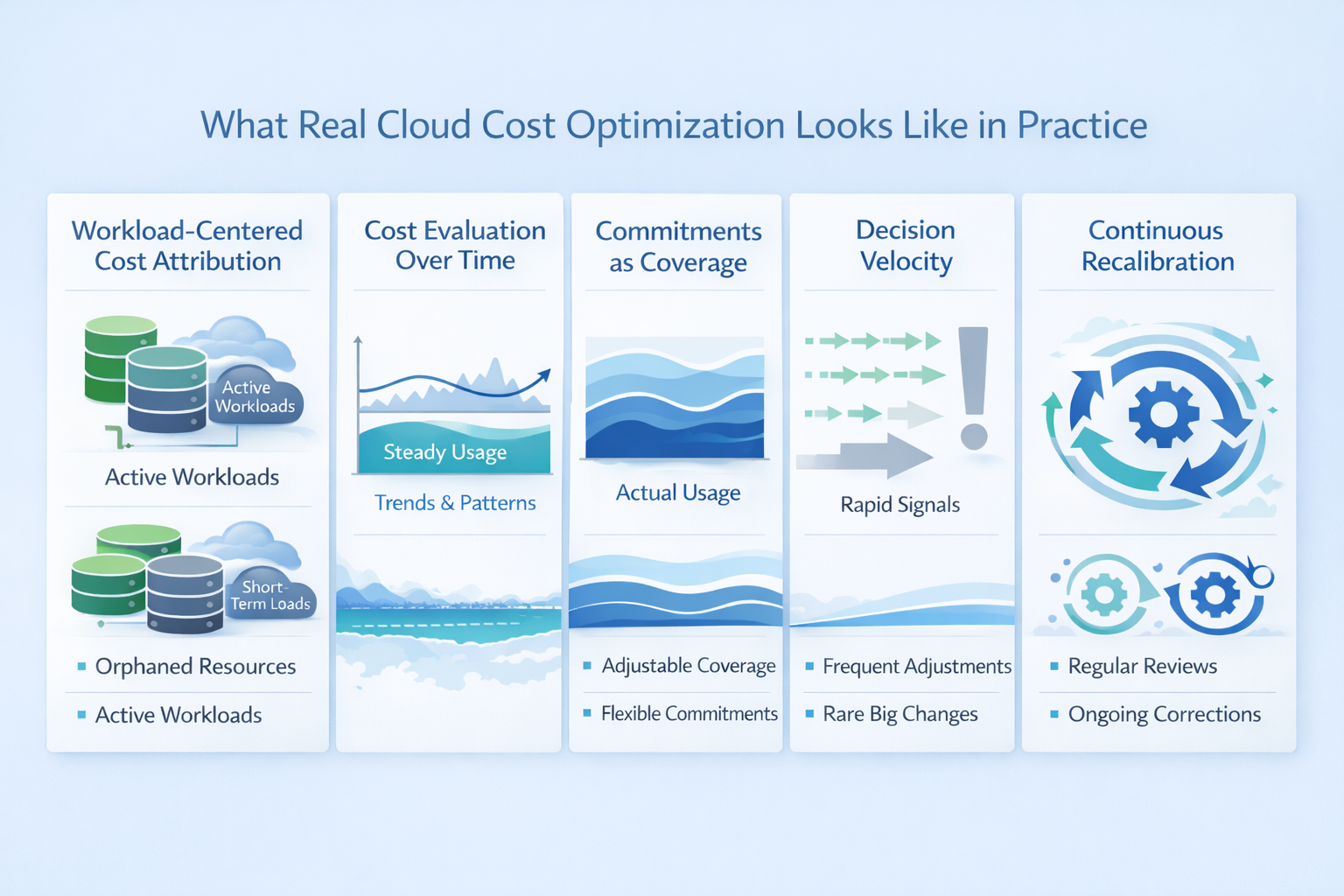
Organizations that achieve sustained cloud cost savings tend to share several characteristics.
- They tie cloud spend to workloads rather than accounts or teams: Workload-level attribution makes it possible to distinguish between production systems that deliver business value and resources that persist without a clear purpose.
- They evaluate cost over time rather than relying on static snapshots: Trend-aware signals help teams differentiate durable usage from temporary spikes and inform more reliable optimization decisions.
- They treat commitments as coverage decisions rather than one-time discounts: Instead of asking whether to commit, they determine how much usage should be covered, for how long, and under what risk tolerance.
- They prioritize decision velocity over theoretical perfection: Smaller, more frequent decisions that can be revisited outperform infrequent decisions designed to last for years.
- They recalibrate continuously: Optimization decisions have a limited shelf life. Revisiting them regularly prevents small misalignments from becoming large financial losses.
In practice, real cloud cost optimization functions less like a project and more like a control system.
Putting Cloud Cost Optimization Into Practice with Usage.ai
At this point, you understand how cloud cost optimization actually works. It is not driven by dashboards alone. It is not achieved through one-time cleanup efforts. And it is not simply a matter of purchasing discounts.
Effective optimization requires continuous execution. This includes observing usage, translating it into financial decisions, managing downside risk, and recalibrating as conditions change.
While this is possible to do manually, it becomes difficult to sustain as environments scale. This is where Usage.ai fits in.
Usage.ai is designed to operationalize cloud cost optimization by continuously evaluating real usage, recommending commitment strategies, and automating execution in a way that accounts for risk and variance.
Instead of forcing teams to choose between savings and flexibility, Usage.ai enables higher commitment coverage while protecting against underutilization through real cashbacks. This changes the economics of optimization by reducing the cost of being wrong.
In practice, this means commitment decisions are revisited continuously rather than quarterly, savings persist as usage changes, and optimization becomes repeatable rather than reactive.
If dashboards explain where money is going, Usage.ai helps ensure cloud spend stays aligned with reality.
Want to See Usage.ai in action? We’d love to walk you through how continuous commitment optimization and cashback-backed protection can reduce your cloud bill. Sign up for free.
%2024%20(12).svg)