
Blog

GCP Committed Use Discount vs Sustained Use Discount: A Technical Comparison, & Break-Even Analysis

Google Cloud offers multiple ways to reduce compute costs, but the two most common are Committed Use Discounts (CUDs) and Sustained Use Discounts (SUDs). Both can significantly lower your effective rate on Compute Engine, but they behave very differently once real-world usage volatility enters the picture.

At a glance, Sustained Use Discounts apply automatically when workloads run consistently throughout the month, requiring no contract or upfront commitment. Committed Use Discounts offer much deeper savings, but only if you commit to a fixed level of spend for one or three years.

The real decision in the GCP Committed Use Discount vs Sustained Use Discount debate is not about which discount percentage is larger. It’s about utilization rates, commitment coverage, and risk tolerance. At what point does a CUD outperform SUD?

This guide walks through the technical mechanics, break-even math, and risk modeling behind GCP CUD vs SUD, so you can make a decision based on numbers.

What is GCP Sustained Use Discounts (SUD)? 

A GCP Sustained Use Discount (SUD) is an automatic discount applied to eligible Compute Engine resources when they run for a significant portion of the billing month. There is no contract, no upfront commitment, and no manual purchase required. The discount increases as usage increases.

SUDs apply to vCPU and memory for most Compute Engine machine types. The more consistently an instance runs during a month, the larger the effective discount becomes. This makes SUDs attractive for steady workloads that you don’t want to commit to long-term.

The Discount Curve

Sustained Use Discounts are tiered. As usage of a specific VM instance type increases within a billing month, incremental portions of that usage receive higher discounts.

While exact percentages vary slightly by machine family and region, the structure generally follows this pattern:

Note: This is a progressive discount that is not applied to all usage. Each usage band receives a different discount rate, which produces a blended effective discount at the end of the month.

Here’s an example: 100% Monthly Usage

Assume a VM runs 24/7 for the entire month. Instead of paying full on-demand pricing for all hours, the final 25% of usage receives the highest discount tier. The earlier usage blocks receive smaller discounts. When blended together, the effective discount typically lands in the 25–35% range, depending on the machine type.

The effective rate can be conceptualized as:

  • Effective Cost = Sum of (Usage Tier × Tiered Price)
  • Effective Discount = (On-Demand Cost − Blended Cost) ÷ On-Demand Cost

Because SUD is automatic, there is no utilization risk. If usage drops mid-month, the discount simply recalculates based on actual runtime. There is no sunk cost and no long-term exposure.

Also read: Cloud Cost Optimization Best Practices to Cut 30–50% of Your Cloud Bill

Key Characteristics of SUD

SUDs require no forecasting and no commitment sizing. They are entirely reactive to usage. This makes them operationally simple and financially safe. However, that safety comes with a ceiling. Even at full utilization, SUD rarely reaches the maximum discount levels available under a 1-year or 3-year Committed Use Discount.

This creates the core tension in the GCP Committed Use Discount vs Sustained Use Discount decision. SUD optimizes for flexibility. CUD optimizes for depth of savings. The trade-off becomes clear once we examine how CUD contracts are structured and how utilization risk changes the equation.

What is GCP Committed Use Discounts (CUD)?

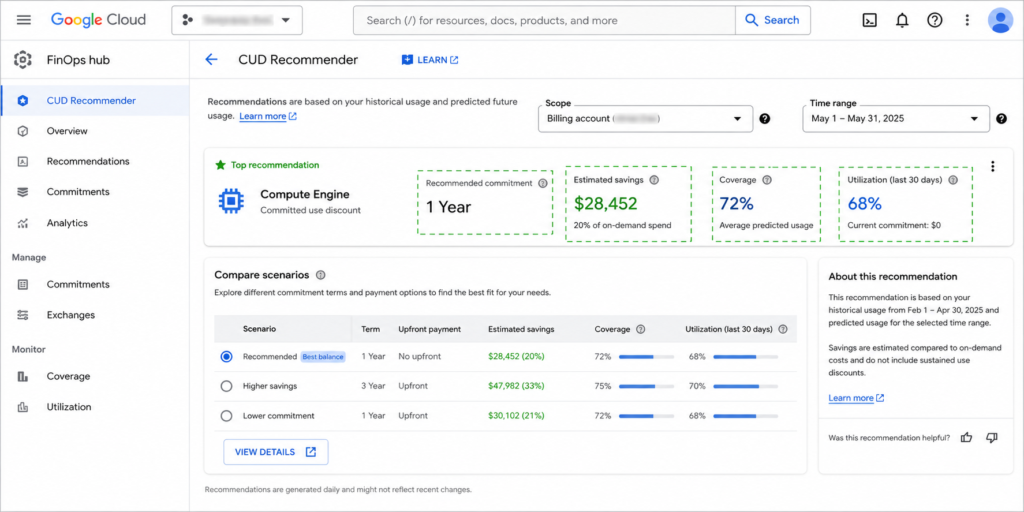
A GCP Committed Use Discount (CUD) is a contractual agreement where you commit to a specific level of compute usage, measured either in resources (vCPU and memory) or spend for a fixed term, typically one or three years. In exchange, Google Cloud provides a significantly deeper discount than Sustained Use Discounts.

Unlike SUD, with CUD, you are promising a baseline level of usage regardless of what actually happens month to month.

Types of GCP Committed Use Discounts

There are two primary CUD models in GCP:

  • Resource-based CUDs apply to a defined quantity of vCPU and memory in a specific region.
  • Spend-based CUDs allow you to commit to a dollar amount of eligible compute spend, offering more flexibility across instance types.

Both are available in 1-year and 3-year terms. The longer the term, the larger the discount.

Discount Ranges by Term

While exact percentages vary by machine family and region, typical discount ranges look like this:

  • 1-Year CUD: ~30–45%
  • 3-Year CUD: ~50–57%+

This is where the appeal becomes obvious. Compared to a blended SUD discount in the 25–35% range, a 3-year CUD can materially reduce effective compute cost.

But these savings assume one critical variable, i.e., utilization.

Also read: Google BigQuery Committed Use Discounts (CUDs) Optimization Guide

The Utilization Variable

With SUD, discounts adjust automatically to actual usage. With CUD, the commitment is fixed.

The core equation is:

Utilization Rate = Actual Usage ÷ Committed Amount

If utilization is 100%, you capture the full advertised discount. But, if it drops below 100%, the unused portion of the commitment becomes sunk cost.

For example, if you commit to $100,000 per month of compute under a 3-year CUD but only consume $80,000 worth of eligible usage, you are still financially responsible for the full commitment amount.

That unused $20,000 does not convert into future credit. It simply reduces your effective savings rate.

Effective Hourly Pricing Comparison: SUD vs CUD

To understand the financial tradeoff in the GCP Committed Use Discount vs Sustained Use Discount decision, it helps to normalize both models against a consistent baseline.

Let’s assume an on-demand rate of $0.10 per hour for an eligible Compute Engine resource.

This comparison shows why CUDs can dramatically outperform SUDs under stable utilization. The hourly cost difference compounds quickly at scale.

However, those lower effective rates only apply if the commitment remains highly utilized. That brings us back to the central question in the GCP CUD vs SUD debate, at what utilization level does CUD stop outperforming SUD?

Also read: Why Cloud Cost Forecasting Breaks in Dynamic Environments

GCP Committed Use Discount vs Sustained Use Discount

To properly evaluate GCP Committed Use Discount vs Sustained Use Discount, we need to move beyond headline discount percentages and look at effective cost under different utilization scenarios. The core distinction between the two models is not simply discount depth, but how each behaves when usage changes.

Sustained Use Discounts automatically adjust based on actual runtime within the billing month. If usage decreases, costs decrease proportionally. Committed Use Discounts, however, are fixed contractual commitments. Once purchased, the committed spend applies whether usage remains constant or declines. This introduces a utilization dependency that materially affects financial outcomes.

To illustrate this, let’s consider a simplified baseline scenario, where: 

  • Monthly on-demand compute spend: $100,000
  • Effective Sustained Use Discount (blended): 35%
  • 3-year Committed Use Discount: 55%

At full utilization, the comparison is as follows.

Under stable, fully utilized conditions, a 3-year CUD clearly produces deeper savings. This is why longer-term commitments appear attractive when workloads are predictable.

The challenge emerges when utilization drops below the committed level.

Utilization Sensitivity Analysis

If an organization commits to $100,000 of monthly spend under a CUD but actual eligible usage declines, the financial obligation does not adjust downward. The unused portion of the commitment effectively reduces the realized savings rate.

The table below shows how effective cost changes as utilization declines.

The break-even point occurs at approximately 60–65% utilization in this example. Above that threshold, the deeper CUD discount outweighs commitment exposure. Below that threshold, SUD becomes financially safer and potentially cheaper.

Also read: What is Cloud Cost Governance: Framework, Best Practices, and KPIs

Volatility Modeling: How Usage Variance Impacts GCP CUD vs SUD

In the previous section, we identified a break-even utilization threshold of roughly 60–65% in our example. Above that level, a 3-year Committed Use Discount outperforms Sustained Use Discounts. Below that level, SUD becomes financially safer.

In practice, the problem is rarely static utilization. Even workloads that appear stable at a quarterly level often fluctuate significantly at a monthly level.

When evaluating GCP Committed Use Discount vs Sustained Use Discount, the real challenge is about understanding how that utilization might vary over the life of a one-year or three-year commitment.

From Static Utilization to Distribution Modeling

Let’s assume the following:

  • Average utilization of committed resources: 80%
  • Expected monthly variance: ±20%
  • Break-even utilization threshold: 64%

That means utilization could realistically fluctuate between 60% and 100%. 

Below is how effective cost behaves across that range:

This table shows why average utilization alone is not enough. The downside risk emerges in the lower tail of the distribution.

Visualizing the Risk Zone

A more accurate way to evaluate GCP CUD utilization risk is to think in terms of probability distribution rather than point estimates.

Imagine utilization plotted on a bell curve:

  • The center (mean) sits at 80%.
  • The left tail represents lower-utilization months.
  • A vertical line at 64% marks the break-even threshold.

Any area of the distribution to the left of that 64% line represents months where CUD underperforms SUD.

Even if the majority of months are above break-even, a meaningful minority below that threshold can reduce realized annual savings. This is why commitment decisions feel risky, even when average numbers look favorable.

Also read: Cloud Cost Monitoring vs Cost Control: What’s the Real Difference?

Commitment Coverage Optimization: How to Size CUDs Safely

After modeling utilization volatility, one conclusion becomes clear that the GCP Committed Use Discount vs Sustained Use Discount decision is not binary.

The real optimization problem is determining how much of your baseline workload should be covered by a Committed Use Discount. This is known as commitment coverage.

What Is Commitment Coverage?

Commitment coverage is the percentage of your total eligible compute usage protected by CUDs.

This means, if your average monthly Compute Engine usage is $100,000 and you purchase $70,000 worth of CUD commitments, your coverage is:

  • Coverage % = Committed Amount ÷ Average Usage
  • Coverage % = 70,000 ÷ 100,000 = 70%

That percentage directly determines both your upside savings potential and your downside exposure risk.

To understand the trade-off, let’s model different coverage levels using the same baseline assumptions:

  • Average monthly spend: $100,000
  • CUD discount: 55%
  • SUD effective discount: 35%
  • Utilization volatility: ±20%
  • Break-even threshold: ~64% utilization

Interpreting the Table

At 100% coverage, you capture maximum theoretical savings, but you are fully exposed to utilization volatility. Any drop below the 64% break-even threshold creates financial underperformance relative to SUD.

At 80% coverage, the commitment aligns more closely with stable baseline demand. Even if total workload declines by 20%, you are likely still near full utilization of the committed portion. This dramatically reduces downside probability while retaining strong CUD economics.

At 60–70% coverage, the strategy shifts toward protecting against volatility first and maximizing savings second. This is how many mature FinOps teams structure commitments: commit the durable baseline, leave variable demand on SUD.

The Optimization Principle

With GCP commitment optimization, the goal is to maximize expected savings subject to volatility constraints.

The safest anchor point is historical minimum baseline usage.

If your lowest 12-month rolling baseline was $65,000 per month, committing near that level significantly reduces the risk of underutilization while still unlocking deeper CUD discounts on predictable demand.

This reframes the GCP CUD vs SUD decision as a portfolio allocation strategy, where you:

  • Commit stable demand
  • Leave volatile demand flexible
  • Continuously reassess coverage relative to observed variance

From here, the next logical question becomes, what happens when baseline usage shifts over time and how do static commitment strategies adapt?

Also read: Why Cloud Resource Optimization Alone Doesn’t Fix Cloud Costs

Dynamic Commitment Management: Adapting CUD Strategy Over Time

Even when a commitment coverage strategy is correctly sized at the time of purchase, it does not remain optimal indefinitely.

The challenge with GCP Committed Use Discounts is that they are fixed-duration financial instruments. Once a 1-year or 3-year commitment is purchased, the contractual obligation remains constant, while infrastructure consumption rarely does.

This creates a structural mismatch between static financial commitments and dynamic cloud workloads.

The Drift Problem in Multi-Year Commitments

When organizations evaluate GCP Committed Use Discount vs Sustained Use Discount, they typically analyze trailing usage data. They examine 6–12 months of historical consumption, calculate stable baseline demand, and size commitments accordingly.

At that moment, the sizing may be mathematically sound. However, cloud environments evolve continuously. Examples of baseline drift include:

  • Engineering-led instance rightsizing initiatives
  • Migration to more efficient machine families
  • Autoscaling threshold adjustments
  • Refactoring monoliths into microservices
  • Architecture shifts toward managed services
  • Regional traffic redistribution

Each of these can reduce or reshape eligible CUD utilization.

Coverage Drift in Practice

Let’s consider an organization with:

  • Average monthly usage: $100,000
  • Commitment coverage: 70%
  • Committed amount: $70,000

At purchase, utilization is stable and safely above break-even. Six months later, an infrastructure optimization initiative reduces average monthly usage to $85,000.

Coverage is now:

Coverage % = 70,000 ÷ 85,000 = 82%

The organization did not increase commitment, yet risk increased because the denominator changed.

If usage declines further to $75,000:

Coverage % = 70,000 ÷ 75,000 = 93%

At that point, even moderate volatility could push effective utilization below break-even.

The commitment remained static, but the workload did not. This is the drift problem.

Also read: GCP Cost Optimization Best Practices & Why They Don’t Scale

Why Periodic Manual Re-Evaluation Is Not Enough

Some FinOps teams attempt to address this risk through quarterly reviews. They reassess utilization, evaluate remaining term, and adjust future commitment purchases accordingly.

While this is better than no monitoring, it has limitations:

  • Volatility can emerge faster than review cycles
  • Manual recalculation introduces delay
  • Recommendation tools often use static historical windows

By the time underutilization is detected, exposure has already occurred. The longer the commitment term, the more pronounced this lag becomes.

A 3-year CUD amplifies both upside and downside over time. Small modeling errors compound across months.

Static Commitments vs Continuous Optimization

Traditional CUD strategy is event-based, where teams analyze usage, purchase commitment and monitor periodically. 

In contrast, a more resilient strategy treats commitment coverage as a continuously managed variable rather than a one-time purchase decision.

In this model:

  • Utilization is recalculated frequently
  • Coverage percentage is monitored relative to break-even thresholds
  • New commitments are layered gradually rather than purchased in bulk
  • Baseline shifts trigger recalibration decisions

This shifts the GCP CUD vs SUD decision from a one-time pricing comparison to an ongoing financial optimization process.

Reducing Commitment Risk: Automation, Recalibration, and Downside Protection

The deeper savings available through GCP Committed Use Discounts are mathematically clear. What complicates the GCP Committed Use Discount vs Sustained Use Discount decision is its lifecycle risk.

Sustained Use Discounts adjust automatically as workloads fluctuate. Committed Use Discounts do not. Once purchased, a 1-year or 3-year commitment becomes a fixed financial obligation, while cloud consumption continues to evolve.

Reducing commitment risk therefore requires shifting from static decision-making to continuous management.

In mature FinOps environments, commitment coverage is not reviewed quarterly or annually, but continuously. Daily effective utilization, rolling 30-day coverage percentage, and proximity to break-even thresholds become operational metrics. When workload baselines shift, commitment strategy must shift with them. Otherwise, what was once optimally sized coverage can quietly drift into higher-risk territory.

This is where automation materially changes the economics.

Usage.ai approaches GCP commitment management as an ongoing optimization problem rather than a one-time purchase decision. Recommendations refresh every 24 hours, incorporating new usage signals quickly instead of relying on static advisory windows. This tighter recalculation loop reduces the lag between workload drift and commitment awareness, which is critical in fast-moving engineering environments.

Beyond monitoring, commitment layering becomes important. Instead of purchasing large CUD blocks in a single event, commitments can be incrementally added as stable baseline demand is validated. This reduces the probability of oversizing exposure while still capturing deeper discount tiers. Automating that discovery and layering logic removes the manual modeling burden that often leads teams to under-commit out of caution.

Even with strong monitoring and incremental sizing, traditional CUD strategy retains one structural constraint: if utilization drops materially, the customer absorbs the downside. Because of this, many organizations cap commitment coverage below mathematically optimal levels. They intentionally leave savings on the table to avoid volatility risk.

Usage.ai introduces a structural shift by pairing commitment automation with assured real cashback protection. If committed capacity is underutilized within agreed parameters, customers receive real cash back rather than absorbing full downside exposure. This changes the coverage optimization curve. Higher commitment coverage becomes achievable without proportionally increasing financial risk.

That evolution from static discount comparison to risk-adjusted commitment optimization is where the greatest savings potential actually resides.

Conclusion

The comparison between GCP Committed Use Discount vs Sustained Use Discount ultimately comes down to more than discount percentages. Sustained Use Discounts provide automatic flexibility and eliminate downside exposure, making them structurally safe but capped in savings potential. Committed Use Discounts unlock materially deeper savings, but only when utilization remains consistently above break-even thresholds and commitment coverage is actively managed.

The real decision is not simply choosing CUD or SUD. It is determining how much of your workload can be safely committed given volatility, baseline stability, and risk tolerance. Organizations that treat commitment coverage as a dynamic financial variable consistently capture greater long-term savings.

In practice, the optimal strategy is often hybrid: commit predictable baseline demand, leave variable demand flexible, and continuously recalibrate coverage as workloads evolve. When combined with automation and downside protection mechanisms, this approach narrows the gap between theoretical CUD savings and realized outcomes.

If you want to see how much additional savings you could unlock safely, run a free GCP commitment coverage assessment with Usage.ai and evaluate your optimal coverage in real time. Sign up now!

Share this post

You may like these articles

See all
GCP Committed Use Discount vs Sustained Use Discount: A Technical Comparison, & Break-Even Analysis
All Articles
New-Releases

GCP Committed Use Discount vs Sustained Use Discount: A Technical Comparison, & Break-Even Analysis

Compare GCP CUD vs SUD with real break-even math, utilization modeling, and coverage strategy. Learn how to maximize savings while minimizing commitment risk.

February 24, 2026
3
 min read
Cloud Cost Optimization Best Practices: 18 Proven Ways to Cut 30–50% of Your Cloud Bill in 2026
All Articles
Cloud Cost Optimization

Cloud Cost Optimization Best Practices: 18 Proven Ways to Cut 30–50% of Your Cloud Bill in 2026

Reduce cloud waste with 18 proven cloud cost optimization best practices. Learn how to unlock 30–50% savings across AWS, Azure & GCP.

February 20, 2026
3
 min read
Google BigQuery Committed Use Discounts (CUDs): Pricing, Savings & Optimization Guide (2026)
All Articles

Google BigQuery Committed Use Discounts (CUDs): Pricing, Savings & Optimization Guide (2026)

Learn how Google BigQuery Committed Use Discounts (CUDs) work, how to calculate real savings, manage commitment risk, and optimize analytics spend.

February 16, 2026
3
 min read

Save towards your growth

Thank you! Your submission has been received!
Oops! Something went wrong while submitting the form.