
New See exactly what you're overpaying AWS in under 60 seconds. Try the Calculator for free

AWS in June 2026: Summit New York, Graviton5 GA, AWS FinOps Agent, and S3 Vectors Gets 80% Cheaper

Updated July 1, 2026
18 min read
AWS in June 2026: Summit New York, Graviton5 GA, AWS FinOps Agent, and S3 Vectors Gets 80% Cheaper
On this page

Executive Summary

June 2026 was one of the busiest months of the year. AWS Summit New York on June 17 anchored the month with a full keynote from Dr. Swami Sivasubramanian, VP of Agentic AI. Three things require immediate attention:

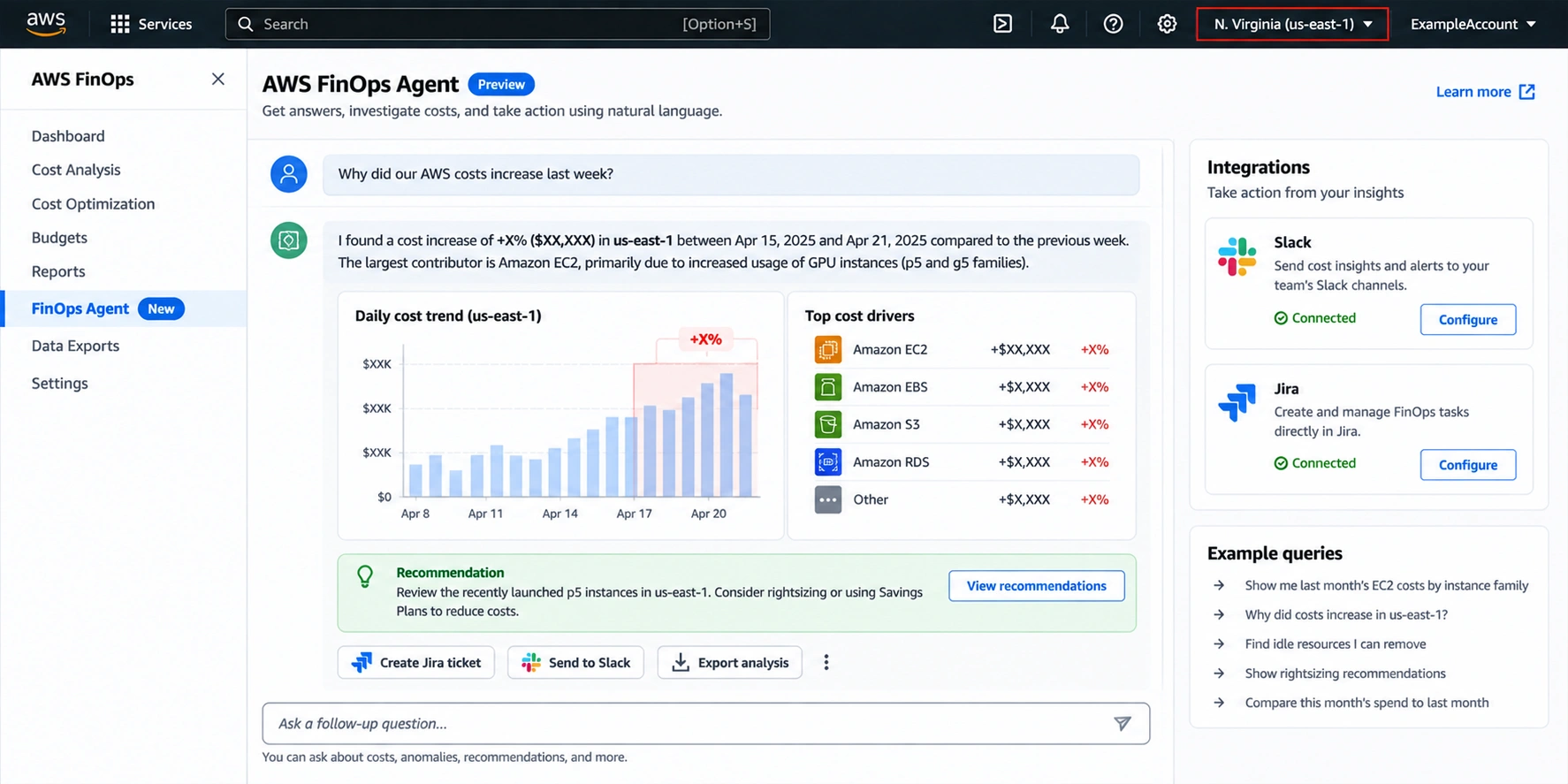
  • AWS FinOps Agent entered public preview on June 9, 2026, available at no additional charge. It answers cost questions in natural language, surfaces rightsizing and Savings Plans recommendations, investigates cost anomalies automatically, and can open Jira tickets and post findings to Slack. This is AWS’s first dedicated AI-powered FinOps agent for cost management and optimization. Available in US East (N. Virginia) only during preview, covering all AWS Regions except GovCloud and China.
  • EC2 M9g and M9gd instances powered by AWS Graviton5 reached general availability on June 10, 2026. Graviton5 delivers up to 25% better compute performance than Graviton4, with 192 cores per chip, DDR5-8800 memory (the fastest DDR5 in the cloud), and a 5x larger L3 cache. The Nitro Isolation Engine is now formally verified using mathematical proof. M9g on-demand pricing is generally around 8–10% higher than comparable Graviton4 instances (depending on Region and size) while delivering up to 15% better price-performance. RDS for PostgreSQL, MySQL, and MariaDB now also supports M9g.
  • Amazon S3 Vectors reduced query charges by up to 80% for large vector indexes. The reduction applies automatically with no application changes required, directly benefiting teams running similarity search across AI, RAG, and semantic search workloads.

For FinOps teams, the AWS FinOps Agent preview is the most actionable launch of the month. It is free during preview and available today. AWS also introduced a Target Coverage feature in the Savings Plans Purchase Analyzer and an AI-Powered Cost Investigations capability for cost anomalies.

AWS Summit New York – June 17, 2026: The Six Headline Announcements

AWS Summit New York City was held on June 17, 2026 at the Javits Center. Dr. Swami Sivasubramanian, VP of Agentic AI at AWS, delivered the keynote around one thesis: agents that compound value over time. The Summit organized its launches into three categories: agents for working, agents for securing, and agents for building.

1. AgentCore Harness Reaches General Availability

Amazon Bedrock AgentCore harness reached general availability at the Summit. Teams can now run production-grade AI agents by defining the agent model, tools, skills, and instructions in configuration. AgentCore runs the orchestration loop in an isolated environment. No orchestration code required. The harness was previously in preview following its April 2026 announcement at the What’s Next event.

Cost implication: AgentCore harness is billed through standard Bedrock infrastructure rates. Teams that were running custom orchestration loops on EC2 or Lambda should model whether migrating to the managed harness reduces infrastructure cost. Managed harness eliminates the compute overhead of the orchestration layer itself.

2. Amazon Bedrock Managed Knowledge Base

Amazon Bedrock Managed Knowledge Base launched at the Summit, simplifying enterprise RAG pipeline construction. It provides:

  • Native data connectors for ingesting data from common enterprise sources without custom ETL.
  • Smart Parsing for automatic multi-format document preparation, handling PDFs, spreadsheets, and structured data sources automatically.
  • Agentic Retriever for complex multi-step queries requiring reasoning across multiple knowledge chunks.
  • Integration with AgentCore Gateway for unified access control and governance.

Cost consideration: Managed Knowledge Base adds a retrieval and processing cost tier on top of the underlying vector storage and model inference costs. Teams building RAG pipelines should compare the managed knowledge base total cost against self-managed retrieval using S3 Vectors or OpenSearch Serverless.

3. AgentCore Web Search: Grounded Responses with Zero Data Egress

Web Search on Amazon Bedrock AgentCore launched at the Summit as a fully managed tool enabling agents to ground responses in current, cited web knowledge. AWS states that customer prompts and context remain within AWS-managed security boundaries while web retrieval is handled by the managed service. Web search results are retrieved and processed within the AWS security boundary without routing customer query data to external endpoints.

Unlike many third-party web search integrations, AWS manages web retrieval within its own service, reducing the need to expose customer prompts directly to external search APIs. For enterprise teams with data residency or security requirements that restrict outbound data flow, AgentCore Web Search is the first web grounding option that keeps query data within the AWS environment. Verify availability and pricing at aws.amazon.com/bedrock – rates change.

4. AWS Continuum: AI-Native Security at Machine Speed

AWS Continuum launched at the Summit as a new AI-native security service for code vulnerabilities, currently in gated preview. It takes vulnerability findings from across the environment, prioritizes by business impact, validates which are exploitable, and drives fixes through the team’s existing process. AWS Security Agent is now part of AWS Continuum and received new capabilities:

  • Threat modeling in preview using the STRIDE framework, generating application threat models with recommended mitigations.
  • Pull request code scanning with remediation across major Git platforms.
  • IDE integrations via Kiro power, Claude Code plugin, and MCP, letting developers run security reviews without switching tools.

Cost note: AWS Continuum is gated preview with pricing not yet published. AWS Security Agent features added as part of Continuum carry no additional charge for existing Security Agent customers during preview. Verify at aws.amazon.com/continuum – rates and availability subject to change.

5. AWS DevOps Agent: Release Management in Preview

AWS DevOps Agent added release management capabilities at the Summit, currently in preview. The two new features: release readiness review, which checks code changes against natural language standards the team defines; and autonomous release testing, which runs change-specific tests in production-like environments before promotion. Teams define what ready-to-ship means once, and the agent validates every change against those standards before it reaches the deployment pipeline.

6. AWS WAF AI Traffic Monetization

AWS WAF launched AI traffic monetization as a new Bot Control capability at the Summit. Content providers and publishers can now price, meter, and collect payment from AI bots and agents accessing their content and APIs. AWS WAF sets the price, accepts payment through third-party providers, and grants scoped access directly at the edge. This is relevant for any team running a content-heavy website or API that receives AI crawler traffic, and wants to convert that traffic into revenue rather than treating it as a cost to be blocked.

Six-tile grid illustrating the headline announcements from AWS Summit New York on June 17, 2026, covering AgentCore Harness GA, Managed Knowledge Base, AgentCore Web Search with zero data egress, AWS Continuum for code security, DevOps Agent release management, and WAF AI traffic monetization.

AWS FinOps Agent: The Most Important FinOps Launch of the Month

AWS FinOps Agent entered public preview on June 9, 2026. This is the first AWS-native agentic tool designed specifically for FinOps practitioners and engineering teams. Available at no additional charge during preview.

What AWS FinOps Agent Actually Does

The FinOps Agent is a frontier agent accessible in the AWS Management Console. Based on the official What’s New announcement, it:

  • Answers cost questions in natural language – ask questions about your AWS costs and get generated reports for finance and engineering teams.
  • Surfaces optimization recommendations – pulls rightsizing, idle resource, and Savings Plans recommendations from AWS Cost Optimization Hub and AWS Compute Optimizer and presents them in conversational form.
  • Investigates cost anomalies automatically – when a cost anomaly is detected, the agent investigates the root cause automatically and can post findings to a Slack channel, eliminating manual triage.
  • Opens Jira tickets on your behalf – acts on optimization findings by creating tickets in the team’s project management system.
  • Runs recurring FinOps workflows on a schedule – automate cost reporting, anomaly checks, and recommendation surfacing on a defined schedule.


Banner

Availability, Regions, and Free Preview Terms

AWS FinOps Agent preview is available in US East (N. Virginia) only. It covers cost and usage data for all AWS Regions except AWS GovCloud (US) Regions and AWS China (Beijing and Ningxia) Regions. It is offered at no additional charge during the preview period.

For teams evaluating how AWS native FinOps tooling compares to automated commitment purchasing, the Usage.ai guide on AWS Cost Optimization covers the full landscape including Savings Plans automation, rightsizing, and commitment strategy.

Savings Plans Purchase Analyzer: Target Coverage Feature

Alongside the FinOps Agent launch, AWS introduced Target Coverage in the Savings Plans Purchase Analyzer. Teams can now specify a target coverage percentage for their Savings Plans and the analyzer generates a recommended purchase to reach that target. This simplifies sizing Savings Plans to achieve a desired coverage target by generating purchase recommendations automatically.

AI-Powered Cost Investigations for Cost Anomalies

AWS also launched AI-Powered Cost Investigations for cost anomalies in the same week as the FinOps Agent. When AWS Cost Anomaly Detection flags an anomaly, the AI investigation automatically analyzes the underlying data to identify the root cause service, resource, or usage pattern. The investigation output appears inline in the AWS Cost Management console. This is separate from the FinOps Agent and available more broadly.

Compute: EC2 M9g and M9gd Graviton5 Generally Available, G7 Instances, and Lambda MicroVMs

EC2 M9g and M9gd Graviton5 Instances: Generally Available June 10, 2026

Amazon EC2 M9g and M9gd instances powered by AWS Graviton5 reached general availability on June 10, 2026. Graviton5 was previewed at re:Invent 2025 and GA’d during the week of June 9. Key specifications from the official AWS product page and announcement:

  • 192 cores per chip, the highest CPU core density in Amazon EC2.
  • 25% better compute performance than Graviton4-based M8g instances.
  • 35% faster for web applications compared to M8g.
  • 35% faster for machine learning workloads compared to M8g.
  • 30% faster for databases compared to M8g.
  • 15% higher network bandwidth and 20% higher EBS bandwidth on average across sizes compared to M8g.
  • DDR5-8800 memory, the fastest DDR5 in the cloud.
  • 5x larger L3 cache than Graviton4, with each core having access to 2.6x more L3 cache.
  • PCIe Gen6 support, first in the AWS fleet.
  • Nitro Isolation Engine: a formally verified security component providing mathematical certainty of VM isolation between customer workloads.

M9gd instances add up to 11.4 TB of NVMe SSD local storage with 30% higher IOPS compared to M8gd. Both M9g and M9gd support Instance Bandwidth Configuration (IBC), allowing bandwidth allocation adjustment between EBS and VPC networking by up to 25%.

Pricing: M9g on-demand pricing is approximately 9% above Graviton4-based M8g instances, but the 25% compute improvement translates to approximately 15% better price-performance. Verify current M9g pricing at aws.amazon.com/ec2/pricing – rates change.

Customer results confirmed at GA: Airbnb saw up to 25% performance improvement over other same-generation architectures. ClickHouse reported a 36% performance boost and 16% higher concurrency versus Graviton4 with zero code changes. SAP HANA Cloud observed 35% to 60% increase in OLTP query performance. Atlassian saw 30% higher performance and 20% lower latency on Jira versus prior Graviton generation.

For teams evaluating Savings Plans coverage on new Graviton5 instance families before migrating workloads from M8g or C7g, the Usage.ai guide on AWS Savings Plans vs Reserved Instances covers how Compute Savings Plans apply across instance families during transitions.

RDS Now Supports Graviton5-Based M9g Instances

Amazon RDS for PostgreSQL, MySQL, and MariaDB now supports Graviton5-based M9g instances. This was confirmed in the AWS updates for June 25, 2026. Teams running these database engines can migrate to M9g for the same performance improvements available on EC2 compute. For RDS, the 30% database performance improvement is particularly relevant.

EC2 G7 Instances: Generally Available, Powered by NVIDIA RTX PRO 4500 Blackwell GPUs

Amazon EC2 G7 instances reached general availability in June 2026. G7 instances are the first cloud instances powered by NVIDIA RTX PRO 4500 Blackwell Server Edition GPUs, making AWS the first major cloud provider to support this GPU. G7 instances pair these GPUs with custom 6th-generation Intel Xeon Scalable processors.

Performance versus G6 instances (confirmed from the Summit announcement): up to 4.6x AI inference performance improvement. Up to 2.1x graphics performance improvement.

G7 is optimized for AI inference workloads, 3D visualization, virtual workstations, and real-time rendering. Verify G7 pricing at aws.amazon.com/ec2/pricing – rates change.

AWS Lambda MicroVMs: VM-Level Isolation for Multi-Tenant Code Execution

AWS Lambda MicroVMs launched as a new serverless compute primitive. Based on the confirmed announcement: VM-level isolated sandboxes with no shared kernel or resources between sessions. Rapid launch and resume. Full lifecycle control. State preservation up to 8 hours. No infrastructure to manage.

Built on Firecracker, Lambda MicroVMs are designed for running user-generated or AI-generated code in multi-tenant applications without trading off isolation, speed, and state. The 8-hour state preservation is the significant new capability: standard Lambda functions do not persist state across invocations. MicroVMs allow agent-driven code execution sessions to suspend and resume within an 8-hour window, enabling longer-horizon agentic code execution without full re-initialization.

EC2 AMI Watermarks: Launched at No Additional Cost

Amazon EC2 AMI Watermarks launched at no additional cost across all AWS Regions. AMI Watermarks let teams embed custom identifiers in private AMIs that automatically carry forward to every derived AMI across copies, Regions, and account shares. Combined with Allowed AMIs and Declarative Policies, teams can restrict launches to approved images. This is a security and governance tool that closes the gap where derived AMIs previously lost their lineage tracking.

Storage: S3 Vectors Gets 80% Cheaper, S3 Annotations Launch, and S3 Vectors Pricing

Amazon S3 Vectors: Query Charges Reduced Up to 80% for Large Indexes

Amazon S3 Vectors reduced query charges by up to 80% for large vector indexes. This reduction applies automatically with no application changes required. For teams running large-scale AI, RAG, and semantic search workloads on S3 Vectors, this is a passive cost reduction that lands on the next invoice without any migration or configuration work.

The reduction specifically targets large vector indexes. Small indexes see a proportionally smaller reduction. The 80% figure applies at the large-index scale tier. Monitor S3 Vectors line items in your next AWS cost report to quantify the actual reduction for your workload.

Amazon S3 Annotations: Up to 1 GB of Queryable Context per Object

Amazon S3 Annotations launched at the Summit, allowing teams to attach up to 1 GB of rich, mutable, and queryable context directly to S3 objects. The annotations are purpose-built for AI agents and autonomous workflows that need to discover, understand, and act on data at scale without maintaining separate metadata systems.

The architectural significance: AI agents processing S3 objects previously had to query a separate metadata service or maintain an external catalog to understand what each object contained. S3 Annotations embeds that context directly on the object, making it retrievable in the same operation as the object itself. For agents running at scale across large S3 datasets, this reduces the number of service calls required per object and simplifies the agent’s data access architecture. Verify pricing at aws.amazon.com/s3/pricing – rates change.

AWS June 2026 launch timeline showing four weeks: AWS FinOps Agent and EC2 Graviton5 M9g GA in week one, model additions and Kiro Pro Max in week two, the dominant AWS Summit New York cluster on June 17, and post-Summit launches including S3 

AI and Models: Gemma 4, Grok 4.3, Claude Fable 5, and Kiro Pro Max on Bedrock

Gemma 4 Now Available on Amazon Bedrock

Google’s Gemma 4 became available on Amazon Bedrock in the week of June 15, 2026. Gemma 4 expands the open-model options available on Bedrock for teams that need open-weight models for fine-tuning, on-premises deployment, or compliance-driven model hosting. Verify current Gemma 4 pricing on Bedrock at aws.amazon.com/bedrock/pricing – rates change.

Grok 4.3 from xAI Now Available on Amazon Bedrock

Grok 4.3 from xAI became available on Amazon Bedrock in the week of June 22, 2026. Grok 4.3 runs on a new inference engine in Bedrock designed for price performance. Supported capabilities at launch: tool calling, structured output, and response streaming. Teams building reasoning, agentic, and enterprise workflows now have Grok 4.3 as an additional model option on the same Bedrock infrastructure.

Claude Fable 5 on Amazon Bedrock

Anthropic Claude Fable 5 launched on Amazon Bedrock on June 9, 2026. Claude Fable 5 is described as delivering Mythos-level capabilities to all customers, with strong safeguards designed for broader enterprise use.

It supports extended asynchronous task execution and advanced vision capabilities across diagrams and dense documents. It is designed for long-horizon agentic tasks requiring sustained context and complex reasoning. Verify current Claude Fable 5 pricing at aws.amazon.com/bedrock/pricing – rates change.

Kiro Pro Max: New Tier Launched June 2026

Kiro launched a new Pro Max tier in the week of June 15, 2026. Kiro Pro Max targets teams requiring the highest capability level available in the IDE, with expanded model access and higher usage limits.

AWS has also continued development of Kiro iOS, which launched at the Summit in gated preview, enabling developers to start sessions, review diffs, and approve agent changes from their phone. Verify Kiro Pro Max pricing at aws.amazon.com/kiro – rates change.

FinOps and Cost Management: What June 2026 Means for AWS Spend

AWS FinOps Agent: Start Using It Now While It Is Free

The preview availability at no additional charge is a limited-time window. Use it to: establish a baseline understanding of how the agent interprets your cost data, validate that the optimization recommendations align with what your team already knows, set up the anomaly investigation Slack integration before go-live, and evaluate whether it replaces or supplements your current FinOps workflow before it moves to paid.

One important caveat: the agent is available in US East (N. Virginia) only during preview and pulls from Cost Optimization Hub and Compute Optimizer. Teams that have not enabled Cost Optimization Hub recommendations will need to do so before the FinOps Agent can surface them.

Graviton5 Migration: Check Savings Plan Coverage Before Moving from M8g

The M9g GA creates the same Savings Plan coverage question that every new Graviton generation does. Compute Savings Plans cover EC2 usage regardless of instance family. If you hold Compute Savings Plans, your M9g workloads are covered automatically. EC2 Instance Savings Plans are family-specific.

If you hold EC2 Instance Savings Plans for M8g in a specific region, migrating to M9g moves that usage out of coverage unless you purchase new M9g-specific plans.

The 15% better price-performance of M9g versus M8g means the migration saves money on on-demand workloads. But on-demand savings do not help if covered spend moves from a Savings Plan rate to on-demand rate during migration. Sequence the migration: verify Savings Plan coverage scope first, then migrate, then purchase any necessary new commitments. Verify at aws.amazon.com/savingsplans – terms change.

S3 Vectors Price Reduction: Check Your Invoices

The up to 80% reduction in S3 Vectors query charges for large indexes applies automatically. Pull your S3 Vectors line items from the AWS Cost and Usage Report for June versus May. The difference is the passive saving. If your team runs large-scale RAG or semantic search workloads on S3 Vectors, quantify the reduction and update your monthly AI infrastructure cost model.

The reduction requires no action. Verify at aws.amazon.com/s3/pricing – rates change.

For teams building out RAG and AI agent architectures on AWS and evaluating commitment strategy across Bedrock and compute, the Usage.ai guide on AWS Database Savings Plans covers which AWS database services qualify for commitment discounts alongside AI workload spend.

Amazon GameLift Servers: Free Network Bandwidth Starting June 2026

Amazon GameLift Servers introduced free network bandwidth in and out of AWS for all instance types from generation 6 and later, including on-demand and Spot, with no commitment required.

Teams using GameLift now pay only for instance hours. All network bandwidth is free. If your team runs GameLift and has been paying for data transfer out, this change reduces your monthly GameLift total cost. Pull your GameLift networking line items from the June CUR to quantify the saving.

The full guide to how Database Savings Plans work, which engines are covered, and when to use them over Reserved Instances is on Usage.ai: AWS Database Savings Plans Explained.

Developer Tools: AWS Copilot CLI End of Support June 12, AWS Transform Continuous Modernization, and More

AWS Copilot CLI End of Support: June 12, 2026

AWS Copilot CLI reached end of support on June 12, 2026. Copilot simplified building and operating containerized applications on ECS and App Runner via CLI. It continues as an open-source project on GitHub but receives no new features or security updates from AWS. Teams using Copilot in production pipelines should migrate to AWS CDK or the native ECS and App Runner CLI and SDK tooling.

No direct cost impact, but security updates will no longer be issued, which creates compliance and vulnerability exposure for any team running Copilot in CI/CD pipelines beyond this date.

AWS Transform Continuous Modernization: Preview

AWS Transform launched continuous modernization in preview at the Summit. It automatically scans code repositories against configurable baselines and generates findings in hours rather than weeks. Once findings are identified and prioritized, the team can configure autonomous remediations that generate pull requests for affected repositories automatically. This shifts tech debt management from a periodic project to a continuous background process in CI/CD.

Strands Agents: New Capabilities

Strands Agents, the open-source toolkit for building production agents, received new capabilities in June 2026: better context management in the Harness SDK, a new isolated execution environment for safer tool use, and additional integrations. Strands is available at no additional charge as open-source tooling. Teams building agents on Bedrock should evaluate whether Strands reduces custom orchestration overhead versus building their own agent loops.

AWS Local Zone in Hanoi, Vietnam

AWS opened a Local Zone in Hanoi, Vietnam in the week of June 22, 2026. This is one of the first AWS Local Zones in Asia Pacific to support both Amazon S3 and Amazon EBS Local Snapshots, enabling customers to meet Vietnamese data residency requirements by storing and backing up data locally. Enable via the Hanoi Local Zone identifier (ap-southeast-1-han-1a) from the Regions and Zones tab in AWS Global View or using the ModifyAvailabilityZoneGroup API.


Banner

Cut cloud cost with automation
Latest from our blogs