

AWS DynamoDB Global Tables charge replicated write capacity units (rWCU) in provisioned mode or replicated write request units (rWRU) in on-demand mode for every write that occurs in any replica region.
Understanding DynamoDB Global Tables pricing requires mapping five cost dimensions, not just the replicated write rate. After the November 2024 price reduction, rWCU and rWRU are priced identically to standard single-region WCU and WRU .
On-demand rWRU costs $0.625 per million in US East (N. Virginia). Provisioned rWCU costs $0.00065 per rWCU-hour. On top of replicated writes, you pay for cross-region data transfer ($0.09/GB), storage in each replica region ($0.25/GB-month for Standard class), and a one-time table restore charge ($0.15/GB) when adding new replicas.

What Are the Five Cost Components of DynamoDB Global Tables?
DynamoDB Global Tables cost breaks down into five distinct billing dimensions. Missing any one of them leads to inaccurate cost forecasts. Here is the complete cost model for every DynamoDB Global Table deployment.
| Cost Component | Billing Unit | Rate (US East, Standard) | Scope | Notes |
| Replicated Writes | rWCU-hour / rWRU per request | $0.00065/rWCU-hr (provisioned) or $0.625/M rWRU (on-demand) | Charged in every replica region | Same rate as standard WCU/WRU post-Nov 2024 |
| Storage | GB-month | $0.25/GB-month | Each region independently | Data stored in every replica region |
| Cross-Region Data Transfer | GB transferred | $0.09/GB | Per GB replicated between regions | Applies to all inter-region replication traffic |
| Table Restore (Adding Replicas) | GB restored | $0.15/GB | One-time charge per new replica | Charged when adding a replica to an existing table with data |
| GSI Writes (Standard WCU/WRU) | WCU-hour / WRU per request | $0.00065/WCU-hr (provisioned) or $1.25/M WRU (on-demand) | Each region containing a GSI | GSI updates use standard write units, not replicated units |
The critical detail: reads and storage are billed identically to single-region tables in each replica region. Only writes change from standard units (WCU/WRU) to replicated units (rWCU/rWRU). And GSI updates are billed as standard write units even when the base table is a Global Table.
How Much Does a Two-Region Global Table Cost? Worked Example
Here is a complete monthly cost calculation for a production Global Table with two regions: US East (N. Virginia) and US West (Oregon). Both use on-demand capacity mode with the DynamoDB Standard table class.
Workload Assumptions
Monthly writes: 42.5 million (1 KB items). Monthly reads: 42.5 million strongly consistent reads (4 KB items). Storage: 25 GB. One GSI projects all attributes. Write traffic originates in US East only (active-passive pattern).
Replicated Write Cost
42.5 million writes generate rWRU charges in both regions. Total rWRUs: 42.5 million x 2 regions = 85 million rWRUs. Cost: 85 million x $0.625/million = $53.13 (verify at aws.amazon.com/dynamodb/pricing — rates change).
For comparison, a single-region table processing the same 42.5 million writes costs: 42.5 million x $1.25/million = $53.13. Wait — the numbers are the same because the rWRU rate ($0.625/M) is lower than the standard WRU rate ($1.25/M), but you pay it in both regions. The math: 42.5M x $0.625/M x 2 = $53.13, versus 42.5M x $1.25/M = $53.13. This is by design after the November 2024 price alignment. The cost of writes does not change by adding a second region, only the per-unit rate shifts to replicated units charged in each region.
However, if you write to both regions (active-active), each region’s writes replicate to the other, so total rWRUs increase with the volume of writes in each region.
GSI Write Cost
The GSI receives 42.5 million updates in US East plus 42.5 million replicated updates in US West. GSI writes use standard WRU (not rWRU): 85 million WRUs x $1.25/million = $106.25 (verify at aws.amazon.com/dynamodb/pricing — rates change).
This is the cost dimension most teams miss: GSI writes on a Global Table are billed at the standard (higher) WRU rate, not the replicated rate. For a table with two GSIs, this cost doubles again.
Read Cost
Reads occur locally in each region at standard rates. Assuming all reads happen in US East: 42.5 million strongly consistent reads = 42.5 million RRU x $0.25/million = $10.63 (verify at aws.amazon.com/dynamodb/pricing — rates change).
Storage Cost
Storage is billed in every replica region independently. 25 GB in US East: 25 GB x $0.25/GB = $6.25. 25 GB in US West: 25 GB x $0.25/GB = $6.25. Total storage: $12.50/month.
Cross-Region Data Transfer
Every write replicated between regions incurs data transfer charges. With 42.5 million writes at 1 KB each: 42.5 million x 1 KB = approximately 40.5 GB of cross-region transfer. Cost: 40.5 GB x $0.09/GB = $3.65 (verify at aws.amazon.com/dynamodb/pricing — rates change).
Total Monthly Cost
| Cost Component | Monthly Cost |
| Replicated Writes (rWRU) | $53.13 |
| GSI Writes (WRU) | $106.25 |
| Reads (RRU) | $10.63 |
| Storage (2 regions) | $12.50 |
| Cross-Region Data Transfer | $3.65 |
| Total | $186.16/month |
The same workload on a single-region table without Global Tables or a GSI costs approximately $63.76/month (writes + reads + storage). Adding Global Tables with one GSI increases the bill to $186.16, roughly a 2.9x multiplier. The GSI writes account for 57% of the total, not the replicated writes.

How Did the November 2024 Price Reduction Change DynamoDB Global Tables Pricing?
AWS reduced DynamoDB Global Tables pricing effective November 1, 2024, in two ways (verify at aws.amazon.com/blogs/database/new-amazon-dynamodb-lowers-pricing-for-on-demand-throughput-and-global-tables — rates change):
On-demand replicated writes (rWRU): Reduced by 67%, from $1.875/million to $0.625/million. This brought rWRU pricing to parity with the new (post-50% cut) standard on-demand WRU rate of $1.25/million, adjusted for the per-region billing model.
Provisioned replicated writes (rWCU): Reduced by 33%, aligning rWCU pricing with standard WCU pricing at $0.00065/rWCU-hour.
Before November 2024, a two-region on-demand Global Table cost 3x the write spend of a single-region table. After the price cut, it costs roughly 1x (because the rWRU rate is half the WRU rate, but charged in two regions). This fundamentally changed the cost-benefit calculation for multi-region architectures. Many workloads that previously could not justify the replication premium can now afford Global Tables.
Also read: DynamoDB Reserved Capacity: 1-Year vs 3-Year Pricing Compared
Can You Use Reserved Capacity to Reduce DynamoDB Global Tables Cost?
No. AWS explicitly excludes replicated write capacity units (rWCU) from reserved capacity purchases (verify at aws.amazon.com/dynamodb/pricing/provisioned — rates change). You can only purchase reserved capacity for standard single-region WCU and RCU on DynamoDB Standard table class tables. This is the single largest limitation when trying to reduce DynamoDB Global Tables cost through commitment-based discounts.
This means the deepest provisioned discount (53% for 1-year, 73% for 3-year reserved capacity) does not apply to your Global Tables write spend. For a write-heavy Global Table, this is a significant cost limitation.
What You Can Optimize with Reserved Capacity
While rWCU are excluded, the following components of a Global Tables deployment are eligible for reserved capacity:
Read capacity units (RCU): All reads in every replica region can use reserved capacity. GSI write capacity units (WCU): GSI updates use standard WCU, which can be covered by reserved capacity. These are billed separately from rWCU.
For a read-heavy Global Table with multiple GSIs, reserved capacity on the read and GSI write components can still yield meaningful savings even though the replicated writes cannot be discounted.
Database Savings Plans as an Alternative
AWS launched Database Savings Plans in December 2025, offering a 1-year commitment at a $/hour spend level that applies a 12-18% discount across DynamoDB (both on-demand and provisioned) and nine other AWS database services.
Database Savings Plans do cover Global Tables replicated writes, making them the only commitment-based discount mechanism available for rWCU/rWRU charges. The discount is shallower than the reserved capacity (12-18% vs. 53-73%), but it applies to the full Global Tables write spend where reserved capacity cannot.
How Does Active-Active vs. Active-Passive Architecture Affect Cost?
The replication cost model changes significantly depending on whether you write to one region or multiple regions.
Active-Passive (One Write Region)
All writes originate in a single primary region and replicate to the secondary. With 42.5 million writes/month at 1 KB in a two-region setup: rWRU charges = 42.5M x 2 regions x $0.625/M = $53.13. Cross-region transfer = 40.5 GB x $0.09 = $3.65. Total write-related cost: $56.78.
Active-Active (Both Regions Write)
Writes originate in both regions. Assume 30 million writes in US East and 12.5 million writes in US West. Each write replicates to the other region. rWRU charges: (30M + 12.5M) x 2 regions x $0.625/M = $53.13 (same total rWRU count if total writes are equal). Cross-region transfer: both directions. 30M x 1KB from East to West = 28.6 GB. 12.5M x 1KB from West to East = 11.9 GB. Total transfer: 40.5 GB x $0.09 = $3.65.
For the same total write volume, the cost is identical regardless of which region originates the writes. The difference emerges in conflict resolution and consistency guarantees, not in billing.
What Is the Cost Impact of DynamoDB Global Tables Strong Consistency (MRSC)?
AWS DynamoDB Global Tables now support multi-region strong consistency (MRSC), allowing strongly consistent reads across regions. DynamoDB Global Tables strong consistency mode has a distinct cost behavior compared to multi-region eventual consistency (MREC) tables.
Write pricing: MRSC tables use the same rWCU/rWRU pricing as MREC tables. There is no write cost premium for strong consistency across regions.
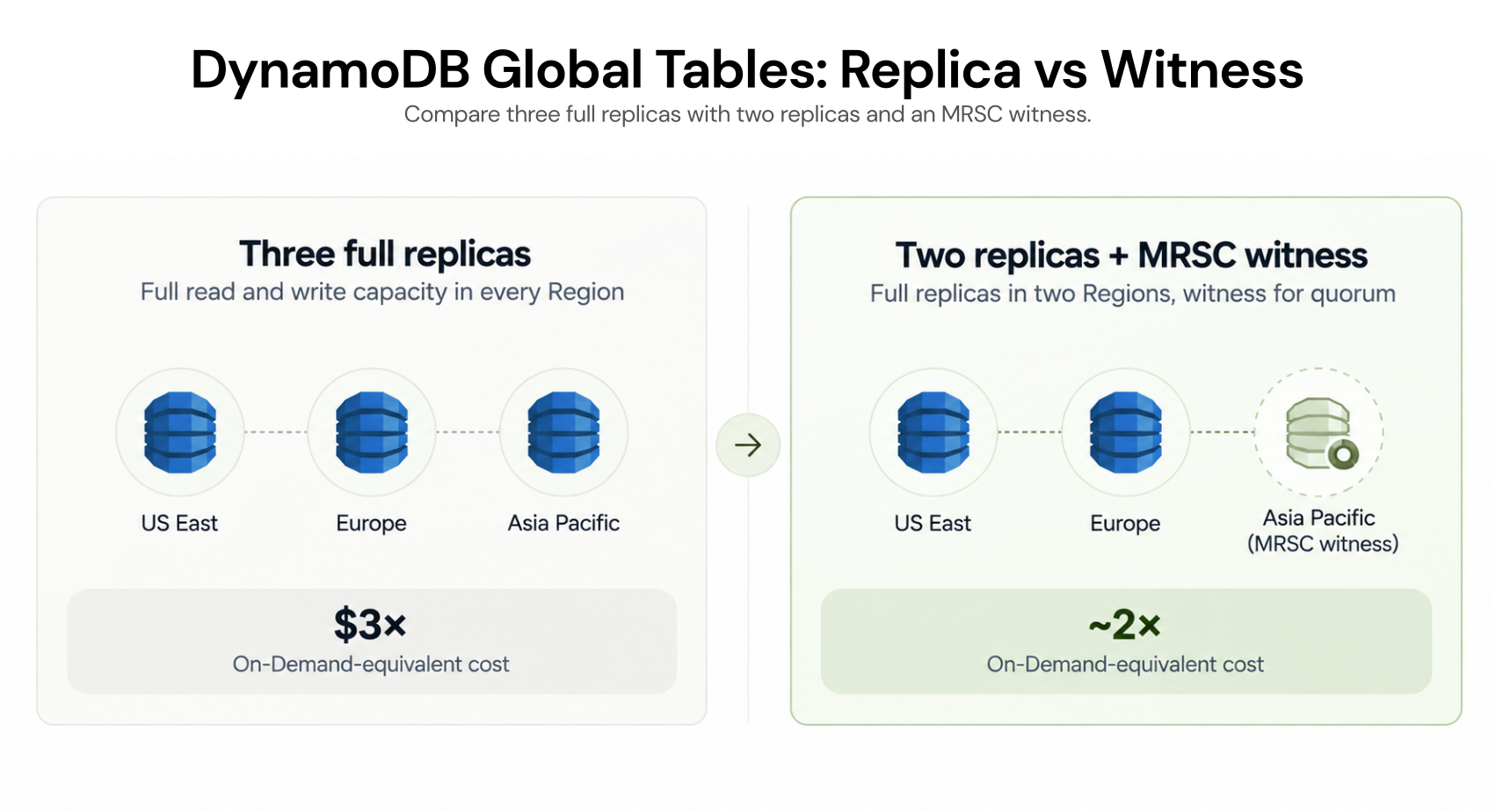
Witness regions: MRSC Global Tables can designate a witness region. Witnesses participate in the consistency protocol but do not store full replicas of the data. Critically, witnesses do not incur replicated write unit costs (rWCU/rWRU), storage costs, or data transfer costs for replication.
This means a three-region MRSC Global Table with two full replicas and one witness costs less than a three-region MREC table with three full replicas, because the witness region avoids storage and data transfer charges entirely.

How Do Global Secondary Indexes Multiply DynamoDB Global Tables Cost?
GSIs are the single largest hidden cost multiplier in a DynamoDB Global Tables deployment. Each GSI on a DynamoDB Global Table receives writes in every replica region, and those writes are billed as standard WRU/WCU, not the lower rWRU/rWCU rate.
Example: A two-region Global Table with 42.5 million writes/month and 3 GSIs (all projecting all attributes). GSI writes per region: 42.5M x 3 GSIs = 127.5M WRU per region. Total GSI writes across 2 regions: 255M WRU. GSI write cost: 255M x $1.25/M = $318.75/month (verify at aws.amazon.com/dynamodb/pricing — rates change).
Compare that to the replicated base table write cost of $53.13/month. The GSI write cost is 6x the base table replication cost. For teams running multiple GSIs on Global Tables, the GSIs likely dominate the bill.
Strategies to Reduce GSI Cost on Global Tables
Use KEYS_ONLY or INCLUDE projection instead of ALL. Projecting all attributes means every base table attribute change propagates to every GSI. Projecting only the key attributes or a specific attribute set reduces the write unit consumption per GSI update.
Consolidate GSIs where possible. If two GSIs serve overlapping query patterns, merging them into a single GSI with a composite sort key eliminates the duplicate write cost.
Consider single-table design patterns that reduce GSI count. In DynamoDB, overloading a single table with multiple entity types and using sparse GSIs can reduce the total number of indexes needed.
What Does a Three-Region AWS DynamoDB Global Table Cost?
Adding a third region to an AWS DynamoDB Global Table scales every cost dimension linearly except reads (which remain local). Here is the same 42.5M-write, 25 GB, one-GSI workload across three regions (US East, US West, EU West).
| Cost Component | 2-Region Cost | 3-Region Cost |
| Replicated Writes (rWRU) | $53.13 | $79.69 |
| GSI Writes (WRU) | $106.25 | $159.38 |
| Reads (RRU) | $10.63 | $10.63 |
| Storage (per region) | $12.50 (2 regions) | $18.75 (3 regions) |
| Cross-Region Transfer | $3.65 | $7.29 |
| Total | $186.16 | $275.74 |
Adding a third region increases the total bill by roughly 48%, from $186.16 to $275.74. The largest incremental cost comes from GSI writes ($53.13 additional), not from replicated writes ($26.56 additional). This pattern reinforces the finding that GSI design is the primary cost lever for Global Tables optimization.
How Should You Monitor and Optimize Global Tables Costs?
Set Up Per-Region CloudWatch Alarms
Create CloudWatch alarms on ConsumedWriteCapacityUnits and ReplicationLatency per replica region. ReplicationLatency tracks the time between a write in the source region and its appearance in the replica. Sustained high latency can indicate under-provisioned rWCU in provisioned mode or throttling in on-demand mode that leads to retry amplification and higher costs.
Use AWS Cost Explorer with Service-Level Filtering
Filter Cost Explorer by the DynamoDB service and group by usage type. Look for line items containing “rWCU” or “rWRU” to isolate Global Tables write costs from standard write costs. Data transfer costs appear under a separate “DataTransfer” usage type group.
Evaluate On-Demand vs. Provisioned for Each Region
Each replica region can use a different capacity mode. For a disaster recovery replica that receives only replicated writes (no direct application traffic), on-demand mode may be cheaper because you avoid paying for idle read capacity. The primary region with predictable traffic may benefit from provisioned mode with auto scaling.
Automating Commitment Purchasing for Eligible Components
While reserved capacity does not cover rWCU, the read capacity (RCU) and GSI write capacity (WCU) on a Global Table are eligible for reserved capacity discounts of 53% (1-year) to 73% (3-year). For read-heavy Global Tables with multiple GSIs, these components can represent over 60% of the total bill.
Usage.ai automates this purchasing decision through its Flex Reserved Instances product for DynamoDB. The platform continuously monitors your Global Tables read and GSI write capacity consumption patterns across all replica regions, then purchases reserved capacity blocks where the utilization justifies the commitment. Usage.ai refreshes its recommendations every 24 hours, catching capacity changes 3 days faster than AWS Cost Explorer’s 72+ hour refresh cycle. If a reservation becomes underutilized because your workload shifted, Usage.ai provides cashback and credits on the unused portion. The fee is a percentage of realized savings only: zero savings means zero cost.
Also read: DynamoDB DAX Pricing: In-Memory Cache Cost vs Performance Gain
When Do DynamoDB Global Tables Stop Being Worth the Cost?
DynamoDB Global Tables are a cost multiplier by design: replication means paying for writes, storage, and transfer in every region. The decision to use them should be driven by quantifiable business requirements, not default architecture. Before enabling any DynamoDB Global Table, calculate the full five-dimension cost and compare it against the revenue at risk from regional unavailability.
Use Global Tables When
Your application requires sub-100ms read latency from multiple geographic locations. Your regulatory or compliance environment mandates data residency in specific regions with active access. Your RPO (Recovery Point Objective) for disaster recovery is near zero: Global Tables replicate asynchronously with typical lag under one second for MREC, and offer strongly consistent reads across regions with MRSC.
Reconsider Global Tables When
Your multi-region need is read-only DR: a cross-region read replica or periodic DynamoDB backup-to-S3 with cross-region copy costs far less than a full Global Table.
Your write volume exceeds 100 million/month with multiple GSIs: at this scale, the GSI write multiplier on Global Tables can produce bills where alternative architectures (application-level replication, Aurora Global Database for relational portions) may be cheaper. Your cost per region exceeds the business value of availability in that region: if a replica serves less than 10% of traffic, the full replication cost for that region may not justify the availability benefit.
Frequently Asked Questions
1. How much does DynamoDB Global Tables cost?
Global Tables cost depends on five components: replicated writes (rWCU/rWRU charged in every replica region), storage (billed per region), cross-region data transfer ($0.09/GB), GSI writes (standard WCU/WRU rates in each region), and a one-time table restore charge ($0.15/GB) when adding replicas. After the November 2024 price cut, replicated writes match standard single-region write pricing (verify at aws.amazon.com/dynamodb/pricing — rates change).
2. Are replicated write units priced differently from standard write units?
No, not since November 2024. Replicated write units (rWCU and rWRU) are now priced identically to standard single-region write units (WCU and WRU). The difference is billing scope: rWCU/rWRU are charged in every region containing a replica table, while standard WCU/WRU are charged only in the region where the write occurs.
3. Can you purchase reserved capacity for Global Tables writes?
No. AWS does not allow reserved capacity purchases for replicated write capacity units (rWCU). Reserved capacity applies only to standard single-region WCU and RCU on DynamoDB Standard table class tables. Database Savings Plans (launched December 2025) are the only commitment-based discount that covers rWCU/rWRU, offering 12-18% savings.
4. What is DynamoDB Global Tables multi-region strong consistency?
Multi-Region Strong Consistency (MRSC) is a Global Tables mode that enables strongly consistent reads from any replica region. MRSC tables can also designate a witness region that participates in the consistency protocol without storing a full data replica, which reduces costs by eliminating storage, rWCU, and transfer charges for the witness.
5. How does adding a third region affect Global Tables cost?
Adding a third region increases replicated write costs by approximately 50% (from 2x to 3x the per-region charge), storage costs by 50% (from 2 to 3 region copies), and cross-region data transfer proportionally. In our worked example, a three-region table costs $275.74/month versus $186.16 for two regions, a 48% increase.
6. Do Global Secondary Indexes cost more on Global Tables?
Yes. GSI write updates on Global Tables are billed as standard write units (WCU/WRU), not replicated units (rWCU/rWRU). Since the standard on-demand WRU rate ($1.25/M) is double the rWRU rate ($0.625/M), and GSI updates occur in every replica region, GSIs are frequently the largest single cost component on a Global Tables deployment.
7. What is the cheapest DynamoDB Global Tables region pair?
US East (N. Virginia) paired with US West (Oregon) is the cheapest two-region Global Tables configuration, as both regions have the lowest DynamoDB pricing tier ($0.25/GB storage, $0.625/M rWRU on-demand). Cross-region data transfer between US regions costs $0.09/GB (verify at aws.amazon.com/dynamodb/pricing — rates change). Pairing with Asia Pacific or South America regions increases per-unit costs by 10-50%.
8. Is DynamoDB Global Tables cheaper than DynamoDB with application-level replication?
For most workloads, yes. Global Tables handle replication automatically with conflict resolution and no additional infrastructure. Application-level replication requires Lambda functions, DynamoDB Streams consumers, and cross-region API calls, which collectively cost more in compute and operational overhead for write volumes above approximately 10 million/month. Below that threshold, a simple Streams-to-Lambda replication pattern may be cheaper.