.png)


Most “cloud cost management” comparisons lump every tool into the same category, then compare them on feature checklists. That produces useless verdicts.
Usage.ai and Vantage are not the same type of tool. Comparing them requires separating two different jobs: seeing your cloud costs clearly, versus structurally reducing them without taking on financial risk. This post covers both dimensions precisely, so you can make an accurate buying decision.
Both platforms are legitimate. Neither is the right answer for every team. This post will tell you which one is right for you.
What Is Usage.ai?
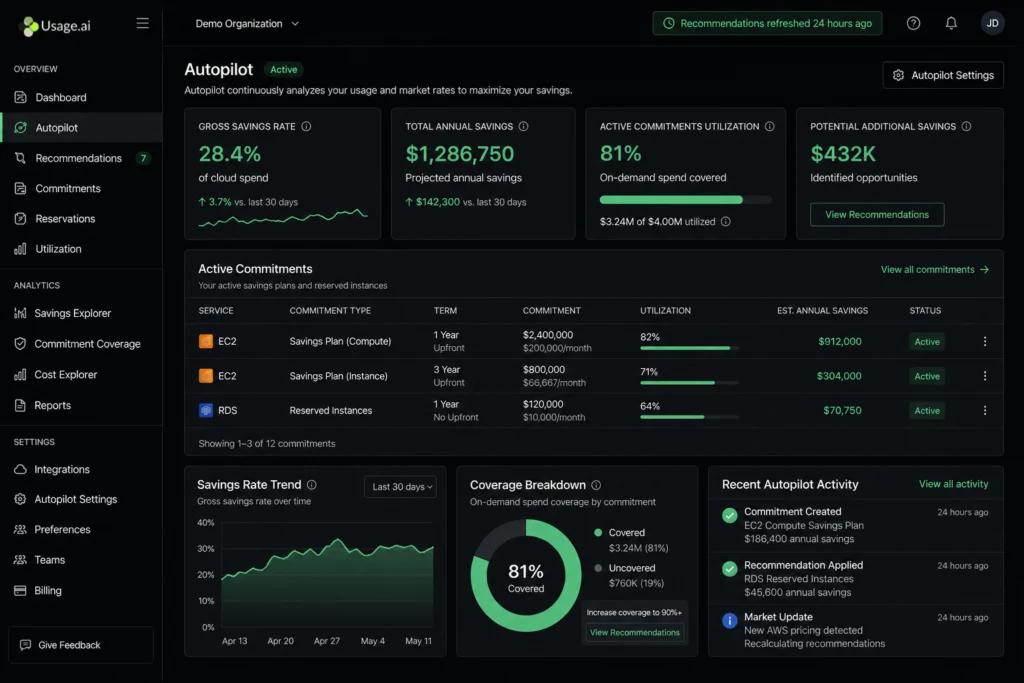
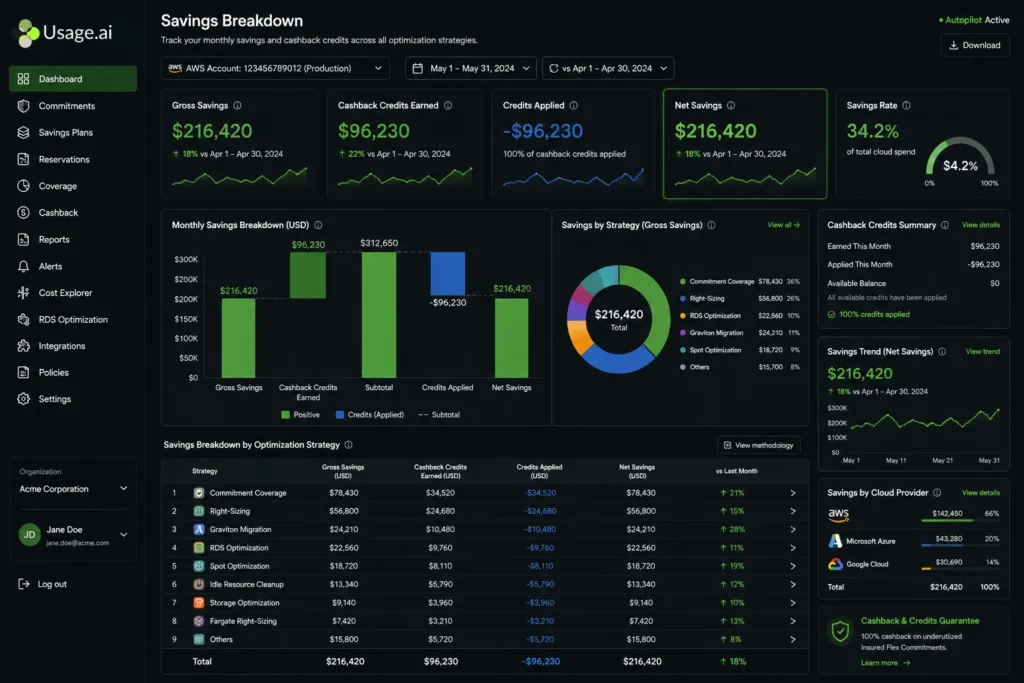
Usage.ai is a cloud commitment automation and cashback-insured savings platform. It purchases cloud commitments (Savings Plans, Reserved Instances, and Committed Use Discounts) on behalf of customers across AWS, GCP, and Azure, then insures those commitments with a buyback guarantee. If any commitment goes underutilized, Usage.ai returns the value as cashback in real money, not credits.
- Saves 30-50% on cloud spend
- Supported clouds: AWS, GCP, Azure
- Fee model: percentage of realized savings only. Zero fee if Usage.ai saves nothing
- 30-minute setup, billing-layer access only, zero infrastructure changes
- The only platform offering both cashback and credits on underutilized commitments
AWS product suite (managed by Usage.ai, $0 upfront, full buyback guarantee):
| Product | Covers | Saves |
| Usage Flex Savings Plan | EC2, Fargate, Lambda | 40-60% |
| Usage Flex DB Savings Plan | RDS, ElastiCache, DocumentDB | 20-35% |
| Usage Flex Reserved Instances | RDS, ElastiCache, OpenSearch, Redshift, DynamoDB | 30-40% |
GCP product suite
| Product | Covers | Saves |
| Usage Flex Compute Engine CUD | Compute Engine VMs, GKE, Cloud Run, Sole-tenant nodes | 28-46% |
| Usage Flex GKE Autopilot CUD | GKE Autopilot clusters, GKE Standard resources | 20-46% |
| Usage Flex Cloud SQL CUD | Cloud SQL PostgreSQL, MySQL, SQL Server | 25-52% |
Azure commitment automation is also supported (VM, Dedicated Hosts, App Service). See how Usage AI works.
What Is Vantage?
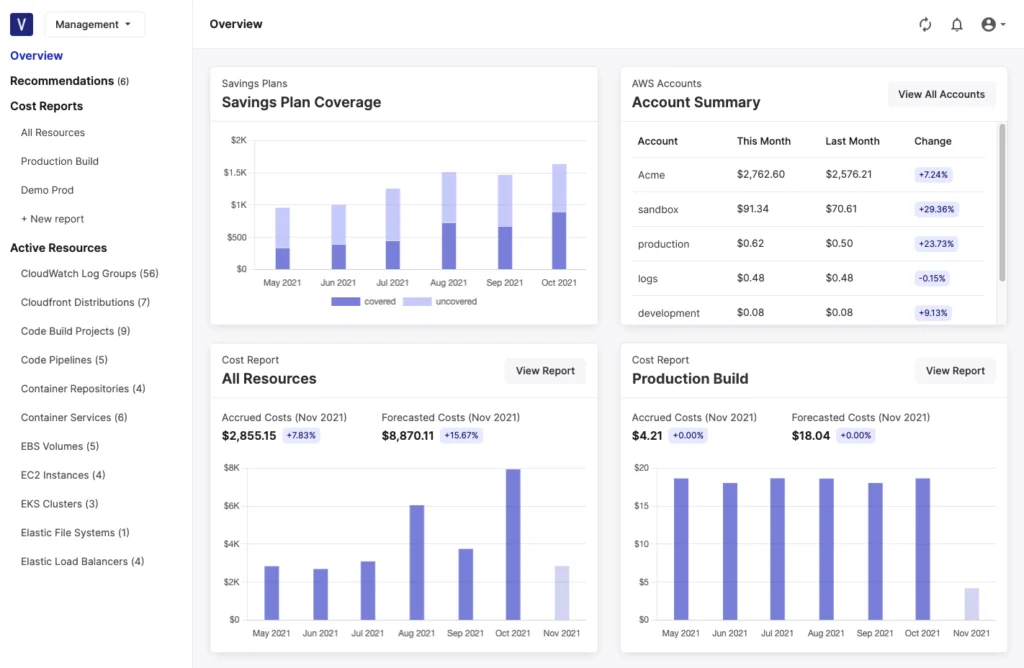
Vantage is a self-service cloud cost visibility and management platform. Its primary value is showing teams where their cloud money is going across 25+ providers, allocating costs to teams and services, and surfacing optimization recommendations.
Verified facts from Vantage’s website:
- Founded 2020, New York, backed by Andreessen Horowitz and Scale Venture Partners
- Supports AWS, Azure, GCP, Kubernetes, Datadog, Snowflake, OpenAI, Anthropic, and 25+ total providers
- Autopilot for AWS Savings Plans: automates SP purchases on EC2, Fargate, Lambda. Fee: 5% of savings realized
- Autopilot is AWS-only. No automated purchasing for Azure RIs or GCP Committed Use Discounts
- Platform pricing: Free (Starter), $30/month (Pro), $200/month (Business), Custom (Enterprise)
- Autopilot fee charged separately at 5% of savings, on top of the subscription
- Downside protection on commitments: AWS 7-day return policy only. No buyback guarantee beyond that window
- FinOps Agent launched May 5, 2026: AI-driven cost analysis inside the console
- Kubernetes cost attribution via the Vantage K8s Agent (requires in-cluster deployment)
Side-by-Side Comparison: Usage.ai vs Vantage
| Dimension | Usage.ai | Vantage |
| Primary purpose | Commitment automation + cashback insurance | Cost visibility + reporting + optimization recommendations |
| Clouds supported (visibility) | AWS, GCP, Azure | AWS, GCP, Azure, Kubernetes, 25+ SaaS providers |
| Commitment automation: AWS | Yes. EC2, Fargate, Lambda (SPs) + RDS, ElastiCache, OpenSearch, Redshift, DynamoDB (RIs) | Yes. EC2, Fargate, Lambda (Compute SPs only). RI management discontinued August 2024 |
| Commitment automation: GCP | Yes. Compute Engine CUDs, GKE CUDs, Cloud SQL CUDs | Recommendations only. No automated GCP CUD purchases |
| Commitment automation: Azure | Yes. VM, Dedicated Hosts, App Service | Recommendations only. No automated Azure RI purchases |
| Downside protection | Buyback guarantee. Cashback in real money on any underutilized commitment. Cancel anytime. | AWS 7-day return window only. No buyback guarantee. Standard AWS SP lock-in beyond 7 days |
| Lock-in | No multi-year lock-in. Quarterly adjustments. Cancel anytime | Standard AWS 1-year or 3-year SP terms. Vantage platform subscription cancellable monthly |
| Fee model | % of realized savings only. Zero fee if nothing saved | Monthly subscription ($30-$200+) regardless of savings, plus 5% of Autopilot savings |
| Upfront cost | $0 always | $0 upfront for SPs. Monthly subscription billed regardless |
| Setup time | 30 minutes. Billing-layer access only | Not specified for Autopilot. Platform setup varies |
| Kubernetes cost attribution | Not a stated core feature | Yes. Vantage K8s Agent: namespace and label-level breakdown |
| Cost allocation and tagging | Billing-layer cost tracking | Yes. Virtual tagging, showback, chargeback automation |
| FinOps Agent / AI assistance | Not a stated core feature (verify at usage.ai) | Yes. Launched May 2026. In-console AI chat for cost analysis |
| Anomaly detection | Not a stated core feature | Yes. Core Vantage feature |
| Rightsizing recommendations | Not a stated core feature | Yes. Compute rightsizing recommendations included |
| API and Terraform | Yes. API access available | Yes. Full API, Terraform provider, MCP server |
| Recommendation refresh | 24-hour refresh cycle | Daily profiling for Autopilot |
| SOC 2 compliance | Not confirmed from project docs (verify at usage.ai) | Yes. SOC 1 and SOC 2 certified |
Commitment Protection: The Dimension Every Comparison Ignores
This is the most financially consequential difference between these two platforms.
When a team buys AWS Savings Plans, they are making a financial commitment that lasts 1-3 years. If their compute usage drops after the purchase, the unused portion of the SP still gets charged. The team absorbs the loss.
Here is exactly how each platform handles that risk:
Vantage Autopilot: Purchases standard AWS Compute Savings Plans with 1-year or 3-year terms. If a purchased SP goes underutilized, Vantage can request a return under AWS’s 7-day return policy, specifically for SPs with an hourly commitment of $100 or less, purchased within the last 7 days and in the same calendar month. Once the calendar month ends, those commitments cannot be returned. No additional protection exists.
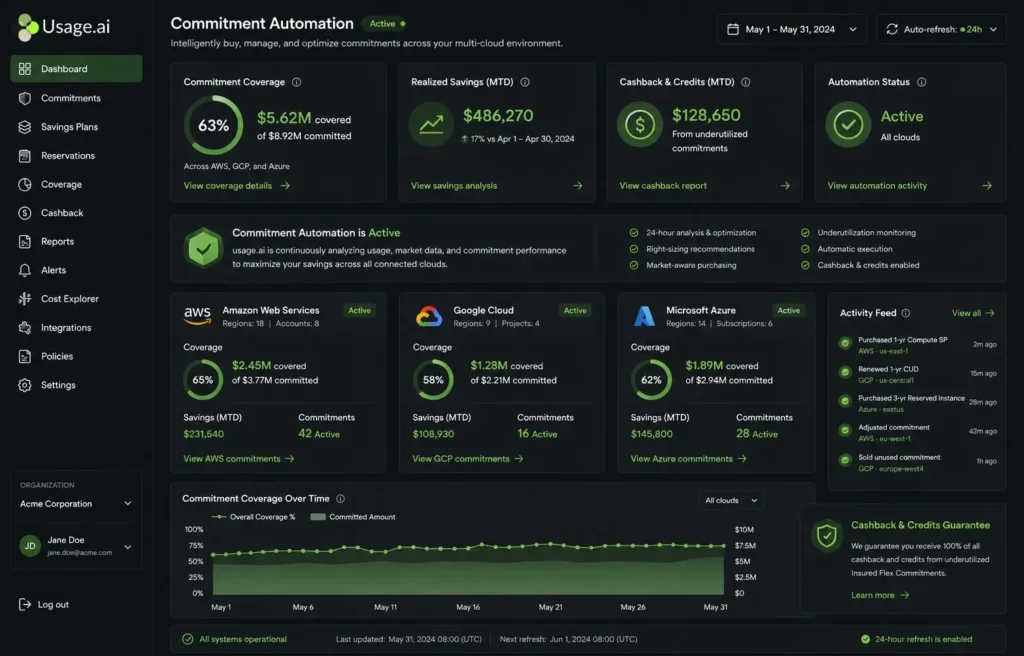
Usage.ai Insured Flex Commitments: Every commitment purchased through Usage.ai carries a buyback guarantee. If a commitment goes underutilized at any point, Usage.ai buys it back and returns the value as cashback in real money, not credits. This applies across AWS, GCP, and Azure. Commitments adjust quarterly. Teams can cancel anytime.
Citable definition: An Insured Flex Commitment is an SP/RI-equivalent discount structure that delivers savings of 30-60% without requiring multi-year lock-in or upfront payment. Every commitment is fully insured. Underutilized portions are returned as cashback (real money), not credits.
For a company running $500K/month in compute, a 10% demand drop after a 1-year SP purchase creates $600K in waste exposure over the commitment term. Vantage has a 7-day window to catch it. Usage.ai has a buyback guarantee that covers it indefinitely.
Usage.ai Insured Flex Commitments carry no multi-year lock-in. Commitments adjust quarterly. Scale down? No penalty. Underutilized? Cashback paid in real money, not credits.
Pricing: Which Model Works for Your Team?
Pricing is where the two platforms take fundamentally different approaches.
Usage.ai pricing:
- Zero fee if Usage.ai saves nothing
- Fee charged as a percentage of realized savings only
- $0 upfront, always
- No baseline subscription cost
This means Usage.ai’s cost is entirely contingent on whether savings are actually delivered. A team that sees no savings in a given month pays nothing.
Vantage pricing (verified from vantage pricing, May 2026):
- Starter: Free (tracks up to $2,500 cloud spend)
- Pro: $30/month (tracks up to $7,500 cloud spend)
- Business: $200/month (tracks up to $20,000 cloud spend)
- Enterprise: Custom pricing, unlimited tracked spend
- Autopilot fee: 5% of savings realized, charged separately on top of the subscription
A team on the Business plan paying $200/month who generates $5,000/month in Autopilot savings would pay $200 (subscription) + $250 (5% Autopilot fee) = $450/month, regardless of whether the savings materialize as expected.
Both Autopilot and Usage.ai charge 5% of savings for their AWS commitment automation. The structural difference is Usage.ai has no baseline subscription cost, while Vantage charges a fixed monthly fee regardless of savings outcome.
For teams with $50K+/month in cloud spend, the subscription cost becomes negligible relative to savings. For smaller teams or teams in usage-volatile periods, Usage.ai’s zero-baseline model is lower risk.
Multi-Cloud Commitment Automation: A Critical Distinction
This is the dimension that most comparisons get wrong by omission.
Vantage is genuinely multi-cloud for cost visibility. It shows AWS, GCP, Azure, and 25+ SaaS provider costs in one dashboard. That is a real and valuable capability.
But Vantage’s Autopilot, the only feature that actually purchases and manages commitments, is AWS-only. The feature page is named “Autopilot for AWS Savings Plans.” The documentation lists only AWS Compute Savings Plans as purchasable through Autopilot. For GCP and Azure, Vantage provides recommendations that teams must execute manually.
Usage.ai automates commitment purchases across all three major clouds:
- AWS: Savings Plans and Reserved Instances across compute and database services
- GCP: Committed Use Discounts for Compute Engine, GKE, and Cloud SQL
- Azure: VM commitments, Dedicated Hosts, App Service
For a multi-cloud engineering team running $300K/month across AWS, GCP, and Azure, Vantage automates the AWS portion. Usage.ai automates all three. That gap translates directly into uncaptured savings on GCP and Azure.
Where Vantage Wins: Honest Assessment
Vantage has genuine strengths that Usage.ai does not match. Any fair comparison has to acknowledge them.
Cost visibility breadth. Vantage supports 25+ provider integrations including Snowflake, Datadog, OpenAI, Anthropic, MongoDB, Databricks, and others. Usage.ai focuses on the three major cloud providers. For teams that want unified cost visibility across their entire infrastructure stack (cloud plus SaaS plus AI APIs), Vantage is the right tool.
Kubernetes cost attribution. Vantage’s K8s Agent provides namespace- and label-level cost breakdown for Kubernetes workloads. If your Kubernetes spend is a significant line item and you need pod-level attribution, Vantage delivers that. Usage.ai does not have an equivalent stated capability.
FinOps reporting and chargeback. Virtual tagging, showback reporting, chargeback automation, financial commitment reports, and unit cost analysis are all core Vantage features. Teams building an internal FinOps practice with multi-team accountability need these. Usage.ai is not a FinOps reporting platform.
Anomaly detection. Vantage has dedicated anomaly detection with configurable alerts. Usage.ai’s focus is commitment management, not spend anomaly monitoring.
FinOps Agent. Vantage launched an in-console AI assistant in May 2026 that can answer cost questions in plain language, create reports, and investigate anomalies. It is a genuine product innovation. Usage.ai does not have a comparable feature.
Developer tooling. Vantage has a Terraform provider, a full API, and an MCP server for AI tool integration. Teams that manage infrastructure as code and want FinOps tooling embedded in their workflow will find Vantage more developer-native.
Also read: Best Cloud Cost Optimization Tools 2026: A Decision Guide That Fits Your Situation
Where Usage.ai Wins: Honest Assessment
Commitment breadth on AWS. Vantage Autopilot purchases Compute Savings Plans for EC2, Fargate, and Lambda. Usage.ai covers those plus RDS, ElastiCache, DocumentDB, OpenSearch, Redshift, and DynamoDB through its DB Savings Plan and Reserved Instance products. A team spending heavily on RDS or Redshift gets automated optimization from Usage.ai and a recommendation-only experience from Vantage.
GCP and Azure commitment automation. Vantage recommends GCP CUDs and Azure RIs. Usage.ai purchases them automatically, with the same buyback guarantee as AWS. For multi-cloud teams, this is a material difference in realized savings.
Downside protection. The buyback guarantee is a structural product differentiator that Vantage does not match. Vantage’s 7-day return window is the only protection against usage drops. For teams with variable workloads, seasonal demand, or growth uncertainty, Usage.ai’s quarterly adjustment cycle and cancel-anytime guarantee eliminate the primary risk of commitment purchasing.
Fee model alignment. Usage.ai’s fee is 100% contingent on savings. There is no cost in months where savings do not materialize. Vantage charges a subscription regardless. For finance teams modeling software ROI, Usage.ai’s model is easier to justify because it is structurally risk-free.
Speed to full coverage. Usage.ai claims full commitment coverage in 60 days versus the 6-9 month industry standard. Vantage does not publish an equivalent coverage timeline claim.
Total savings delivered. $91M+ in verified savings across 300+ enterprise customers is a scale signal. Vantage does not publish an equivalent aggregate savings figure.
Decision Tree: Which Platform Is Right for You?
Work through this in order. The first branch that fits your situation is your answer.
Start here: What is your primary goal?
If your primary goal is understanding where your cloud money goes across AWS, GCP, Azure, Kubernetes, Snowflake, Datadog, and SaaS tools in one dashboard, go to Branch A.
If your primary goal is reducing the actual cloud bill by automating commitment purchasing with zero financial risk, go to Branch B.
Branch A: Cost Visibility
Do you need pod-level Kubernetes cost attribution?
- Yes: Vantage wins. The K8s Agent delivers namespace-level breakdown. Usage.ai does not match this.
- No: Continue.
Do you need chargeback, showback, and virtual tagging across multiple internal teams?
- Yes: Vantage wins. These are core Vantage capabilities.
- No: Continue.
Do you need AI-driven cost analysis via plain-language queries?
- Yes: Vantage FinOps Agent (launched May 2026) covers this.
- No: Native cloud tools (AWS Cost Explorer, GCP Billing, Azure Cost Management) may be sufficient at your scale.
Branch B: Commitment Automation and Protection
Are you primarily on AWS with stable, predictable workloads?
- Yes: Both Vantage Autopilot and Usage.ai will serve you. Evaluate on fee model fit and whether the baseline Vantage subscription cost is acceptable. Note: Usage.ai covers 8 additional AWS services that Vantage Autopilot does not.
Are you running significant spend on GCP or Azure that you want automated?
- Yes: Usage.ai is the right choice. Vantage does not automate GCP CUD or Azure RI purchases.
Do you have variable or seasonal workloads where usage could drop after commitment purchase?
- Yes: Usage.ai wins. The buyback guarantee and quarterly adjustment cycle structurally protect against overcommitment. Vantage’s 7-day return window does not cover this scenario.
Are you a multi-cloud team that needs both comprehensive visibility AND commitment automation?
- Consider both platforms serving different jobs: Vantage for the FinOps reporting layer, Usage.ai for the commitment automation and protection layer. They are not mutually exclusive.
Real-World Use Cases: Who Uses Each Platform
Usage.ai is typically chosen by: Teams whose primary mandate is reducing the cloud bill with the lowest possible financial risk. FinOps leads who need to justify commitment purchasing to a CFO without taking on balance-sheet exposure. Multi-cloud companies that want automated optimization across AWS, GCP, and Azure rather than AWS-only automation with manual follow-up on the other clouds. Companies with variable or high-growth workloads where demand shifts make standard SP lock-in risky.
Vantage is typically chosen by: Engineering-led teams that want self-serve cost visibility across every service they use, not just the big three clouds. FinOps practitioners building internal accountability practices with chargeback, showback, and tag enforcement. Multi-cloud organizations with Kubernetes workloads needing pod-level cost attribution. Teams that want to embed cost management into their engineering workflow via Terraform and API.
Frequently Asked Questions
1. Does Vantage automate commitment purchasing on GCP and Azure?
No. Vantage’s Autopilot feature, which handles automated commitment purchases, covers AWS Compute Savings Plans only (EC2, Fargate, Lambda). For GCP Committed Use Discounts and Azure Reserved Instances, Vantage provides recommendations that engineering or FinOps teams must execute manually. Vantage’s cost visibility integrates all three clouds, but automated purchasing is AWS-exclusive.
2. What happens with Vantage Autopilot if my usage drops after a Savings Plan is purchased?
Vantage can request a return under AWS’s 7-day return policy for Savings Plans with an hourly commitment of $100 or less, purchased in the last 7 days and in the same calendar month. Once the calendar month ends, those commitments cannot be returned and standard AWS lock-in applies. Vantage does not offer a buyback guarantee beyond this AWS-native return window.
3. What is the Usage.ai buyback guarantee?
The buyback guarantee means that if any commitment purchased through Usage.ai goes underutilized, Usage.ai buys it back and returns the value as cashback in real money, not credits. This applies across AWS, GCP, and Azure. Commitments also adjust quarterly, so if usage patterns shift, the commitment level adjusts with no financial penalty. This structure eliminates the primary financial risk of commitment purchasing.
4. Which platform charges more?
Vantage charges a monthly subscription ($30-$200/month on standard plans, custom at Enterprise) plus 5% of Autopilot savings. Usage.ai charges a percentage of realized savings only with zero baseline subscription. For a team generating $10,000/month in savings from commitment automation, both platforms charge approximately $500/month in savings-contingent fees. Vantage adds $30-$200/month on top. The breakeven comparison changes at very high savings volumes. Always get current pricing from both vendors.
5. Does Usage.ai help with cost visibility and reporting beyond commitments?
Usage.ai provides multi-org reporting, showback support, summary reports, and dashboards at the billing layer. It is not a cost visibility platform comparable to Vantage’s scope (25+ integrations, virtual tagging, anomaly detection, Kubernetes attribution). If deep cost visibility across every service and team is a primary requirement alongside commitment automation, evaluate whether both tools serving distinct roles makes sense for your organization.
6. Is Usage.ai or Vantage better for a small startup?
For a startup spending under $50K/month, both tools add value at different thresholds. Vantage’s free Starter tier provides cost visibility up to $2,500 in tracked spend with no commitment. Usage.ai’s zero-fee model means zero cost unless it generates savings, making it risk-free to try at any spend level. For early-stage startups primarily on AWS with predictable workloads, Vantage Autopilot’s Pro tier at $30/month is an accessible starting point. For startups on multi-cloud or with variable workloads, Usage.ai’s commitment protection model adds more value even at smaller scale.
7. Can I use both Usage.ai and Vantage at the same time?
Yes. They are not mutually exclusive. Usage.ai operates at the billing layer to manage commitment purchasing across AWS, GCP, and Azure. Vantage provides cost visibility, allocation, reporting, and anomaly detection across those same clouds plus 25+ additional providers. Teams that want both comprehensive visibility and insured commitment automation can run both. There is no technical conflict since Usage.ai requires billing-layer access only and makes no infrastructure changes.