
 AWS
 Microsoft Azure
 Google Cloud

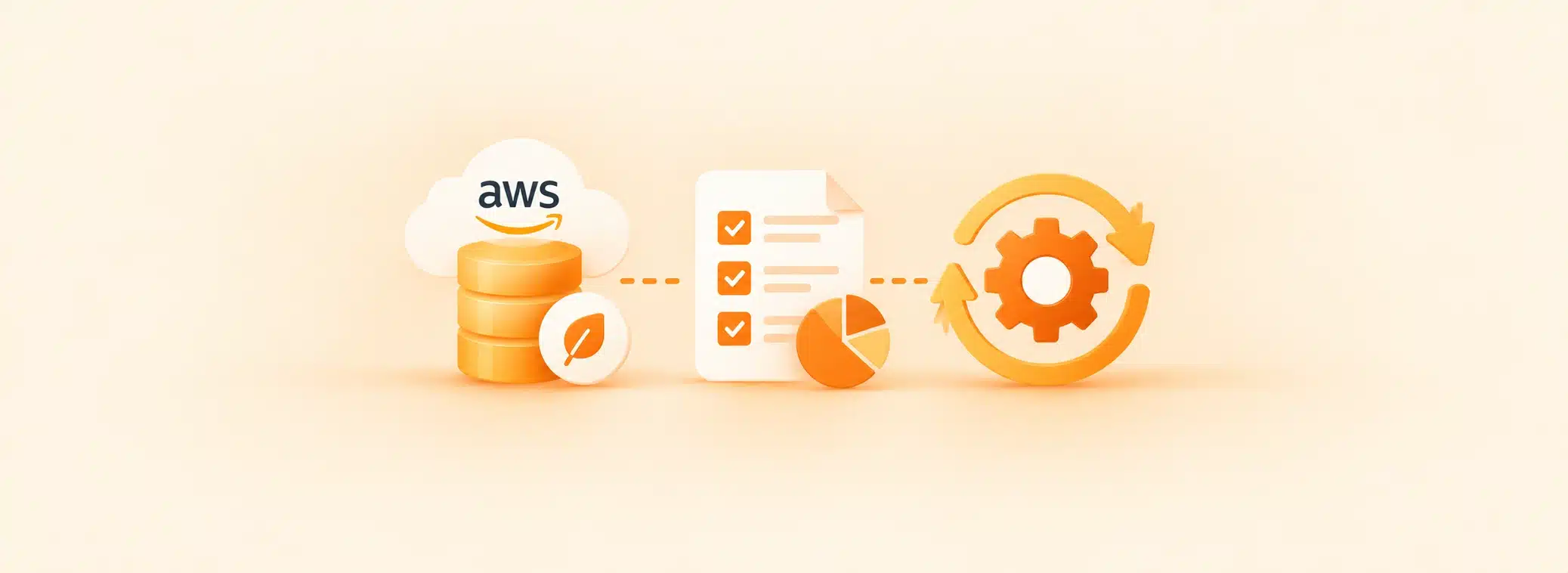
We now automate the DSP lifecycle across all 10 eligible services, including analysis, sizing, approved purchase, monitoring, and eligible Flex Commitment protection.
We started working on DSP support when AWS announced Database Savings Plans at re:Invent 2025. In January 2026, we shipped initial support for RDS, Aurora, and ElastiCache for Valkey. That coverage is now complete.
Why Database Savings Plans matter
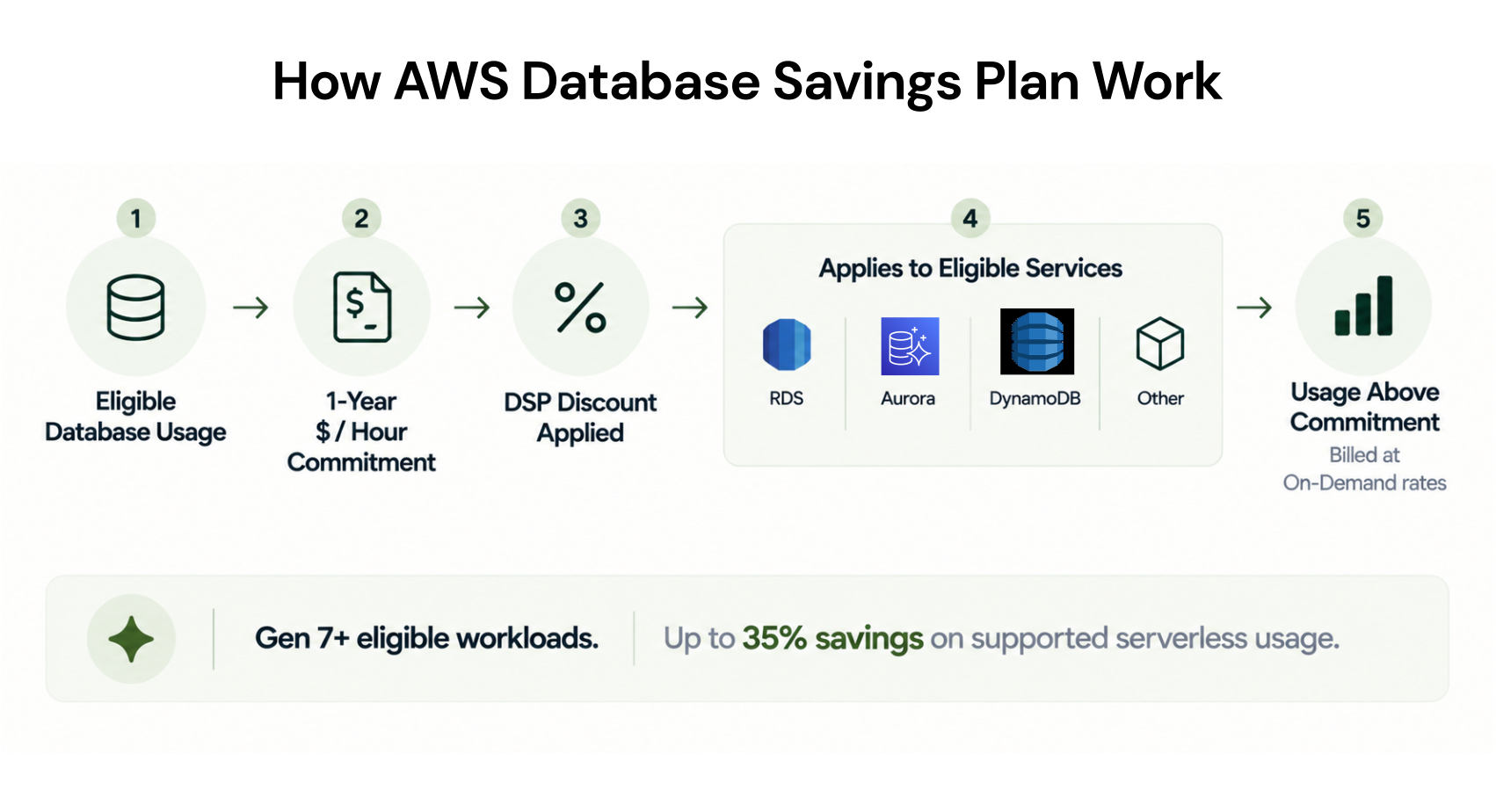
AWS Database Savings Plans are a one-year, No Upfront commitment to a consistent amount of eligible database usage measured in dollars per hour. AWS automatically applies discounted rates to eligible usage up to the commitment, while usage beyond it remains at On-Demand rates. See AWS Database Savings Plans pricingAWS publishes savings of up to 35% for supported serverless usage and up to 20% for provisioned instances across supported database services. DynamoDB and Keyspaces use different throughput discount ceilings: up to 18% for on-demand throughput and up to 12% for provisioned throughput.
The model is more flexible than service-specific reservations because the discount can follow eligible usage across supported engines, instance families, sizes, deployment options, services, and regions. AWS added Amazon OpenSearch Service and Neptune Analytics to the program on March 5, 2026. Read AWS’s March 5 expansion announcement
For the broader pricing and eligibility framework, see our AWS Database Savings Plans complete guide. For how DSP fits with other commitment types, see our AWS Savings Plans guide.
Before DSP, many managed database discounts depended on service-specific reservations. RDS Reserved Instances can provide stronger economics for stable workloads, but they are more configuration-specific.
Size flexibility exists for several RDS engines within the same instance family, so a resize does not always eliminate RI benefit. AWS currently publishes RDS RI savings of up to 69% for steady-state workloads.
| Factor | Reserved Instances | Database Savings Plans |
|---|---|---|
| Commitment basis | Matching reservation attributes for a specific service | Consistent eligible usage in $/hour |
| Term | Typically 1 or 3 years, depending on service | 1 year |
| Payment options | Vary by reservation product | No Upfront |
| Published maximums | RDS RIs can save up to 69% | Up to 35% for supported serverless; up to 20% for provisioned RDS/Aurora |
| Flexibility | More service, configuration, and Region constraints | Can follow eligible usage across supported services, sizes, deployment types, and Regions |
| Best fit | Stable workloads where a matching reservation has stronger economics | Modern, changing estates with eligible Gen 7+ or serverless usage |
Do you qualify for DSP?
Use this fast qualification check before reviewing the service list:Provisioned instances: Are they Generation 7 or newer?
Serverless: Is the specific serverless offering listed as DSP eligible by AWS?
ElastiCache: Is the engine Valkey? Redis OSS and Memcached are outside DSP coverage.
Timestream: Is the workload Timestream for InfluxDB?
Existing coverage: Is the workload already covered by an RI or DynamoDB reserved capacity?
RDS for SQL Server: Have Windows Server and SQL Server licensing charges been excluded?
Other charges: Have storage and ancillary charges been checked against the current AWS eligibility table instead of assumed eligible?
Coverage across 10 eligible services
Here is what we currently cover.Amazon RDS Eligible: Generation 7 and newer provisioned DB instances. Older generations can still be candidates for RDS Reserved Instances. See our RDS Reserved Instances guide for the alternative commitment path.
Amazon Aurora Eligible: Generation 7 and newer provisioned instances, Aurora Serverless v2, and Aurora DSQL. Provisioned Aurora can receive up to 20% DSP savings, while supported serverless usage can reach higher published DSP rates.
Amazon DynamoDB Eligible: on-demand and provisioned throughput. AWS publishes up to 18% for on-demand throughput and up to 12% for provisioned throughput. DSP and reserved capacity cannot discount the same workload simultaneously.
Amazon ElastiCache Eligible: Valkey provisioned instances and ElastiCache Serverless for Valkey. Redis OSS and Memcached are not DSP eligible. Our ElastiCache Serverless pricing guide explains the wider cost model.
Amazon DocumentDB Eligible: Generation 7 and newer provisioned instances and DocumentDB Serverless.
Amazon Neptune Eligible: Generation 7 and newer provisioned instances, Neptune Serverless, and Neptune Analytics. Neptune Analytics joined DSP on March 5, 2026. See our Neptune pricing guide for the three deployment models.
Amazon Keyspaces Eligible: on-demand and provisioned throughput. AWS publishes up to 18% and 12%, respectively. Our Keyspaces pricing guide covers throughput, storage, backups, and other billing dimensions.
Amazon Timestream Eligible: Timestream for InfluxDB instances.
Amazon OpenSearch Service Eligible: Generation 7 and newer provisioned usage plus OpenSearch Serverless. OpenSearch Service joined DSP on March 5, 2026.
AWS Database Migration Service Eligible: Generation 7 and newer replication instances and DMS Serverless. Size commitments around durable replication usage rather than a temporary migration that will disappear during the one-year term.
How we automate DSP
The operational challenge is separating eligible spend from ineligible or already-covered spend, choosing a durable commitment level, and monitoring that position as the estate changes.Analysis. We use Cost and Usage Report data to identify DSP-eligible usage and separate older instance generations, non-Valkey ElastiCache usage, existing reservation coverage, and other ineligible charges.
Commitment sizing. We analyze the past 60 days of historical usage to estimate the durable hourly floor. AWS Purchase Analyzer also supports lookback periods within the previous 60 days, making that period useful for comparing custom purchase scenarios.
Purchase. After approval, we call the relevant AWS API to purchase the commitment and manage eligible recommendations through our Flex Insured Commitment Program.
Monitoring. We monitor DSP utilization on a 24-hour refresh cycle so changes in the managed commitment position can be reviewed as usage evolves.
Cashback protection. For eligible Flex Commitments, if the commitment costs more than equivalent On-Demand usage, we calculate that loss monthly. The applicable cashback accrues to the account and is paid 90 days after accrual, subject to current program eligibility and terms. See how Usage.ai cashback works
Our fee is performance-based: we charge a percentage of realized savings from eligible Flex Commitments.
Size the commitment conservatively
A DSP should be sized against the optimized, durable baseline, not the current peak bill.Right-size first. Reduce oversized resources before calculating the commitment.
Plan migrations. Model upcoming moves from older generations to Gen 7+ before assuming that spend is DSP eligible.
Remove excluded spend. Separate licensing, non-covered engines, existing reservation coverage, and other ineligible charges.
Find the hourly floor. Review nights, weekends, seasonal lows, and known workload changes. Commit to the stable portion, not the peak.
Suppose your modeled DSP-eligible usage across RDS, Aurora, and DynamoDB reaches $4.20 per hour at busy times but the stable eligible baseline is $2.80 per hour.
Illustrative annual commitment:
Account sharing changes the math
Savings Plans benefits can apply across accounts in an AWS Organizations consolidated billing family when sharing is enabled. AWS also allows Cost Categories to group accounts and prioritize or restrict discount applications within those groups.For FinOps teams, that means commitment sizing and chargeback should be evaluated at the relevant payer, account, or cost-category scope. Treating each linked account as isolated can misstate both the available baseline and who ultimately receives the discount.
DSP or Reserved Instances?
Use these five questions before choosing a commitment path:Is the workload Gen 7+ or an eligible serverless or throughput-based offering?
Is the baseline stable enough for a one-year hourly commitment?
Would a matching one-year or three-year RI produce better economics for a very stable workload?
Is a resize, engine migration, service change, or Region move likely during the term?
Is existing RI or reserved-capacity coverage already absorbing part of the workload?
Identify eligible database usage, your durable baseline, and protected commitment opportunities.
Frequently asked questions
How many services does AWS Database Savings Plans cover?
AWS currently lists 10 eligible services. The detailed qualification rules are summarized in the service coverage section above.
Can DSP and Reserved Instances be used together?
Yes, across different workloads. AWS does not allow Database Savings Plans and RDS Reserved Instances or DynamoDB reserved capacity to discount the same workload at the same time.
Do older RDS instances qualify for DSP?
No. AWS states that provisioned DSP coverage starts with Generation 7 and newer eligible instances. Older generations can still be candidates for Reserved Instances.
How much should I commit to DSP?
Start with the stable eligible hourly baseline after right-sizing, excluding ineligible charges, and accounting for existing commitments. Avoid sizing from peak spend alone.
Does our DSP automation require application changes?
No application code changes are required for commitment analysis and purchase automation. The workflow operates through billing data and approved cloud-provider permissions.