.png)


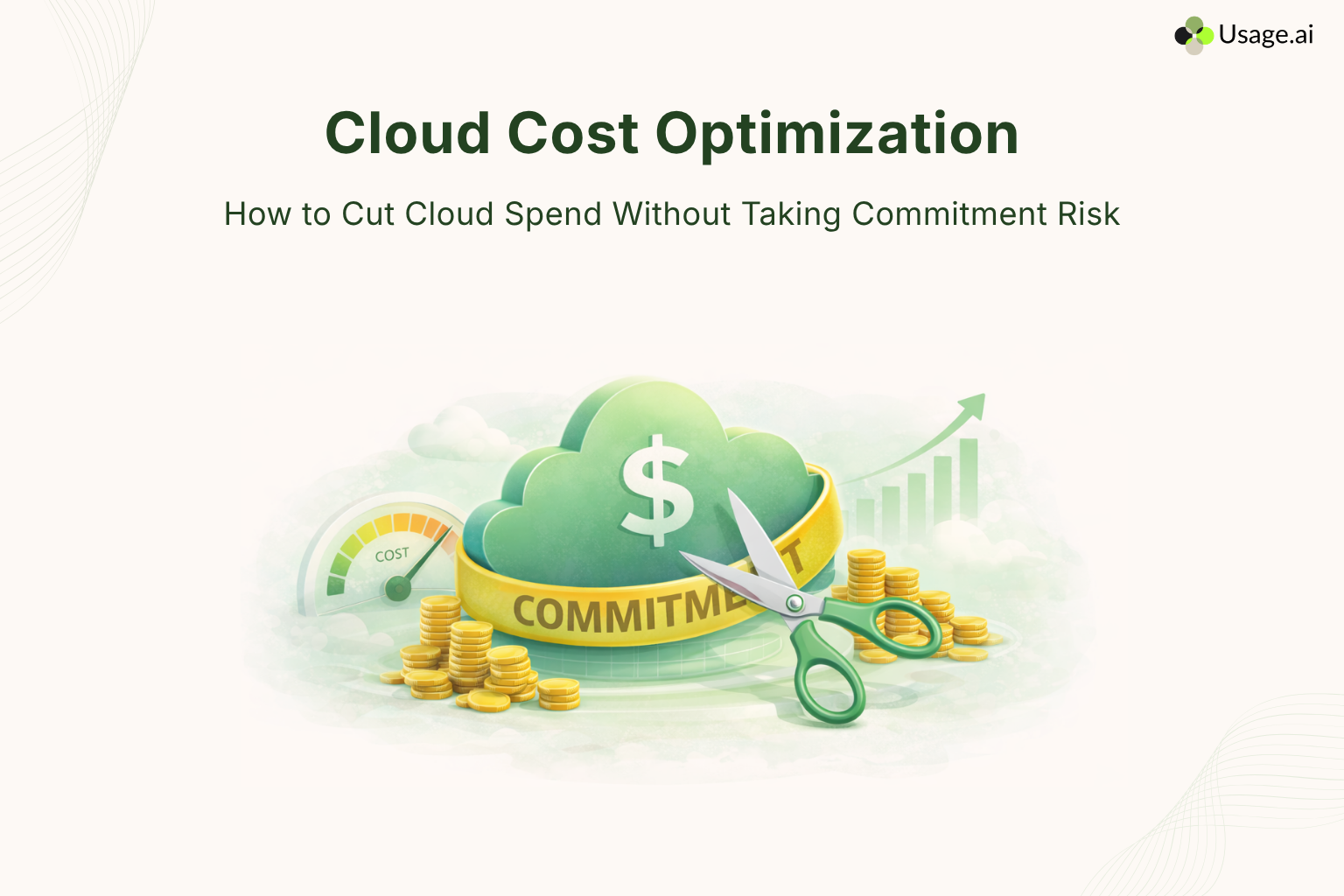
A practical, educational guide to cloud cost optimization, covering strategies, commitments, risk, and modern FinOps best practices.
Cloud computing has fundamentally changed how companies build and scale software. Infrastructure that once required long procurement cycles and upfront capital can now be provisioned in minutes, scaled automatically, and paid for as it is used. This flexibility has enabled faster innovation, but it has also made cloud costs harder to predict, control, and optimize.
For many organizations, cloud spend grows quietly in the background. New services are added, workloads scale automatically, environments multiply, and pricing models become increasingly complex. By the time costs draw executive attention, they are often deeply embedded in production systems, making reductions feel risky or disruptive. As a result, teams frequently oscillate between short-term cost-cutting efforts and long-term acceptance of rising cloud bills.
Cloud cost optimization exists to break that cycle. Rather than treating cloud spend as an unavoidable side effect of growth, optimization provides a structured way to align cloud usage with actual business needs without sacrificing reliability, performance, or developer velocity.
This guide takes a practical, engineering- and finance-aware look at cloud cost optimization, what it really means, why costs grow faster than expected, and which strategies have the greatest impact at scale.
What Is Cloud Cost Optimization?
Cloud cost optimization is the ongoing practice of reducing cloud spend while maintaining the required performance, reliability, and scalability. It focuses on aligning cloud consumption and pricing choices with real business demand, rather than simply reacting to monthly bills.
At a high level, cloud cost optimization typically involves three dimensions:
- Improving usage efficiency: Ensuring resources are sized appropriately, idle or unused services are removed, and consumption reflects actual workload needs.
- Making informed architectural and service choices: Selecting services, regions, and configurations that balance performance, resilience, and cost.
- Choosing the right pricing models: Deciding when to pay fully variable, pay-as-you-go rates versus when to commit to discounted pricing in exchange for predictability.
While many organizations associate cost optimization primarily with dashboards, tagging strategies, or budget alerts, these tools are better understood as cost management.
To help you understand this further, cost management answers the question, “Where is our money going?” Cost optimization goes further, asking, “How do we structurally spend less over time without increasing operational risk?”
Also read: Cloud Cost Analysis: How to Measure, Reduce, and Optimize Spend
Why Cloud Costs Grow Faster Than Expected
Cloud costs rarely spike overnight. More often, they increase gradually and persistently, driven by a combination of technical, organizational, and economic factors that are easy to overlook in fast-moving environments. Understanding these forces is essential before attempting to optimize spend in a sustainable way.
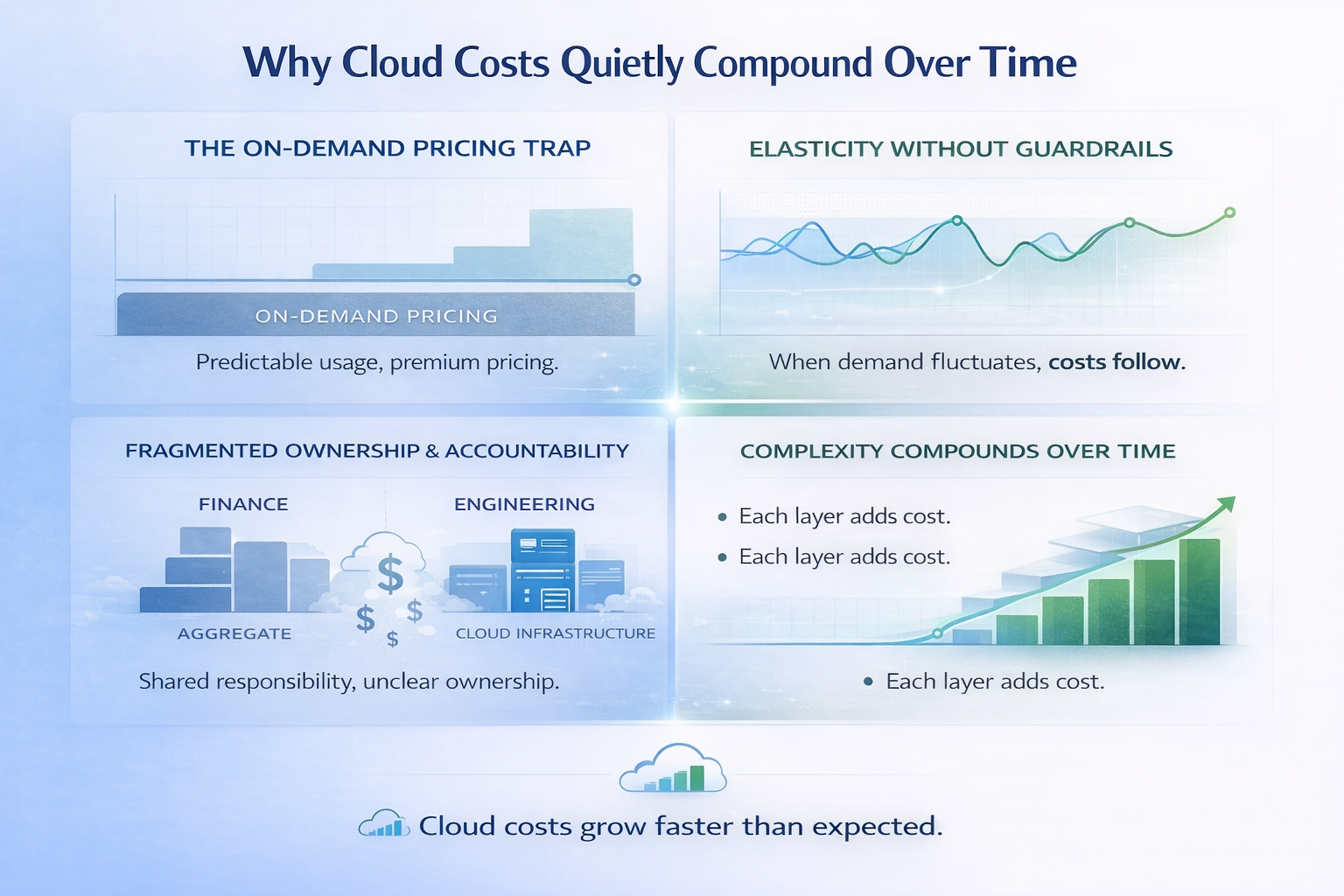
The On-Demand Pricing Trap
Most cloud services default to on-demand pricing, which means resources are billed per second, minute, or hour, with no long-term commitment required. This model feels safe because it minimizes upfront risk and preserves flexibility
However, this flexibility comes at a premium. On-demand pricing is intentionally the most expensive way to consume cloud resources. As workloads stabilize and run continuously, organizations often continue paying variable rates for infrastructure that has effectively become predictable. Over time, this leads to significantly higher costs than necessary without any corresponding increase in value.
Elasticity Without Guardrails
Cloud platforms make it easy to scale resources automatically in response to demand. While this elasticity is one of the cloud’s greatest strengths, it also removes natural cost constraints that existed in traditional infrastructure.
Autoscaling groups, managed databases, container platforms, and serverless services can all expand usage without direct human intervention. If demand increases, so does spend. If demand fluctuates unpredictably, costs follow suit. Without strong guardrails, elasticity can optimize for availability and performance while ignoring cost efficiency entirely.
Also read: 7 AWS Savings Plan KPIs Every FinOps Team Should Track for Better Cost Efficiency
Fragmented Ownership and Accountability
Another driver of cost growth is organizational complexity. Cloud spend is often distributed across teams, services, and accounts, making it difficult to establish clear ownership. When no single team feels responsible for the total bill, optimization becomes everyone’s problem and no one’s priority.
Finance teams may see aggregate costs but lack the technical context to influence architecture. Engineering teams control infrastructure decisions but may not feel the financial impact directly. Without alignment between these groups, cost optimization efforts tend to stall after initial visibility improvements.
Complexity Compounds Over Time
Finally, cloud environments naturally become more complex as companies grow. New services are adopted, legacy systems coexist with modern architectures, and pricing models evolve. What was once simple becomes layered and opaque.
Each layer adds optionality and optionality adds cost. Without deliberate optimization, complexity itself becomes a long-term driver of cloud spend.
Together, these factors explain why cloud costs often grow faster than revenue or usage, even in well-run organizations.
The Core Levers of Cloud Cost Optimization
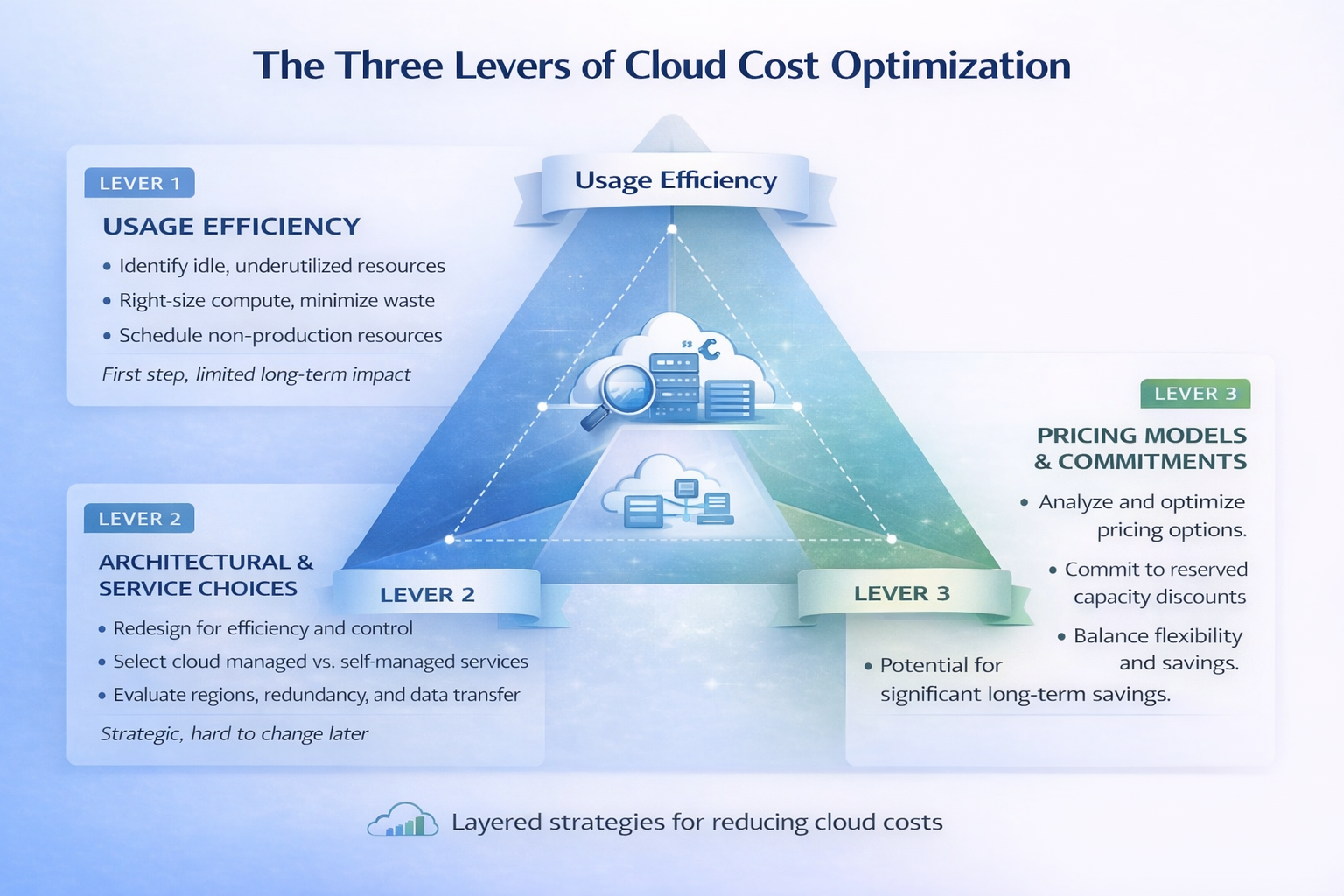
Effective cloud cost optimization relies on a small set of foundational levers that influence how cloud resources are consumed, designed, and paid for.
Lever 1: Usage Efficiency
Usage efficiency focuses on ensuring that cloud resources are actually needed and appropriately sized for the workloads they support. This is often the first place teams look when cloud costs come under scrutiny.
Common usage-efficiency practices include identifying idle or underutilized resources, rightsizing compute instances, scheduling non-production environments to shut down when not in use, and applying lifecycle policies to storage. These actions can produce immediate, visible savings, particularly in young or rapidly evolving environments.
However, usage efficiency has natural limits. Once obvious waste is removed and workloads are reasonably sized, further gains become incremental. In mature environments, efficiency improvements tend to flatten over time, making them an important, but insufficient lever on their own.
Lever 2: Architectural and Service Choices
The second lever involves higher-level decisions about how systems are designed and which cloud services are used. Architecture has a direct and lasting impact on cost, often in ways that are difficult to reverse later.
Service selection plays a key role. Managed services can reduce operational overhead but may introduce higher unit costs. Self-managed alternatives may offer more control at the expense of engineering effort. Regional choices, data transfer patterns, and redundancy strategies also influence spend in non-obvious ways.
Cost optimization at this level requires treating cost as a design constraint alongside performance, reliability, and security. Decisions made early, such as database engines, compute platforms, or data replication models can lock in cost structures for years. Revisiting these choices periodically is essential as usage patterns and business priorities change.
Also read: How Cloud Cost Optimization Actually Works (Beyond Dashboards & Discounts)
Lever 3: Pricing Models and Commitments
The third lever, and often the most impactful at scale, is how cloud resources are priced. Cloud providers offer multiple pricing models for the same underlying services, ranging from fully variable pay-as-you-go rates to deeply discounted options in exchange for longer-term commitments.
Organizations that rely exclusively on on-demand pricing pay a premium for flexibility, even when workloads are stable and predictable. Conversely, discounted pricing models can significantly reduce unit costs, but they require confidence in future usage.
This tradeoff between flexibility and efficiency is at the heart of cloud cost optimization. While the first two levers focus on what is used and how it is built, pricing models determine how much is ultimately paid for that usage. Ignoring any one of these leaves meaningful savings on the table.
Understanding Cloud Commitments (Savings Plans and Reserved Instances)
To understand why pricing decisions play such a large role in cloud cost optimization, it helps to look at how cloud providers structure their discounts. While on-demand pricing offers maximum flexibility, it is intentionally the most expensive way to consume cloud resources. Discounted pricing exists to reward customers who can offer predictability in return.
Cloud commitments are the primary mechanism through which providers offer these discounts.
Why Cloud Providers Offer Commitment Discounts
From the provider’s perspective, commitments reduce uncertainty. When customers agree to a minimum level of usage over a defined period, providers can plan capacity, infrastructure investments, and revenue more effectively. In exchange for that predictability, providers pass some of the savings back to customers in the form of lower rates.
This is why commitment-based discounts can be substantial, often reducing compute costs by 30–60% compared to on-demand pricing. The economics are straightforward. Predictability has value, and cloud providers are willing to pay for it.
Common Types of Cloud Commitments
Although the exact names and mechanics vary by provider, most cloud commitments fall into two broad categories.
- Reserved Instances are resource-specific commitments. They typically require customers to commit to a particular instance type, region, and operating system for a fixed term. Because of this specificity, Reserved Instances often provide the deepest discounts, but they are less forgiving if workloads change.
- Savings Plans, by contrast, are usage-based commitments. Rather than locking into a specific resource configuration, customers commit to a consistent level of compute spend over time. Savings Plans generally offer more flexibility than Reserved Instances, applying across multiple instance families or services, though sometimes at slightly lower discount rates.
Both Savings Plans and Reserved Instances are commonly offered with one-year or three-year terms, with longer commitments providing higher discounts.
Why Commitments Matter for Cost Optimization
For organizations running steady, always-on workloads, commitments are often the single largest lever for reducing cloud costs. Once workloads are stable, continuing to pay on-demand rates is equivalent to paying a premium for flexibility that is no longer being used.
This is why organizations that focus exclusively on rightsizing or architectural changes often hit a savings ceiling. After inefficiencies are removed, pricing decisions dominate the cost structure.
The Tradeoff: Savings Versus Flexibility
Despite their benefits, commitments are not universally adopted or fully utilized. The reason is risk.
Committing to future usage assumes that workloads will continue to run at similar levels. When usage declines due to seasonality, product changes, or architectural shifts, committed capacity can go unused. In those cases, the effective cost can exceed on-demand pricing, negating the intended savings.
This tension between capturing discounts and preserving flexibility sits at the center of cloud cost optimization. To understand commitments, you need to be aware of the financial and operational assumptions behind them.
The Hidden Risk in Cloud Cost Optimization
While cloud cost optimization strategies often focus on reducing waste or capturing discounts, they frequently overlook an important dimension, i.e., financial risk. Many optimization decisions implicitly assume that future usage will resemble past usage. When that assumption breaks, the cost consequences can be significant.
This risk is most visible when organizations move beyond on-demand pricing and begin using discounted pricing models such as Savings Plans and Reserved Instances. These models can dramatically lower unit costs, but they require confidence in future demand. If that confidence proves misplaced, optimization efforts can backfire.
What Happens When Usage Changes
Cloud usage is rarely static. Even stable businesses experience shifts driven by:
- Seasonality and cyclical demand
- Product launches or feature deprecations
- Customer growth or contraction
- Infrastructure refactoring or service migrations
When usage declines after commitments are made, organizations may find themselves paying for capacity they no longer need. The unused portion of a commitment does not disappear; it continues to incur cost regardless of whether it is consumed.
In these situations:
- Committed capacity goes unused
- The effective cost per unit of actual usage increases\
- Total spend may exceed what on-demand pricing would have cost
This dynamic explains why many teams remain cautious about long-term commitments, even when historical data suggests they could save money.
Also read: How to Choose Between 1-Year and 3-Year AWS Commitments
Why Risk Is Often Underestimated
Risk in cloud cost optimization is easy to underestimate because it does not appear immediately. A commitment decision may look successful for months before usage diverges. During that time:
- Early savings reinforce confidence in the strategy
- Assumptions about stability go unchallenged
- Reversing decisions becomes operationally and financially difficult
Forecasting cloud usage is also inherently challenging. Application demand depends on factors that infrastructure teams cannot fully control, including:
- Market conditions
- Customer behavior
- Competitive dynamics
- Product and roadmap changes
As a result, many organizations respond to uncertainty by under-committing. While this limits downside exposure, it also leaves meaningful savings unrealized.
Optimization as a Financial Tradeoff
At its core, cloud cost optimization is a financial tradeoff between efficiency and flexibility.
- Higher discounts require stronger assumptions about future usage
- Greater flexibility carries higher per-unit costs
Traditional optimization approaches often manage this tradeoff informally, relying on conservative buffers, manual reviews, or infrequent planning cycles. While these methods can prevent worst-case outcomes, they also constrain how aggressively teams can optimize.
Recognizing this tradeoff explicitly is a key step toward more mature cloud cost optimization. Rather than avoiding commitments or relying solely on intuition, organizations must understand how pricing decisions interact with change over time.
Operating Cloud Cost Optimization at Scale
Cloud cost optimization looks very different at scale than it does in small or early-stage environments. As organizations grow, manual processes and ad hoc reviews that once worked begin to break down. Optimization shifts from a series of tactical fixes to an operational discipline that must function continuously.
Why Manual Optimization Stops Working
In many organizations, early cost optimization efforts rely on spreadsheets, quarterly reviews, or one-off cleanup projects. These approaches can surface savings initially, but they struggle to keep pace with dynamic cloud environments.
Several factors contribute to this breakdown:
- Usage changes faster than review cycles: Cloud usage can shift daily, while optimization reviews often happen monthly or quarterly.
- Data volume and complexity increase: As accounts, services, and workloads multiply, manually analyzing cost data becomes impractical.
- Human decision-making becomes a bottleneck: Optimization decisions often require coordination across engineering, finance, and leadership, slowing execution.
As a result, teams respond to cost spikes after they occur rather than continuously shaping cost behavior.
Characteristics of Scalable Optimization Programs
Organizations that manage cloud costs effectively at scale tend to share a few common characteristics. Key traits include:
- Continuous analysis: Cost and usage data are reviewed frequently, not episodically, allowing teams to respond to changes quickly.
- Clear ownership and accountability: Responsibility for cloud costs is defined, with alignment between engineering and finance teams.
- Standardized decision frameworks: Teams use consistent criteria to evaluate tradeoffs between cost, performance, and flexibility.
- Feedback loops: Optimization decisions are monitored over time, and outcomes inform future actions.
These characteristics help shift optimization from reactive cost control to proactive cost shaping.
Moving from Static Planning to Ongoing Adjustment
One of the most important shifts at scale is moving away from static planning assumptions. Cloud environments are inherently dynamic, and optimization strategies must reflect that reality. Instead of asking, “What is the right configuration for the next year?” mature teams ask:
- What portion of our usage is stable versus variable?
- Which workloads justify long-term efficiency?
- How frequently should pricing and capacity decisions be revisited?
Aligning Cost Optimization with Business Outcomes
Finally, operating optimization at scale requires connecting technical decisions to business objectives. Cost reductions that compromise reliability or slow product delivery often create downstream costs that outweigh short-term savings.
Effective programs evaluate optimization decisions in the context of customer experience, revenue impact, engineering productivity and risk tolerance.
When cloud cost optimization is treated as part of overall business operations, it becomes easier to sustain over time and easier to justify at the executive level.
Emerging Approaches to Risk-Aware Cloud Cost Optimization
Modern teams increasingly focus on approaches that balance cost efficiency with adaptability, recognizing that usage patterns, architectures, and business needs change continuously. Rather than relying on a single optimization technique, these approaches combine automation, workload segmentation, and continuous decision-making to reduce costs while managing uncertainty.

1. Automated Commitment Management
One of the most significant shifts in modern cloud cost optimization is the move toward automated management of pricing commitments such as Savings Plans and Reserved Instances.
Instead of making infrequent, high-stakes commitment decisions, teams continuously evaluate usage patterns and adjust commitment levels over time. This reduces reliance on long-term forecasts and helps align discounts more closely with actual consumption.
The goal is not to eliminate risk entirely, but to prevent commitments from drifting out of sync with real workloads.
2. Differentiating Stable and Variable Workloads
Another hallmark of risk-aware optimization is explicitly separating workloads by stability. Not all infrastructure behaves the same way over time, and treating it as such leads to overly conservative decisions.
Mature optimization programs distinguish between:
- Baseline workloads that are consistently present and predictable
- Variable workloads that fluctuate due to demand, experimentation, or change
This distinction allows teams to apply different optimization strategies to different parts of their environment. Stable workloads are candidates for deeper efficiency, while variable workloads retain flexibility. The result is higher overall savings without forcing uniform assumptions across the entire platform.
3. Increasing Optimization Frequency
Instead of attempting to make perfectly accurate long-term decisions, leading teams focus on revisiting optimization decisions more frequently.
Shorter feedback loops allow teams to:
- Detect changes in usage earlier
- Adjust pricing and capacity decisions before inefficiencies compound
- Reduce the impact of incorrect assumptions
This approach shifts optimization from a forecasting problem to an adjustment problem.
4. Embedding Cost Controls Earlier in the Lifecycle
Another emerging practice is shifting cost considerations earlier in the development and deployment process.
Rather than reacting to costs after services are in production, teams introduce guardrails during design, provisioning, and deployment. This includes standardized configurations, default cost controls, and automated enforcement of basic optimization policies.
By addressing cost earlier, teams reduce the need for disruptive corrections later.
5. Treating Cost Optimization as a Continuous System
At a structural level, modern cloud cost optimization is treated as a system rather than a project.
This system continuously:
- Monitors usage and spend
- Evaluates optimization opportunities
- Applies changes incrementally
- Measures outcomes over time
The result is an optimization process that adapts to change rather than resisting it.
How Modern Platforms like Usage AI Apply These Principles
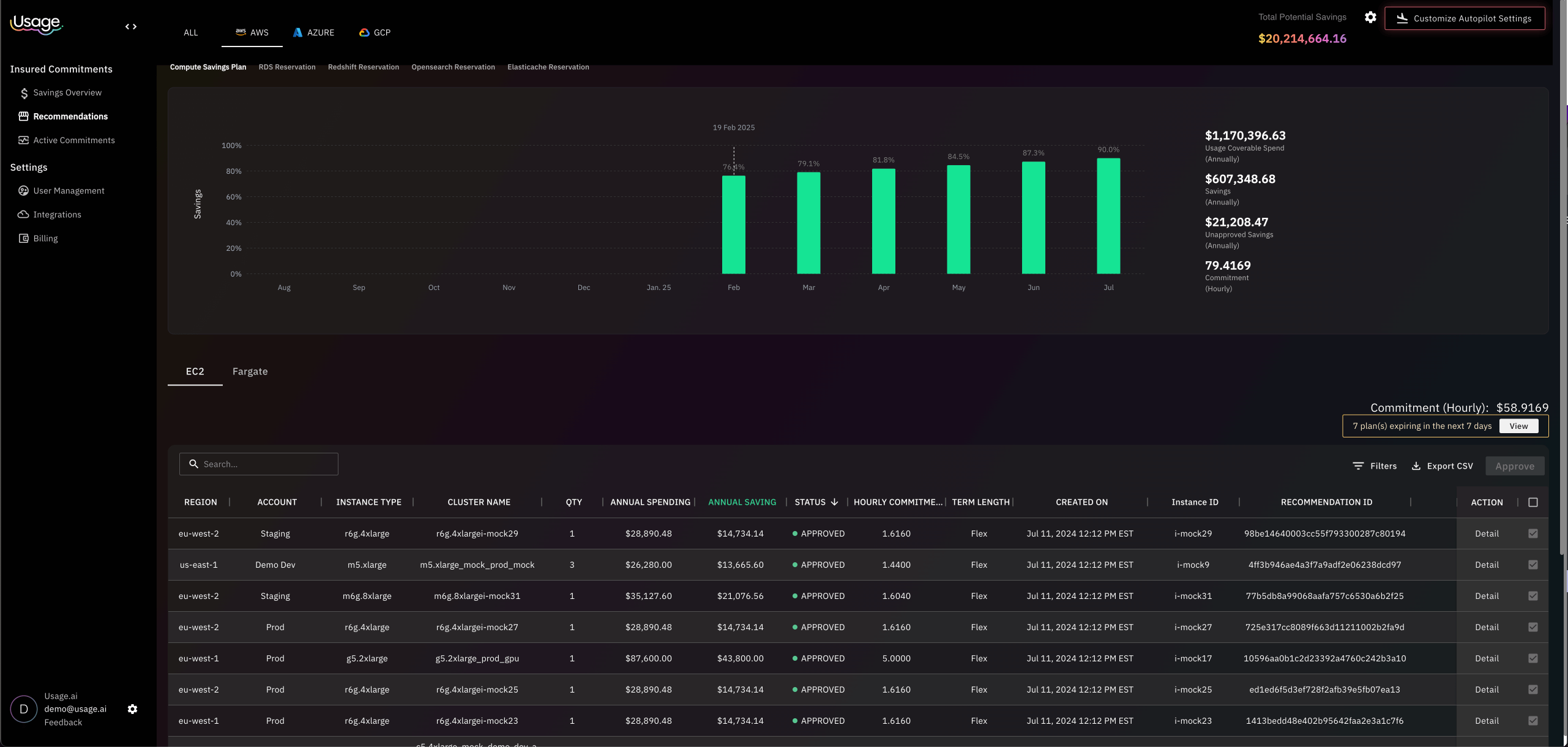
The shift toward risk-aware cloud cost optimization has created a new class of platforms designed to operationalize these principles end to end. Rather than stopping at visibility or recommendations, these platforms actively execute optimization decisions, continuously adapt to change, and take responsibility for financial outcomes.
Among them, Usage.ai represents one of the clearest examples of what modern, execution-driven cloud cost optimization looks like in practice.
From Recommendations to Execution
Traditional cost optimization tools focus on analysis, showcasing dashboards, reports, and lists of potential savings opportunities. The burden of action, like deciding what to do, when to do it, and how much risk to take remains with the customer.
Usage.ai flips this model. Instead of merely identifying opportunities, it automates the entire commitment lifecycle, from discovery to purchase to ongoing management. The platform continuously analyzes cloud usage data and translates it into concrete, executable decisions around Savings Plans, Reserved Instances, and flexible commitment structures.
This removes one of the biggest bottlenecks in cloud cost optimization – the gap between knowing what to do and actually doing it.
Continuous, High-Frequency Optimization
A defining characteristic of modern optimization platforms is speed. Cloud usage changes quickly, but many traditional tools rely on slow refresh cycles or manual reviews that lag reality.
Usage.ai refreshes recommendations on a 24-hour cadence, allowing commitment decisions to stay aligned with current usage rather than outdated forecasts. This high-frequency feedback loop enables teams to optimize more aggressively while maintaining control, because decisions are revisited continuously instead of being locked in for long planning cycles.
In practice, this turns optimization from a quarterly exercise into a living system.
Separating Discount Capture From Risk
Perhaps the most important innovation in modern platforms is the explicit separation of savings from downside risk.
Historically, committing to lower cloud prices meant fully absorbing the risk if usage declined. Usage.ai introduces a fundamentally different model by assuring customers against underutilization. When committed usage is not fully consumed, the platform provides real cashbacks (not cloud credits) to offset the financial impact.
This changes the optimization equation entirely. Teams no longer have to choose between being conservative and capturing savings. They can increase commitment coverage with confidence, knowing that downside risk is contractually protected.
Incentives Aligned With Outcomes
Modern platforms also differ in how they monetize. Instead of charging fixed SaaS fees regardless of results, Usage.ai charges only on realized savings. If customers do not save money, the platform does not get paid.
This alignment matters. It ensures that optimization decisions are evaluated not by theoretical savings or projected discounts, but by actual financial outcomes. The platform succeeds only when customers do.
What This Enables for Teams
By combining automation, frequent decision-making, and financial protection, platforms like Usage.ai enable optimization strategies that were previously impractical.
Teams can:
- Increase commitment coverage without betting on perfect forecasts
- Respond to usage changes faster than manual processes allow
- Treat cloud cost optimization as a managed system, not a recurring fire drill
Sign up for Usage.ai to run a free savings analysis and see how much discounted coverage you can safely unlock in your cloud environment.
Conclusion
Cloud cost optimization has evolved beyond ad hoc cleanups, visibility dashboards, and one-time savings initiatives. In modern cloud environments, costs are shaped by architecture, pricing models, and decisions made continuously over time.
As this guide has shown, the most meaningful savings come from understanding how cloud providers price infrastructure, deliberately using commitments such as Savings Plans and Reserved Instances, and acknowledging the uncertainty inherent in future usage. The challenge is not knowing that discounts exist, but managing the tradeoff between efficiency and flexibility as systems change.
Frequently Asked Questions
1. What is cloud cost optimization?
Cloud cost optimization is the ongoing practice of reducing cloud spend while maintaining performance, reliability, and scalability. It involves improving usage efficiency, making cost-aware architectural decisions, and choosing the most effective pricing models (like on-demand usage versus discounted commitments) based on actual business demand.
2. What is the most effective way to reduce cloud costs?
The most effective way to reduce cloud costs depends on workload maturity. Early savings often come from eliminating waste and rightsizing resources, but at scale, the largest and most durable savings usually come from using discounted pricing models like Savings Plans and Reserved Instances for stable workloads.
3. How is cloud cost optimization different from cloud cost management?
Cloud cost management focuses on visibility and control, like tracking spend, allocating costs, setting budgets, and monitoring usage. Cloud cost optimization goes further by actively changing how resources are used and paid for in order to structurally reduce costs over time, not just observe them.
4. Are Savings Plans and Reserved Instances risky?
Savings Plans and Reserved Instances are not inherently risky, but they require confidence in future usage. If usage declines significantly after a commitment is made, unused committed capacity can reduce or eliminate expected savings. This is why many organizations adopt conservative commitment strategies or revisit commitment decisions frequently.
5. How often should cloud cost optimization be reviewed?
In dynamic cloud environments, cloud cost optimization should be reviewed continuously rather than on a quarterly or annual basis. Usage patterns can change daily, so more frequent analysis helps ensure that optimization decisions remain aligned with current demand and architecture.
6. Who should own cloud cost optimization in an organization?
Effective cloud cost optimization is typically a shared responsibility between engineering, finance, and platform teams. Engineering teams control infrastructure decisions, finance teams track financial outcomes, and FinOps or platform teams often coordinate optimization efforts across the organization.
7. What tools are used for cloud cost optimization?
Cloud cost optimization tools range from cost visibility and allocation platforms to automation-focused solutions that manage commitments, enforce cost controls, and adjust optimization decisions over time.
8. How does Usage.ai help with cloud cost optimization?
Usage.ai helps organizations optimize cloud costs by automating commitment decisions, refreshing recommendations daily, and protecting customers against underutilization with real cashback. This allows teams to increase discounted coverage while managing the financial risk typically associated with cloud commitments.