
Blog

Cloud Waste in AWS, Azure, and GCP: Causes, Examples & How to Eliminate It

Organizations running workloads on Amazon Web Services, Microsoft Azure, and Google Cloud Platform often discover that a significant portion of their cloud bill is spent on resources that are unused, over-provisioned, or poorly optimized. This unnecessary spending is known as cloud waste.

For many companies, cloud waste can represent 20–35% of total cloud spend. Idle compute instances, forgotten storage volumes, and underutilized long-term commitments quietly accumulate costs every hour infrastructure remains active.

Modern FinOps teams are therefore tasked with continuously identifying and eliminating cloud waste. This involves more than just deleting unused infrastructure. Teams must analyze utilization patterns, right-size resources, and manage long-term pricing commitments such as Savings Plans or Reserved Instances.

Yet one of the most overlooked sources of cloud waste is commitment mismanagement. Organizations purchase long-term cloud commitments to receive discounted pricing, but if usage decreases, those commitments can become underutilized, turning what was meant to save money into another form of waste.

In this guide, we’ll break down what cloud waste is, why it happens and the most common types of cloud waste in AWS, Azure, and GCP. 

What Is Cloud Waste?

Cloud waste refers to money spent on cloud resources that are unused, underutilized, or inefficiently configured. This includes idle compute instances, over-provisioned infrastructure, unused storage, and poorly optimized long-term commitments like Savings Plans or Reserved Instances.

Think of cloud infrastructure as renting thousands of remote computers in data centers. Instead of buying physical hardware, companies run workloads on virtual machines provided by platforms like Amazon Web Services, Microsoft Azure and Google Cloud Platform. 

Each of these machines is billed by the second, minute, or hour depending on the service. If those machines sit idle, run at low utilization, or are configured far larger than necessary, the organization is still paying for them, even though the computing power isn’t actually being used. That unused spend becomes cloud waste.

Why Cloud Waste Happens So Easily

Cloud platforms are intentionally designed to make infrastructure easy to provision and scale. Engineers can launch new instances, storage volumes, and entire environments in seconds.

While this flexibility accelerates innovation, it also creates a side effect. For example:

  • A development team launches test environments and forgets to shut them down.
  • Production workloads are sized for peak traffic but rarely reach that level.
  • Storage volumes remain attached long after applications are deleted.
  • Commitments like Savings Plans are purchased but later become underutilized.

Over time, these inefficiencies accumulate into significant spending.

The Hidden Layer of Cloud Waste - “Commitments”

Many teams assume cloud waste only comes from idle resources, but another major source comes from mismanaged long-term pricing commitments.

Cloud providers offer discounted pricing through commitment models such as Savings Plans, Reserved Instances and Long-term capacity reservations. These commitments can reduce compute costs by up to ~66%, but they require companies to commit to a certain level of usage over one or three years.

If workloads change and usage drops, organizations still pay for the committed capacity, creating another form of cloud waste.

Modern cloud cost optimization platforms address this challenge by automating commitment management, continuously analyzing usage patterns, and helping teams increase discount coverage while reducing the risk of underutilization.

Why Cloud Waste Matters for FinOps Teams

For organizations spending millions on cloud infrastructure, even small inefficiencies can translate into massive financial losses. That is why FinOps teams increasingly focus on identifying waste across three core areas:

  • Infrastructure efficiency – ensuring compute and storage match real demand
  • Resource lifecycle management – removing idle infrastructure quickly
  • Commitment optimization – maximizing discounts without increasing risk

When these practices are combined, companies can significantly reduce cloud spending while maintaining the flexibility that makes cloud computing valuable.

Why Cloud Waste Happens in AWS, Azure, and GCP

Platforms like Amazon Web Services, Microsoft Azure, and Google Cloud Platform allow engineers to provision infrastructure in seconds. This agility is what makes the cloud powerful,  but it also creates the perfect conditions for uncontrolled spending and resource inefficiencies.

Understanding why cloud waste occurs is the first step toward eliminating it.

1. Overprovisioning for Peak Traffic

One of the most common causes of cloud waste is overprovisioned infrastructure. Engineering teams typically provision systems to handle peak demand, not average usage. 

For example, an API service may require 16 CPUs during traffic spikes, but operate most of the day using only 4 CPUs. To avoid performance issues, teams keep the larger instance running continuously. The result is 75% of the compute capacity is unused, but still billed. 

This pattern is extremely common across compute services such as virtual machines, container clusters and database instances. 

2. Idle Resources That Are Never Decommissioned

Another major contributor to cloud waste is idle infrastructure. During development cycles, teams frequently create temporary environments for testing new features, running QA pipelines, debugging production issues and experimenting with new services.

However, once the work is completed, those environments are often forgotten rather than deleted. Common examples include:

  • idle virtual machines
  • unattached storage volumes
  • unused load balancers
  • abandoned Kubernetes clusters

Because cloud resources are billed continuously while running, even small forgotten resources can generate costs every hour they remain active.

3. Poor Resource Lifecycle Management

Cloud environments evolve quickly. Applications are deployed, scaled, replaced, and deprecated constantly. Without strong governance policies, infrastructure can accumulate orphaned resources. Typical examples include:

  • outdated machine images
  • unused snapshots and backups
  • duplicate staging environments
  • legacy networking infrastructure

These resources rarely appear in daily operations, which means they can persist unnoticed for months or even years.

4. Lack of Visibility Across Teams

In large organizations, multiple teams provision cloud infrastructure simultaneously. For example:

  • DevOps teams manage production systems
  • Data teams launch analytics clusters
  • Developers spin up environments for testing
  • Platform teams maintain shared services

Without proper tagging, ownership tracking, and cost allocation, it becomes difficult to answer simple questions such as: Who owns this resource? Is it still needed? Can it be safely removed?

This lack of visibility makes it harder for FinOps teams to identify inefficiencies and enforce cost governance across the organization.

5. Mismanaged Cloud Commitments

One of the most overlooked sources of cloud waste comes from poorly managed long-term pricing commitments. Cloud providers offer discounted pricing models that reward customers for committing to long-term usage, like Savings Plans, Reserved Instances and Capacity reservations. 

However, commitments introduce utilization risk. If workloads change or infrastructure demand decreases, the organization may end up paying for commitments that are no longer fully used. 

Modern FinOps platforms address this challenge by continuously analyzing cloud usage, recommending optimal commitment purchases, and automating commitment management to maintain high utilization rates.

The 5 Most Common Types of Cloud Waste

Understanding the different types of cloud waste helps FinOps and DevOps teams identify where cloud spending is leaking and which optimization strategies will have the biggest impact.

Below are the five most common types of cloud waste found in environments running on AWS, Azure, and Google Cloud Platform.

1. Idle Compute Resources

Idle compute resources are virtual machines or containers that are running but performing little to no useful work. This often happens when teams spin up infrastructure for temporary tasks and forget to shut it down afterward.

Examples include:

  • Development environments left running overnight
  • Test instances used during debugging sessions
  • Temporary clusters created for experiments
  • Backup instances that remain active after incidents are resolved

2. Overprovisioned Infrastructure

Overprovisioning occurs when resources are sized significantly larger than the workloads actually require. For instance:

  • A workload that needs 4 CPUs may run on a 16-CPU instance
  • A database requiring 20 GB of memory may be allocated 64 GB
  • A container cluster may run nodes that remain mostly unused

While this approach guarantees performance, it also means organizations are paying for capacity that remains unused most of the time.

Rightsizing infrastructure to match real workload demand is one of the fastest ways to reduce cloud waste.

3. Unused or Orphaned Storage

Storage is another common source of hidden cloud waste. Because storage services are relatively inexpensive per unit, organizations often accumulate large volumes of unused storage without noticing the financial impact. Examples include:

  • Unattached block storage volumes
  • Old database backups and snapshots
  • Deprecated object storage buckets
  • Duplicate staging datasets

While each resource may only cost a small amount individually, large cloud environments can accumulate thousands of unused storage assets over time. 

4. Idle Networking Infrastructure

Networking resources are often overlooked in cloud cost optimization, but they can also contribute to cloud waste. Examples include:

  • Load balancers attached to services that no longer exist
  • NAT gateways created during testing
  • Idle VPN connections
  • Data transfer infrastructure supporting deprecated applications

Many of these services continue generating charges even when they process little or no traffic.

5. Underutilized Cloud Commitments

One of the largest and least understood forms of cloud waste involves long-term pricing commitments. Cloud providers offer discounted pricing models, including Savings Plans, Reserved Instances and Committed use discounts.

These programs allow organizations to receive significant price reductions in exchange for committing to a certain level of usage over one or three years. While these commitments can reduce compute costs dramatically, they also introduce utilization risk.

Modern FinOps platforms help resolve this challenge by automatically analyzing usage patterns, and ensuring organizations maintain high utilization rates across their cloud commitments.

Cloud Waste vs Cloud Cost Optimization

While the terms are often used interchangeably, cloud waste and cloud cost optimization are not the same thing.

Cloud waste refers to unnecessary spending caused by unused or inefficient cloud resources, such as idle instances, oversized infrastructure, or unused storage.

Cloud cost optimization is a broader practice that focuses on continuously improving how cloud infrastructure is used and priced. This includes eliminating waste, rightsizing resources, and optimizing long-term commitments.

Aspect Cloud Waste Cloud Cost Optimization
Definition Spending on unused or inefficient cloud resources Continuous practice of improving cloud spending efficiency
Focus Eliminating idle or unnecessary infrastructure Maximizing value from cloud infrastructure
Examples Idle instances, unused storage, underutilized commitments Rightsizing workloads, optimizing commitments, automation
Time Horizon Short-term cost reduction Long-term financial and operational efficiency
Role in FinOps First step in reducing cloud spending Ongoing discipline for managing cloud economics

In most organizations, reducing cloud waste is the first step toward a larger cloud cost optimization strategy.

How Much Cloud Waste Do Companies Actually Have?

Industry estimates suggest that 20–35% of cloud spending is wasted due to idle infrastructure, overprovisioned resources, and poorly optimized commitments. For companies running large cloud environments, this waste can quickly translate into millions of dollars in unnecessary spending every year.

A Simple Example of Cloud Waste

Consider a mid-sized company spending $5 million per year on cloud infrastructure. If even 25% of that spend is wasted, the financial impact looks like this:

Example of Cloud Waste
Annual Cloud Spend Estimated Waste Potential Savings
$500,000 $100,000 Recoverable through optimization
$5,000,000 $1,250,000 Major optimization opportunity
$50,000,000 $12,500,000 Enterprise-level inefficiency

In many cases, organizations are unaware of these inefficiencies because cloud spending is distributed across multiple teams and services. 

How Mature FinOps Teams Identify Cloud Waste

Most teams focus on three core signals:

  1. Utilization metrics: Monitoring CPU, memory, and storage usage helps identify resources that are significantly underused or idle.
  2. Resource lifecycle analysis: Teams look for infrastructure that has not been used recently, such as inactive instances, unattached storage volumes, or forgotten development environments.
  3. Commitment coverage and utilization: FinOps teams analyze how much of their infrastructure is running on discounted commitments versus expensive on-demand pricing. Low coverage or unused commitments often signal optimization opportunities.

Because cloud environments change constantly, these analyses must be performed continuously. Modern platforms automate this process by scanning billing and usage data daily and generating updated optimization recommendations.

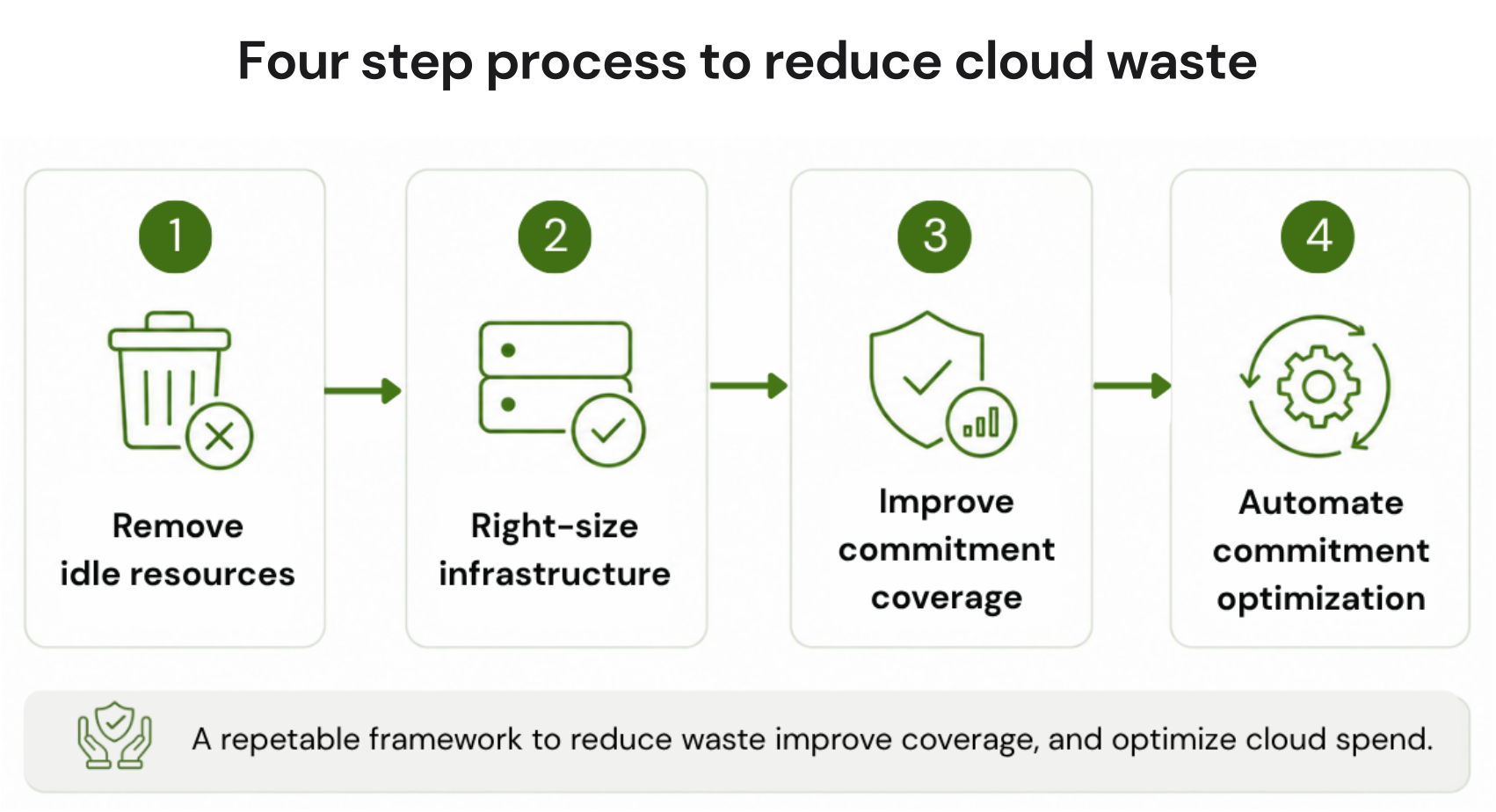
How to Reduce Cloud Waste (Step-by-Step)

Eliminating cloud waste requires a combination of infrastructure optimization, operational discipline, and financial strategy. FinOps and DevOps teams typically approach this in a series of structured steps that gradually reduce inefficiencies across their cloud environments.

1. Right-Size Infrastructure

The first step in reducing cloud waste is ensuring that infrastructure matches real workload demand.

Many resources are initially provisioned with extra capacity to avoid performance issues, but over time those workloads rarely use the full allocation.

Rightsizing involves reducing oversized virtual machines, adjusting database capacity and scaling container clusters based on real usage patterns. By aligning infrastructure with actual demand, organizations can immediately eliminate a significant portion of unused compute capacity.

2. Remove Idle Resources

Idle resources are one of the easiest types of cloud waste to eliminate. FinOps teams typically look for infrastructure that has had little or no activity over a defined time window, such as 

inactive virtual machines, unused storage volumes, abandoned development environments or outdated snapshots and backups. 

Automated policies can also help reduce waste by shutting down development and testing environments outside working hours, preventing unnecessary overnight spending.

3. Improve Commitment Coverage

One of the most effective ways to reduce cloud costs is by increasing the percentage of infrastructure covered by discounted pricing commitments.

Cloud providers offer commitment programs such as Savings Plans or Reserved Instances that allow organizations to receive significant discounts compared to on-demand pricing. When managed correctly, these commitments can reduce compute costs by up to ~66%.

However, purchasing commitments requires careful cost analysis. Teams must ensure that commitments match long-term usage patterns; otherwise, unused commitments can become another form of cloud waste.

4. Automate Commitment Optimization

Manually analyzing cloud usage and purchasing commitments is difficult because cloud workloads change constantly. As a result, commitment strategies that were optimal last quarter may no longer be ideal today.

Modern cloud cost optimization platforms solve this problem by:

  • continuously analyzing billing and usage data
  • generating updated commitment recommendations
  • helping teams purchase the right commitments at the right time

Platforms like Usage.ai automate this process and refresh optimization recommendations every 24 hours, allowing organizations to react quickly to infrastructure changes.

5. Reduce Commitment Risk

Even with strong analysis, many organizations hesitate to increase commitment coverage because of the risk of underutilization.

Usage.ai helps reduce this risk by introducing cashback protected commitments, where customers can receive cashback if commitments become underutilized. This approach allows organizations to capture deeper discounts while protecting against unexpected usage changes.

Conclusion

Cloud waste is rarely caused by a single mistake. Instead, it builds up gradually as infrastructure scales. For many organizations running on Amazon Web Services, Microsoft Azure, or Google Cloud Platform, these inefficiencies can quietly consume 20–35% of total cloud spend.

The good news is that cloud waste is one of the most controllable cloud cost problems. With strong FinOps practices, teams can reduce waste by rightsizing infrastructure, removing idle resources, and improving how long-term commitments are managed.

This is why many organizations are moving toward automated cloud cost optimization platforms that continuously analyze usage, recommend better commitment strategies, and help maintain high utilization across discounted pricing models.

Frequently Asked Questions

1. What is cloud waste?

Cloud waste is the money organizations spend on cloud resources that are unused or inefficiently configured. This can include idle compute instances, oversized infrastructure, unused storage, or underutilized commitments. In many environments, cloud waste accounts for roughly 20–35% of total cloud spending.

2. What causes cloud waste?

Cloud waste typically occurs when infrastructure is provisioned faster than it is optimized. Common causes include idle resources, overprovisioned compute instances, forgotten development environments, unused storage volumes, and poorly managed long-term commitments.

3. How much cloud spending is wasted?

Industry estimates suggest that organizations waste 20–35% of their cloud spending due to inefficient resource usage. As cloud environments scale, small inefficiencies across many resources can accumulate into significant financial losses.

4. How do companies reduce cloud waste?

Companies reduce cloud waste by rightsizing infrastructure, removing idle resources, cleaning up unused storage, and improving commitment utilization. Many organizations also adopt automated optimization platforms that continuously analyze usage data and recommend cost-saving actions.

5. What is the difference between cloud waste and cloud cost optimization?

Cloud waste refers specifically to unnecessary spending caused by unused or inefficient resources. Cloud cost optimization is the broader practice of continuously improving how cloud infrastructure is used and purchased to ensure organizations get the best value from their cloud spending.

Share this post

You may like these articles

See all
Introduction to Cloud Unit Economics: A Comprehensive Guide for DevOps and FinOps Teams
All Articles
New-Releases

Introduction to Cloud Unit Economics: A Comprehensive Guide for DevOps and FinOps Teams

Learn what cloud unit economics is, how to calculate cost per user or request, and how DevOps and FinOps teams optimize infrastructure efficiency.

March 11, 2026
3
 min read
Cloud Waste in AWS, Azure, and GCP: Causes, Examples & How to Eliminate It
All Articles
Cloud Cost Optimization

Cloud Waste in AWS, Azure, and GCP: Causes, Examples & How to Eliminate It

Cloud waste can consume 20–35% of your cloud budget. Learn what causes cloud waste and how FinOps teams eliminate it using modern commitment automation

March 11, 2026
3
 min read
10 Biggest Cloud Cost Optimization Challenges (and How to Solve Them)
All Articles
Cloud Cost Optimization

10 Biggest Cloud Cost Optimization Challenges (and How to Solve Them)

Discover the top cloud cost optimization challenges FinOps teams face across AWS, Azure, and GCP and how modern platforms reduce risk and automate savings.

March 10, 2026
3
 min read

Save towards your growth

Thank you! Your submission has been received!
Oops! Something went wrong while submitting the form.