.png)



On the surface, cloud cost management looks like a solved problem today. Modern teams have far more visibility than they did three or four years ago, with cost dashboards firmly in place, tagging coverage significantly improved, and cost allocation models established across teams. Monthly cost reviews have become part of the regular operating rhythm, so on paper, many organizations appear to be “doing FinOps” just fine.
And yet, industry research consistently shows that 27–55% of cloud spend is wasted, most often on idle, over-provisioned, or underutilized resources.
What’s striking is that this waste persists even in teams with mature tooling and well-documented processes. Teams generally know where the money is going. The harder problem is turning that understanding into durable financial outcomes as environments continue to change. Today:
- Cloud usage is not static.
- Traffic patterns keep shifting.
- Features launch and sunset.
- Engineering teams refactor architectures.
- Growth assumptions keep changing.
A commitment or optimization decision that made perfect sense based on last quarter’s usage can quietly become a liability a few months later.
This is why cloud cost management so often feels frustrating in practice. Not because teams aren’t trying, but because the problem is continuous, people-heavy, and operational, while most approaches remain periodic and manual.
What Is Cloud Cost Management?
Cloud cost management is the practice of controlling, optimizing, and sustaining cloud spend over time, in contrast to simply reporting on it.
Most teams begin with visibility. Dashboards, tagging strategies, and cost allocation models are used to understand where spend comes from, how it is distributed across teams or services, and how it changes month over month. This foundation is essential, but it is largely descriptive. It tells teams what is happening in their cloud environment without necessarily changing the outcome.
The next layer is optimization. Teams act on what they see by rightsizing workloads, removing unused resources, or adjusting configurations. These actions often reduce meaningful waste and deliver quick wins, especially early on. However, the decisions behind these actions are typically based on current or recent usage patterns, which may not hold for long.
The real challenge begins with the third layer, which is management.
Cloud cost management, in practice, requires making financial decisions, sometimes longer-term ones and ensuring those decisions continue to make sense as usage evolves. This layer focuses less on identifying inefficiencies and more on whether savings persist as workloads grow, shrink, or change shape over time.
This distinction matters because many organizations never fully move beyond visibility and optimization. They can identify savings, and even realize them briefly, but struggle to make those savings durable. In dynamic cloud environments, cost management is not just about finding inefficiencies. It is about maintaining financial control as systems, teams, and demand continuously change.
That is where many cloud cost efforts stall.
Also read: Cloud Cost Analysis: How to Measure, Reduce, and Optimize Spend
Cloud Cost Management vs. Cloud Cost Optimization
Once teams understand where their cloud spend comes from, the next question is usually what to do about it. This is where cloud cost optimization comes in and where it is often mistaken for cloud cost management as a whole.
Cloud cost optimization is tactical and point-in-time. It focuses on identifying inefficiencies based on historical or current usage and acting on them. Common examples include rightsizing resources, removing unused services, or adjusting configurations to reduce waste. These actions are typically driven by tooling recommendations and evaluated based on their immediate cost impact.
Cloud cost management, on the other hand, includes optimization, but it does not stop there. It is continuous and outcome-driven. Management looks at whether cost decisions continue to hold up as usage changes over time. Instead of focusing only on individual actions, it focuses on whether those actions result in sustained financial control.
A simple way to see the difference:
- Optimization asks: “Did this change reduce cost right now?”
- Management asks: “Will this decision continue to reduce cost as usage changes?”
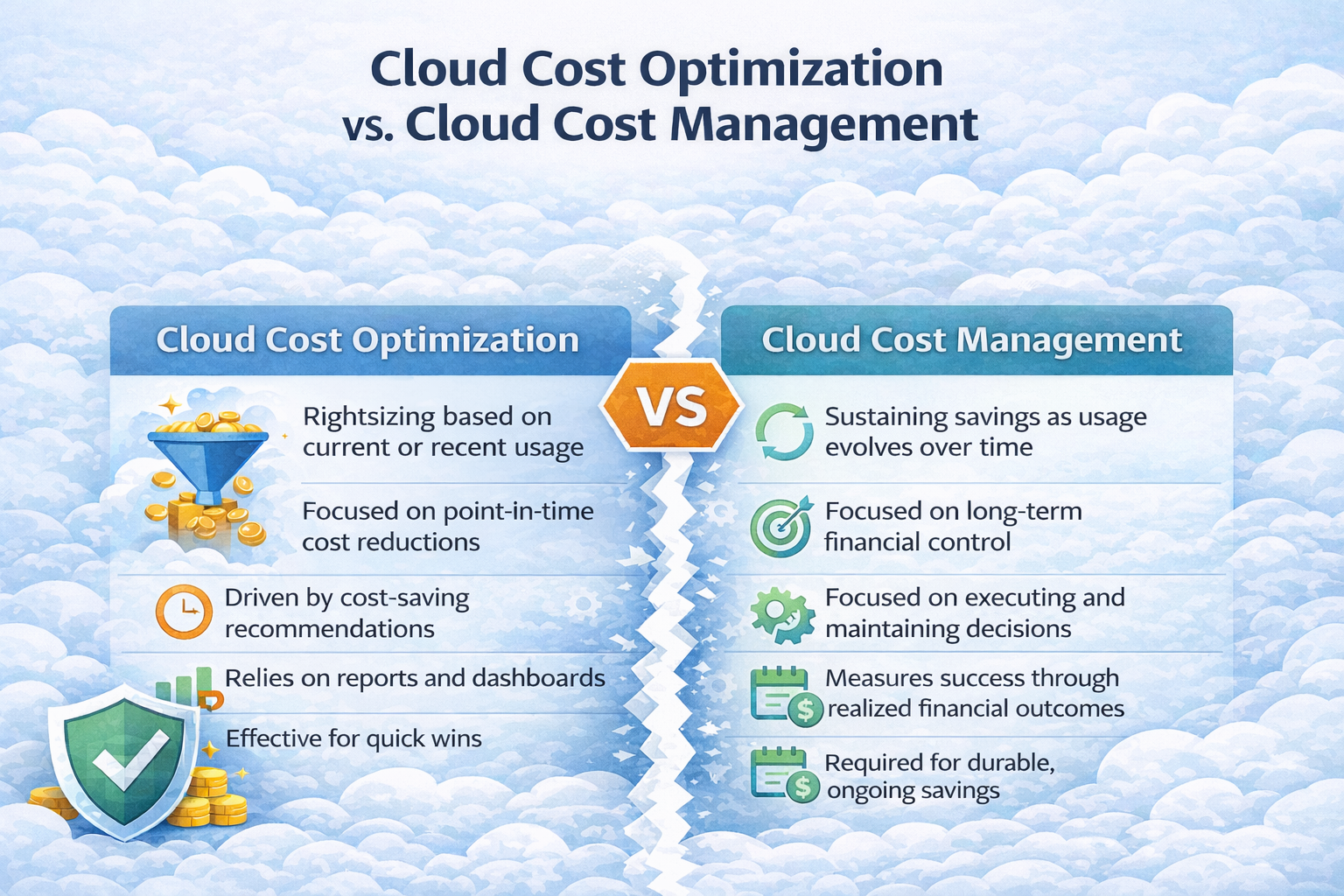
This distinction matters because cloud environments are inherently dynamic. Optimization can reduce costs today, but without ongoing management, those savings may not persist. Cloud cost management treats cost control as a continuous discipline, one that adapts as usage patterns change, rather than assuming a single round of optimization is enough.
Also read: Cloud Cost Optimization: How to Cut Cloud Spend Without Taking Commitment Risk
Why Cloud Cost Management Breaks Down in Real Production Environments
The difference between optimization and management becomes most visible once systems are running in production. Optimization works best when usage is relatively stable and underlying assumptions hold. Management becomes harder as soon as those assumptions start to drift, which, in modern cloud environments, is the normal condition.
Usage constantly changes
Production workloads are shaped by continuous change. Traffic grows or contracts. Background jobs expand quietly over time. Services are refactored. Autoscaling policies react in real time. Many cost decisions, such as sizing, baseline capacity, or pricing choices are derived from historical usage windows. When workload shape changes, those decisions may no longer reflect how the system actually behaves.
From an engineering perspective, nothing is broken here. The system is doing what it was designed to do: adapt. The challenge is that cost assumptions tend to lag behind these changes, and there is rarely a clear signal indicating when a previously correct decision has started to drift.
Ownership is fragmented
Cloud cost behavior emerges across multiple layers of the system. Application teams influence request volume and scaling behavior. Platform teams define shared infrastructure and defaults. Finance teams interpret spend through budgets and forecasts. When changes occur in one layer, such as a new service dependency or a change in scaling thresholds, the financial impact may surface elsewhere.
This fragmentation weakens feedback loops. Engineers may not see the financial impact of system changes until long after deployment. Finance teams may observe spend shifting without clear visibility into the underlying technical cause. As a result, cost issues are often detected late and addressed reactively.
Optimization tools stop at recommendations
Many cost tools analyze observed usage and generate recommendations that are valid at the moment they are produced. What is often missing is continuous validation. Once a recommendation is applied, teams rarely receive a clear signal when that change has become suboptimal again.
Without ongoing feedback, optimizations can quietly degrade, especially in environments where reliability, performance, and delivery speed take priority over cost tuning. Over time, teams assume savings are still in place even as conditions change around them.
Teams avoid long-term commitments due to uncertainty
Some of the largest cost levers require making assumptions about future usage. From an engineering standpoint, committing based on today’s behavior introduces risk. Systems are intentionally designed for elasticity and change, and fixed assumptions can feel misaligned with that design philosophy.
Avoiding that risk is rational. But it also limits how far optimization alone can go. Without a way to manage uncertainty over time, teams either overcommit and accept downside risk or undercommit and leave meaningful savings unrealized.
Also read: How to Identify Idle & Underutilized AWS Resources
The Hidden Reason Most Cloud Cost Programs Plateau
After the initial round of optimization, cloud cost programs often slow down. The easy wins are gone. Dashboards look cleaner. Cost growth may even flatten for a period of time.
What remains is harder to act on.
Early optimizations work because they are structurally safe. Unused resources stay unused. Clearly oversized instances can be resized without constraining future design choices. These decisions come with a wide margin of safety and little downside risk.
What follows is fundamentally different. The remaining opportunities depend less on averages and more on variance. How stable is baseline traffic? How bursty is the workload? How much headroom is actually required to meet SLOs? Engineers understand that these values are ranges, not constants, and that those ranges shift over time.
Most cost controls implicitly assume steady-state behavior. But production systems operate inside feedback loops: autoscaling responds to load, retries amplify traffic, background jobs compete for capacity, and feature changes alter usage patterns in non-obvious ways. When decisions are based on narrow historical windows, teams have little confidence in how safe those decisions will be under future conditions.
As a result, teams become cautious. Not because they don’t see the savings, but because they don’t trust the assumptions behind them. Elasticity is preserved, even when it is more expensive, because it absorbs uncertainty better than fixed financial constraints.
At this point, the cost program has not failed. It has reached the limit of what optimization alone can safely deliver.
How Cloud Cost Management Evolves as Teams Scale
Cloud cost management does not mature all at once. It evolves as systems grow in complexity and organizations gain experience managing cost under uncertainty.

- Visibility-first: Teams focus on understanding spend through dashboards, tagging, and allocation. Costs are easier to understand, but they are largely observed rather than actively controlled.
- Optimization-driven: With visibility in place, teams act on insights by rightsizing resources, cleaning up unused services, and adjusting configurations. These efforts deliver early savings, but they are often reactive and closely tied to recent usage patterns.
- Commitment-aware: As environments scale, teams start exploring structural cost reductions that depend on longer-term assumptions about usage. The potential savings are larger, but so is the uncertainty. Decisions increasingly involve trade-offs between flexibility, risk, and cost.
- Risk-managed: At higher scale, the focus shifts from identifying opportunities to preserving outcomes as usage changes. Cost management becomes less about one-time optimizations and more about protecting decisions over time, even as workloads evolve.
Many teams stall when their approach no longer matches the complexity of their systems. Progress comes from recognizing which stage you are operating in and understanding the new constraints that scale introduces.
What Modern Cloud Cost Management Looks Like and Where Traditional Approaches Fall Short
Modern cloud cost management reflects a shift away from periodic cleanup and toward continuous control.
- It operates continuously rather than in fixed review cycles. Production systems evolve faster than monthly or quarterly cost reviews, which allows assumptions to drift unnoticed between checkpoints.
- It measures success by financial outcomes, not completed actions. Cost decisions are treated as hypotheses that require validation over time.
- It builds tight feedback loops between system behavior and cost impact, shortening the delay between a technical change and its financial signal. This allows teams to respond while decisions are still reversible, rather than after costs have already shifted.
Traditional approaches often struggle at this stage. Most cloud cost management tools excel at analysis but stop at recommendations. They assume steady-state behavior and treat uncertainty as an edge case rather than a core operating constraint.
As systems become more dynamic, these limitations become increasingly visible and increasingly costly.
Cloud Cost Management Is Ultimately a Risk Problem
At this point, a clear pattern emerges. The hardest cloud cost decisions are about acting on savings that depend on future system behavior.
The most meaningful cost levers introduce risk. They rely on assumptions about how workloads will behave over time. They trade flexibility for efficiency. And once applied, they are often difficult to reverse quickly without operational impact.
Traditional approaches tend to handle this risk implicitly, assuming that careful analysis or periodic review is enough. In dynamic production systems, it often is not.
A risk-aware approach makes that uncertainty explicit. It evaluates decisions based on tolerance to variance, designs controls that degrade gracefully when assumptions are violated, and values confidence and reversibility alongside efficiency.
Cloud cost management is not just about eliminating uncertainty, but also about acknowledging it and making decisions that remain defensible when that uncertainty inevitably shows up.
How Platforms Like Usage.ai Approach Cloud Cost Management
As cloud cost management matures, some platforms are being designed specifically to address the gaps that appear beyond visibility and basic optimization. Rather than focusing only on reporting or static recommendations, these platforms aim to help teams act on cost decisions and sustain results as usage changes over time.
Usage.ai is an example of this next-generation cloud cost management approach.
Instead of stopping at analysis, Usage.ai automates the discovery and purchase of cloud commitments, reducing the operational friction that often prevents teams from acting on known savings opportunities. The emphasis is on realized savings, measured by what actually appears on the bill over time, not theoretical projections.
Learn more: What is Usage AI’sFlex-Commit Program
The platform is also designed around what happens when assumptions break. Usage can drop due to seasonality, product changes, or broader business shifts. Rather than treating this as an edge case, the approach explicitly accounts for downside risk, helping teams protect outcomes even as usage evolves.
Finally, the incentive model aligns with outcomes. Fees are tied to realized savings, reinforcing trust between engineering, finance, and platform teams who are cautious about decisions with long-term implications.
Taken together, this reflects where cloud cost management is heading: away from static optimization and toward systems that help teams make and stand behind financial decisions in environments that never stop changing.
If you want to see how this works in practice, you can sign up for Usage.ai and explore a risk-aware approach to cloud cost management.