
 AWS
AWS Microsoft Azure
 Google Cloud

This guide names every cost, quantifies it at three scales, and flags the two billing traps that surprise production teams.
The Short Answer
DynamoDB zero-ETL has no integration activation fee, but its required services create recurring costs. For OpenSearch, the OpenSearch Ingestion pipeline and search destination establish the cost floor.For Redshift, PITR, exports, storage, and actual Redshift compute consumption determine the total; Serverless usage must be measured from billed RPU-seconds after a representative test. Compare that recurring cost with the infrastructure and maintenance cost of your existing pipeline before choosing an architecture.
How Do DynamoDB Zero-ETL Integrations Work?
DynamoDB zero-ETL covers two AWS-managed integrations that replicate table data to analytics services without you building or running pipelines.DynamoDB Zero-ETL to OpenSearch
The OpenSearch integration uses DynamoDB Streams to capture table changes and an OpenSearch Ingestion (OSIS) pipeline to index them into a managed cluster or Serverless collection. You get full-text, fuzzy, and vector search within seconds of a write, with no pipeline code to maintain.Requirements:
- DynamoDB Streams enabled with NEW_IMAGE for ongoing replication; NEW_AND_OLD_IMAGES is also supported. PITR is required when the pipeline uses an initial DynamoDB export.
- Same region and same account only (as of April 2026).
- OCU sizing: set the pipeline minimum to at least the maximum number of open DynamoDB Stream shards divided by 150, rounded up to the nearest whole OCU. Use pipeline lag and CloudWatch metrics to validate the setting under your own traffic pattern.
DynamoDB Zero-ETL to Redshift
The Redshift integration performs an initial full export to seed Redshift, then replicates changes via DynamoDB incremental exports on a 15–30 minute cycle. Data lands as a read-only database, queryable with full SQL including joins.The 15-minute minimum latency suits reporting and batch analytics, not near-real-time work. Export volume bills at standard rates full breakdown in [DynamoDB Export to S3 Cost].
Requirements:
- PITR enabled on the source table.
- Table encrypted with an Amazon-owned or customer-managed KMS key (AWS-managed keys not supported).
- Same Region only; cross-account supported via the Redshift ARN.
- Table size up to 100 tebibytes; target is a Redshift Serverless workgroup or RA3 provisioned cluster.
What Does DynamoDB Zero-ETL Actually Cost?
Expect a floor of roughly $350/month for the OpenSearch path (Classic Serverless) and $180–$2,190/month for Redshift, depending on how often replication keeps compute active.Rates are US East, April 2026 verify at Amazon DynamoDB pricing and Amazon OpenSearch Service Pricing before budgeting.
| Cost Component | OpenSearch Path | Redshift Path | Rate | Zero-Traffic Cost | Notes |
|---|---|---|---|---|---|
| DynamoDB PITR | Required | Required | $0.20/GB-month | Charged on table size | Required for Redshift; required for OpenSearch when the default snapshot-based load is used |
| DynamoDB Streams reads | Required (change capture) | Not used (exports instead) | $0.02/100K reads | Minimal when idle | Free tier: 2.5M reads/month |
| OpenSearch Ingestion OCUs | Required | Not applicable | $0.24/OCU-hour | $175/month (1 OCU min) | Bills even when no data flows |
| OpenSearch cluster / Serverless | Required | Not applicable | From $0.036/hr (managed) or $0.24/OCU-hr (Serverless) | Classic production min ~$350/mo (2 OCUs); dev ~$175 (1 OCU) | NextGen changes this; see optimization |
| DynamoDB export to S3 | Required for initial snapshot; optional if snapshot is excluded* | Required | $0.10/GB | One-time seed, then incremental | Same rate for full and incremental exports |
| Redshift compute | Not applicable | Required | $0.375/RPU-hr (Serverless) | Varies with refresh cycles | Replication can keep the workgroup active |
| Redshift Managed Storage | Not applicable | Required | $0.024/GB-month | Charged on replicated size | Same rate for Serverless and RA3 |
| Zero-ETL activation | $0.00 | $0.00 | Free | $0.00 | The only truly free part |
DynamoDB Zero-ETL to OpenSearch Cost by Scale
Small: 5 GB table, low write traffic (500K WRUs/month, 1 OCU min)
- DynamoDB PITR: 5 GB × $0.20 = $1.00/month
- OSIS OCU: 1 × $0.24/hr × 730 hrs = $175.20/month
- OpenSearch Serverless (dev, redundancy disabled): 1 OCU = $175.20/month
- Serverless storage: 5 GB × $0.024 = $0.12/month
- One-time initial DynamoDB export (default snapshot load): 5 GB × $0.10 = $0.50
The surprise: a 5 GB table costs over $350/month because the OCU floors run 24 hours a day (see Trap 1).
Medium: 100 GB table, moderate traffic (10M WRUs/month, 2 OCU min)
- DynamoDB PITR: 100 GB × $0.20 = $20.00/month
- OSIS OCU: 2 × $0.24/hr × 730 = $350.40/month
- OpenSearch managed cluster (r6g.large.search, 2 nodes): ~$245/month
- Storage: 100 GB × $0.10 = $10.00/month
- One-time initial DynamoDB export (default snapshot load): 100 GB × $0.10 = $10.00
Large: 1 TB table, high traffic (100M WRUs/month, 10 OCU min for ~20 MiB/sec peak)
- DynamoDB PITR: 1,000 GB × $0.20 = $200/month
- OSIS OCU: 10 × $0.24/hr × 730 = $1,752/month
- OpenSearch managed cluster (r6g.xlarge.search, 3 nodes + masters): ~$900/month
- Storage: 1,000 GB × $0.10 = $100/month
- One-time initial DynamoDB export (default snapshot load): 1,000 GB × $0.10 = $100
At this scale the OSIS OCUs dominate $1,752/month for the pipeline alone.
Also read: [DynamoDB Single-Table Design: Does It Actually Save Money?]
DynamoDB Zero-ETL to Redshift Cost by Scale
Small: 5 GB table, reporting use case
- Initial export: $0.50 one-time; incrementals (~5% daily change): ~$0.50/month
- DynamoDB PITR: $1.00/month; Redshift storage: $0.12/month
- Redshift Serverless (8 RPU base, queries 2 hrs/day): 2 hrs × $3.00/hr × 30 days = $180/month
Medium: 100 GB table, BI dashboards
- Initial export: $10 one-time; incrementals: ~$5/month; PITR: $20/month
- Redshift Serverless (32 RPU base, ~70% active from replication cycles): 32 × $0.375/hr × 730 × 70% = $6,132/month
- Redshift RA3.xlplus (1 node, on-demand): $1.086/hr × 730 = $793/month; storage: $2.40/month
Large: 1 TB table, analytics platform
- PITR: $200/month; initial export: $100 one-time; incrementals: ~$50/month
- Redshift RA3.4xlarge (2 nodes, 3-year all-upfront Reserved Nodes): ~$1,800/month; storage: $24/month; cross-AZ: ~$10/month
Reserved Node discounts reach roughly 76% for 3-year all-upfront terms, making provisioned RA3 far cheaper than Serverless for steady-state zero-ETL.
DynamoDB Zero-ETL vs Traditional ETL: Cost Comparison
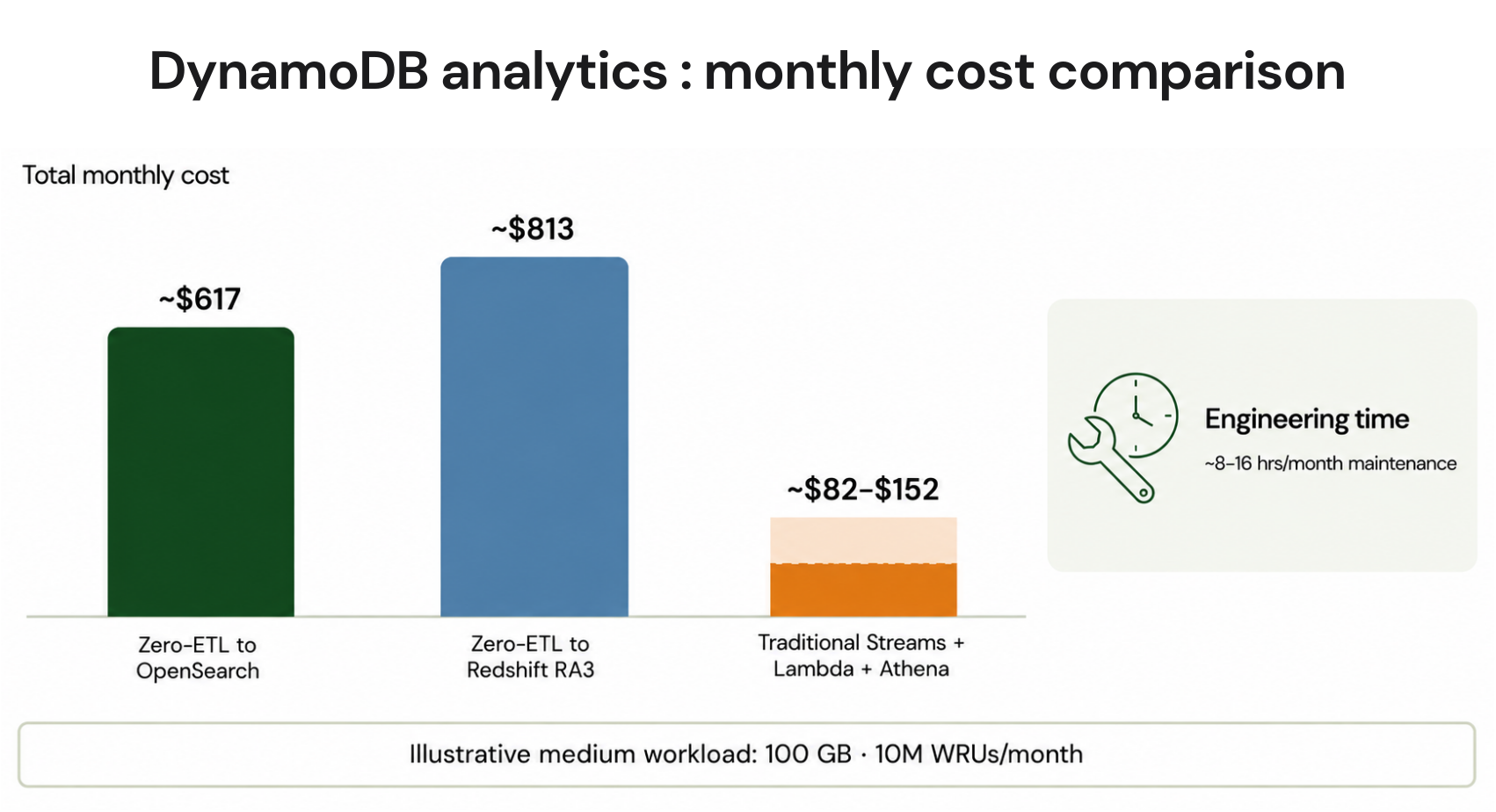
The traditional pipeline uses Streams plus a Lambda consumer plus Firehose or a custom script. Here is the medium workload (100 GB, 10M WRUs/month):| Component | Zero-ETL OpenSearch | Zero-ETL Redshift (RA3) | Traditional: Streams + Lambda + Firehose |
|---|---|---|---|
| DynamoDB PITR | $20/month | $20/month | Optional ($20/month) |
| DynamoDB Streams | $2/month (in OCU billing) | Not used (incremental exports) | $2/month (Lambda reads free) |
| Pipeline compute | $350/month (2 OCU) | Included in RA3 cluster cost | $30/month (Lambda + Firehose) |
| Analytics service | $245/month (managed cluster) | $793/month (RA3.xlplus) | $30–100/month (S3 + Athena) |
| Engineering time/month | ~2 hrs (monitoring) | ~2 hrs (monitoring) | ~8–16 hrs (maintenance) |
| Total monthly cost | ~$617 | ~$813 | ~$82–152 |
Two Cost Traps That Catch Teams Off-Guard
Trap 1: Idle Ingestion Pipelines Bill Continuously
An enabled ingestion pipeline bills its OCU minimum every hour, whether it processes one record or ten million. A 2-OCU minimum costs $350.40/month even with zero writes.The fix: start at 1 OCU and raise the minimum only when CloudWatch shows pipeline lag growing, a minimum of 4 when 1 suffices wastes about $525/month. For dev and test, pause the pipeline during idle periods to cut OCU costs by 50–80%.
Trap 2: Redshift Serverless Never Goes Fully Idle
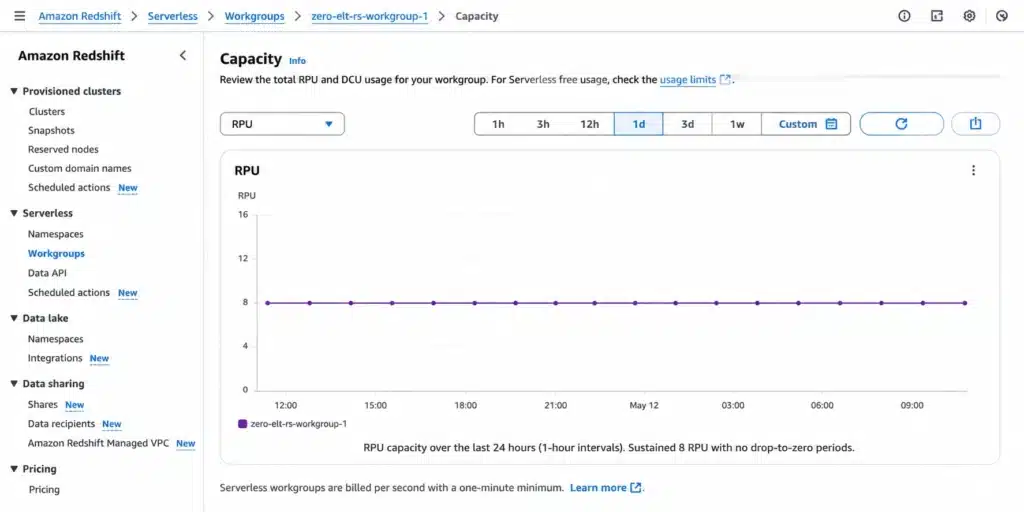
Redshift Serverless bills consumed RPU capacity rather than an always-on cluster rate. DynamoDB zero-ETL refresh activity can add RPU consumption beyond interactive query time, so estimate cost from observed RPU-seconds, refresh behavior, and workload metrics instead of assuming the workgroup will remain idle between queries.The fix: lengthen the REFRESH_INTERVAL on the target database beyond its 900-second (15-minute) default, it extends up to five days to batch cycles. Fully idle billing still isn’t guaranteed, so for cost-controlled environments, provisioned RA3 with Reserved Nodes removes the ambiguity.
Why this matters: replication-driven RPU consumption is workload-specific, so review Cost Explorer for Redshift Serverless usage and integration metrics after a representative test period, and verify your REFRESH_INTERVAL before your first billing cycle closes.
DynamoDB Zero-ETL Limitations That Affect Cost
Both integrations carry constraints with cost consequences. Multi-region deployments need a separate OpenSearch pipeline per region, multiplying OCU costs. Initial loads on large tables run for hours at elevated OCU consumption.On Redshift, replication writes compete with query throughput. Concurrency Scaling does not cover them.
When to Choose Zero-ETL vs Your Own Pipeline
Choose zero-ETL to OpenSearch when you lack dedicated data engineering, need to search within seconds of a write, can absorb the $175–700/month OCU minimums, and your table and cluster share a region and account.Choose zero-ETL to Redshift when you need SQL analytics tolerating 15–60 minutes of latency, want to join DynamoDB data with other Redshift sources, and plan on provisioned RA3 nodes to avoid the idle-billing trap.
Build your own pipeline when $600–900/month isn’t justified, you need sub-15-minute Redshift latency or cross-region replication, or your existing pipeline already runs reliably.
Before you enable zero-ETL
Redshift path is 15-minute minimum; OpenSearch is seconds.
Source table and target must share a region and account.
Start at 1; every extra minimum OCU is ~$175/month, idle or not.
Configure it before the first billing cycle closes.
Zero-ETL pays off only against 8–16 hrs/month of pipeline upkeep.
How Do You Optimize DynamoDB Zero-ETL Costs?
Use a Managed Cluster Instead of Classic Serverless
Serverless Classic carries a 2-OCU production floor (~$350/month for the collection alone). NextGen Serverless (GA May 28, 2026) removes that floor for new collections, which scale to zero after 10 idle minutes verify NextGen sink support and rates at Amazon OpenSearch Service Pricing.Managed clusters start at $0.036/hour for a t3.small.search (~$26/month). For steady workloads, a $100–200/month managed cluster beats the $350/month Classic floor once data exceeds a few GB.
Lengthen the Refresh Interval and Shrink the Source Table
Extending REFRESH_INTERVAL beyond the 900-second default batches cycles and reduces wake-ups; the trade-off is staleness, which reporting tolerates. On the source side, DynamoDB TTL removes expired data, cutting both the $0.20/GB-month PITR charge and the volume each cycle moves PITR economics are in [DynamoDB Export to S3 Cost].How Usage.ai Optimizes DynamoDB Costs
Zero-ETL doesn’t change your source table’s cost provisioned throughput remains the largest line item in the total analytics stack, and optimizing it matters as much as tuning OCUs or refresh intervals.We analyze your usage data and recommend qualifying commitments sized to stable eligible throughput.
With Flex Insured Commitments, teams can get the 30–40% savings of a 1-year commitment with none of the commitment risk.
If eligible usage drops and a qualifying DynamoDB Flex Commitment ends up costing more than the on-demand rate for that usage, we provide cashback protection on that difference, subject to program terms.
Our fee is a percentage of realized savings only. If we don’t save you money, you don’t pay anything.
[See how much you can save on DynamoDB with Usage.ai →]
Connect in 15 minutes. No contracts, no infrastructure changes. See your savings before committing.
Frequently asked questions
How much does DynamoDB zero-ETL to OpenSearch cost?
Roughly $350–$525/month minimum for a small table, driven by mandatory PITR and the OCU floors: the pipeline's 1-OCU minimum ($175/month) plus the collection Classic Serverless production requires 2 OCUs (~$350/month). NextGen removes the collection floor for new deployments (verify at Amazon OpenSearch Service Pricing rates change).
How much does DynamoDB zero-ETL to Redshift cost?
The integration is free. Costs include PITR ($0.20/GB-month), the initial export ($0.10/GB), ongoing incrementals, and Redshift compute at $0.375/RPU-hour on Serverless. The warning: replication cycles can keep a workgroup active far beyond query hours (verify at Amazon Redshift pricing rates change).
What is the minimum latency for DynamoDB zero-ETL to Redshift?
15 minutes, unsuitable for near-real-time dashboards but appropriate for reporting and batch analytics. DynamoDB-to-OpenSearch achieves seconds via Streams-based change capture.
Does DynamoDB zero-ETL to Redshift consume RCUs?
No. The Redshift integration replicates via incremental exports built on PITR, which never touch your table's read capacity. Streams read for the OpenSearch path also bill separately from RCUs details in [DynamoDB Streams Pricing].
Can you use DynamoDB zero-ETL across regions or accounts?
For OpenSearch: cross-region and cross-account are not supported as of April 2026. For Redshift: cross-region is not supported, but cross-account works via the Redshift ARN from another account.