
 AWS
 Microsoft Azure
 Google Cloud


What both platforms actually solve
Cloud providers offer discounted rates in exchange for commitments to usage or spend. The challenge is deciding how much to commit, which instruments to use, and when to purchase as workloads change.Usage.ai and ProsperOps analyze usage and existing commitments, then manage commitment portfolios around expected demand. This reduces the ongoing purchasing and monitoring work for FinOps teams. Our ProsperOps review examines its operating model and buyer considerations.
Both can help lower the rate paid for eligible usage. The underlying provider obligations still apply, so buyers need to evaluate changing demand, unused commitments, and vendor fees alongside projected savings.
Usage.ai vs ProsperOps at a glance
| What buyers compare | Usage.ai | ProsperOps |
|---|---|---|
| Commitment automation | Autopilot manages eligible commitments automatically | Autonomous Discount Management manages eligible commitments automatically |
| Cloud coverage | AWS, Azure, and Google Cloud | AWS, Azure, and Google Cloud |
| Purchasing control | Choose Autopilot or approval-based CoPilot per service | Autonomous execution within customer-defined portfolio targets and constraints |
| Underutilization protection | Cashback protection for eligible Flex Insured Commitments, subject to program terms | Portfolio strategies designed to reduce commitment risk |
| Fee calculation | On our savings-based model, an agreed percentage of realized savings covered by your agreement | Savings Share rates applied to defined savings categories |
| Existing commitments | We account for your existing portfolio when sizing new purchases; your agreement defines the fee base | Customer-procured commitment savings can fall within the fee base |
| Reporting and allocation | Savings, fees, cashback, and coverage reporting | Savings reporting and Intelligent Showback for supported AWS and Azure services |
| Exit economics | Remaining provider commitments and the end of eligible Flex protection determine exit exposure | Remaining provider commitments plus potential unrealized Savings Share charges |
For the financial details, see how we calculate savings, fees, and cashback and our ProsperOps pricing breakdown.
Which services and commitments do the platforms cover?
Both platforms support AWS, Azure, and Google Cloud, but cloud-level support does not establish coverage for every workload.Ask each vendor to map your billing data to the services, commitment instruments, and charge types it can actively manage. Distinguish production-ready capabilities from preview or Early Access offerings.
Review the current service coverage for each platform:
Usage.ai: AWS, Azure, and Google Cloud.
ProsperOps: Multi-cloud service coverage and Azure compute and database coverage.
The three layers of commitment risk
A commitment can fit your usage today and become a poor fit six months later. When comparing Usage.ai vs ProsperOps, ask how each platform adapts and what happens financially if usage still falls short.1. Your usage changes after you commit
A migration, rightsizing project, or product shutdown can change how much cloud capacity you need. Both platforms manage commitment portfolios to accommodate those changes.Our Autopilot adjusts future purchases as your usage evolves. ProsperOps uses customer-defined portfolio controls to guide its automated decisions. Staggered purchases and provider-supported exchanges can help, but commitments already purchased may still become underutilized.
2. Using less does not automatically mean paying less
Stopping a workload does not necessarily end the commitment supporting it. Your options depend on the cloud provider and commitment type. For example, AWS Savings Plans terms generally cannot be modified or canceled after purchase, although certain plans may qualify for a limited return windowAsk both vendors to show what you would still owe if a major workload disappeared halfway through the term.
3. Cashback helps with qualifying financial losses
We add cashback protection for eligible Flex Insured Commitments, subject to program terms. The calculation compares the eligible commitment cost with what the same usage would have cost On-Demand. An unused portion alone does not establish a qualifying loss.Our savings, fees, and cashback guide explains the calculation. Check which commitments qualify, when rebates settle, and how leaving the program affects eligibility.
How ProsperOps works
ProsperOps automates commitment management across AWS, Azure, and Google Cloud. You set portfolio targets and operating constraints, and the platform analyzes usage, accounts for existing commitments, and executes eligible actions automatically.The instruments and strategies vary by cloud and service.
Its operating model suits teams that want ongoing optimization without reviewing every transaction. You still guide the strategy through customer-defined settings, including commitment targets and, for applicable AWS purchases, approved prepayment budgets.
For your Usage.ai vs ProsperOps evaluation, ask how those controls accommodate planned migrations, rightsizing, and lower demand. Our ProsperOps review explores the platform’s operating model and buyer considerations.
Also review the Savings Share fee calculation. Fees can include savings from certain customer-procured commitments.
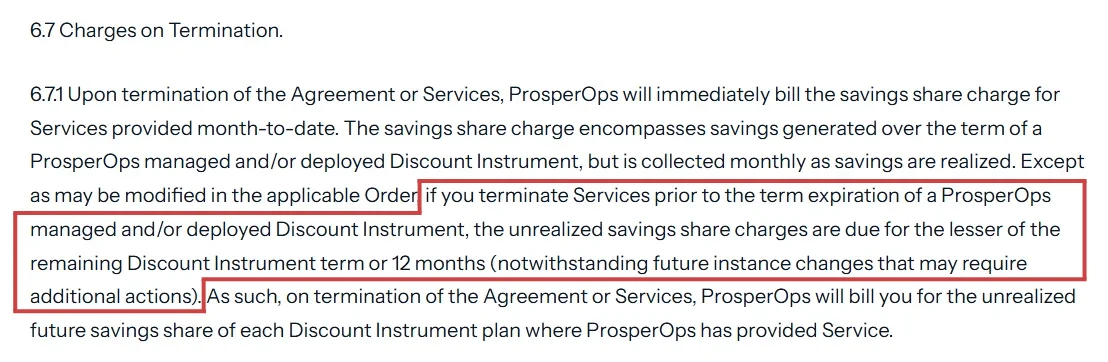
If you leave before managed commitments expire, ProsperOps’ published guidance describes a final charge on estimated future savings for the remaining instrument term, capped at 12 months, subject to your agreement.
How Usage.ai works
We analyze your usage and existing commitments, forecast expected demand, and build a commitment strategy around the eligible usage you expect to keep. As workloads change, we reassess the portfolio and adjust future purchasing decisions.You choose how purchases happen. Autopilot executes eligible recommendations automatically, while CoPilot lets your team review and approve them first. You can select the mode per service, automating stable workloads while keeping approval where business plans need closer review.
We also provide cashback protection for eligible Flex Insured Commitments. If an eligible commitment costs more than the same usage would have cost On-Demand, the qualifying difference may generate a rebate.
For your Usage.ai vs ProsperOps evaluation, compare projected savings, the applicable fee base, and qualifying protection together. Our savings, fees, and cashback guide explains how those figures affect the value you retain.
Who can authorize purchases or change settings.
Who can authorize purchases or change settings.
How approvals and commitment actions are recorded.
Pausing future purchases does not cancel commitments already purchased.
Usage.ai vs ProsperOps fees and net savings
The financial comparison should measure what each platform adds above your existing commitment strategy, after fees and unused commitment costs. Savings against On-Demand pricing alone can include discounts you already receive.Establish the same billing baseline
For a Usage.ai vs ProsperOps evaluation, ask both vendors to model the same accounts, services, usage period, negotiated rates, and existing commitments.Keep three figures separate:
On-Demand equivalent: What the evaluated usage would cost without commitment discounts, using the applicable rates.
Reference portfolio cost: What that usage would cost with your existing commitments and an explicitly defined renewal strategy.
Proposed portfolio cost: What that usage would cost under the vendor’s strategy, including amortized upfront payments, recurring commitment charges, unused commitment cost, and uncovered usage.
Reconcile the fee base by commitment category
On our savings-based model, the fee equals applicable realized savings multiplied by the agreed percentage. Your commercial agreement defines which commitments and savings enter that calculation.ProsperOps calculates Savings Share using defined savings categories. Its billing documentation includes customer-procured instruments within AWS Base Savings and Google Cloud Inherited Savings.
Buyers should request the applicable rate and dollar amount for each category, rather than apply one assumed percentage across the portfolio. See the ProsperOps billing definitions.
A lower fee percentage can still cost more
Consider two hypothetical proposals delivering the same cloud-provider cost:| Monthly economics | Proposal A | Proposal B |
|---|---|---|
| On-Demand equivalent | $120,000 | $120,000 |
| Cost with existing commitment strategy | $100,000 | $100,000 |
| Proposed cloud-provider cost | $75,000 | $75,000 |
| Savings against On-Demand | $45,000 | $45,000 |
| Additional savings above existing strategy | $25,000 | $25,000 |
| Illustrative fee basis | 20% of additional savings | 15% of savings against On-Demand |
| Vendor fee | $5,000 | $6,750 |
| Additional benefit retained after fees | $20,000 | $18,250 |
Proposal B’s lower percentage produces a higher fee because its base includes $20,000 of savings already generated by the reference portfolio.
Note: Always compare both proposals under expected usage and a realistic lower-demand scenario, including remaining commitment costs, vendor fees, and qualifying cashback.
Ownership, cancellation, and exit costs
Leaving a management platform does not automatically end your cloud commitments. Separate the remaining provider payments from vendor termination charges and the protection you may lose.With ProsperOps, you retain your commitment portfolio and take over its management. Its published fee guidance describes a final Savings Share charge on estimated future savings from certain managed commitments, covering the remaining instrument term up to 12 months, subject to your agreement.
With Usage.ai, ending the agreement also ends eligibility for Non-Usage Rebates under the current Flex Commitment Program terms, including qualifying underutilization incurred during the agreement. Account for accrued but unsettled cashback when assessing your exit timing.
Before signing, request an exit schedule showing:
Remaining commitments, payment obligations, and expiry dates.
Final vendor fees and how they are calculated.
When protection ends and how pending rebates are treated.
Who manages the portfolio after handoff.
Usage.ai vs ProsperOps: which platform fits your team?
Choose Usage.ai when
You need autonomous purchasing for some services and approval-based CoPilot for others.
Cashback protection for eligible Flex Insured Commitments addresses a financial risk your team wants covered.
Our proposal demonstrates stronger incremental savings after fees, with coverage that fits your workloads.
Choose ProsperOps when
You prefer autonomous execution governed by portfolio targets rather than individual purchase approvals.
Its Intelligent Showback capabilities fit your commitment cost-allocation requirements.
Its proposal delivers stronger net economics after accounting for the complete Savings Share schedule and exit charges.
Compare Usage.ai with ProsperOps on coverage, fees, controls, and cashback protection.
Frequently asked questions
What is the main difference between Usage.ai and ProsperOps?
Both automate cloud commitment management. We offer Autopilot or approval-based CoPilot per service, plus cashback protection for eligible Flex Insured Commitments. ProsperOps executes autonomously within customer-defined portfolio controls. Compare eligible coverage, fees, and protection terms for your environment.
Can I evaluate Usage.ai while still using ProsperOps?
Yes. Our read-only Savings Test evaluates existing commitments and potential additional savings without authorizing purchases.
Does switching to Usage.ai automatically protect my existing commitments?
No. We account for your existing commitments when evaluating new purchases, but connecting your account does not automatically make that portfolio eligible for cashback. Existing commitments and eligible Flex Insured Commitments are treated separately; protection depends on program requirements and applicable terms.
Which platform delivers more savings after fees?
There is no universal winner in Usage.ai vs ProsperOps. Compare the additional savings each proposal delivers above your existing strategy, using the same usage, negotiated rates, and evaluation period.
Include the complete fee base, unused commitment costs, qualifying cashback, and termination charges. A lower fee percentage alone does not establish better net savings.
Do I need to connect my cloud account for a comparison demo?
No. We can explain our coverage, purchasing controls, pricing approach, and cashback eligibility without account access. An account-specific savings estimate requires a separate billing and usage review. Bring your questions and vendor shortlist so we can discuss the differences that matter to your team.
If you notice any material information that is incorrect, outdated, or no longer applicable, please contact us at [email protected]. We’ll review the information and update the article where appropriate.