
 AWS
 Microsoft Azure
 Google Cloud


What Finout already does, and why teams consider alternatives
Finout combines cloud, Kubernetes, data platform, and AI spending into one financial view. MegaBill consolidates costs, while Virtual Tags help allocate spending across products, teams, and customers.It also provides optimization capabilities:
CostGuard: Identifies idle resources, rightsizing opportunities, and potential commitment savings.
CostOptimizer: Supports Reserved Instance management and documented automation capabilities. Confirm purchasing scope by plan and instrument.
Financial management: Offers budgeting, forecasting, allocation, and unit economics.
Allocation needs: More detailed product-level or customer-level cost analysis.
Execution gaps: Better automation for supported optimization opportunities.
Commitment management: Different purchasing controls or financial protection.
Broader governance: Financial oversight across more technology spending.
Commercial fit: Pricing and implementation requirements better aligned with the business.
Whether an alternative offers better value depends on what it can improve after fees and implementation costs.
How we compared Finout alternatives
We evaluated six platforms using official product documentation, published pricing, cloud coverage, and optimization capabilities.Our main criteria were:
Reporting and cost allocation capabilities
Supported cloud providers and commitment instruments
Recommendations versus actual execution
Financial-risk treatment and commercial terms
Whether a platform can replace or complement Finout
Finout alternatives compared at a glance
| Platform | Cloud and execution scope | Role versus Finout | Financial-risk treatment | Pricing |
|---|---|---|---|---|
| Usage.ai | Eligible AWS, Azure and GCP commitment management through CoPilot or Autopilot | Specialist complement | Flex Cashback Protection | Share of realized savings |
| CloudZero | Cloud/AI allocation, unit economics and recommendations | Reporting replacement | Verify contractual remedy | Custom quote |
| Vantage | Multi-cloud reporting; AWS Savings Plan Autopilot and supported RI purchases through FinOps Agent | Reporting alternative | Verify contractual remedy | Published plans + 5% Autopilot fee |
| IBM Cloudability | Multi-cloud allocation, planning and commitment analysis | Broad replacement | Verify contractual remedy | Quote-based |
| Flexera One FinOps | Package-dependent; outcome-based ProsperOps+ options | Broad replacement | Verify contractual remedy | Package-dependent |
| Harness | AWS, Azure and GCP visibility, workload automation and commitment orchestration | Replacement or complement | Verify contractual remedy | Package-dependent |
The 6 best Finout alternatives
1. Usage.ai: best for automated commitment savings with financial protection
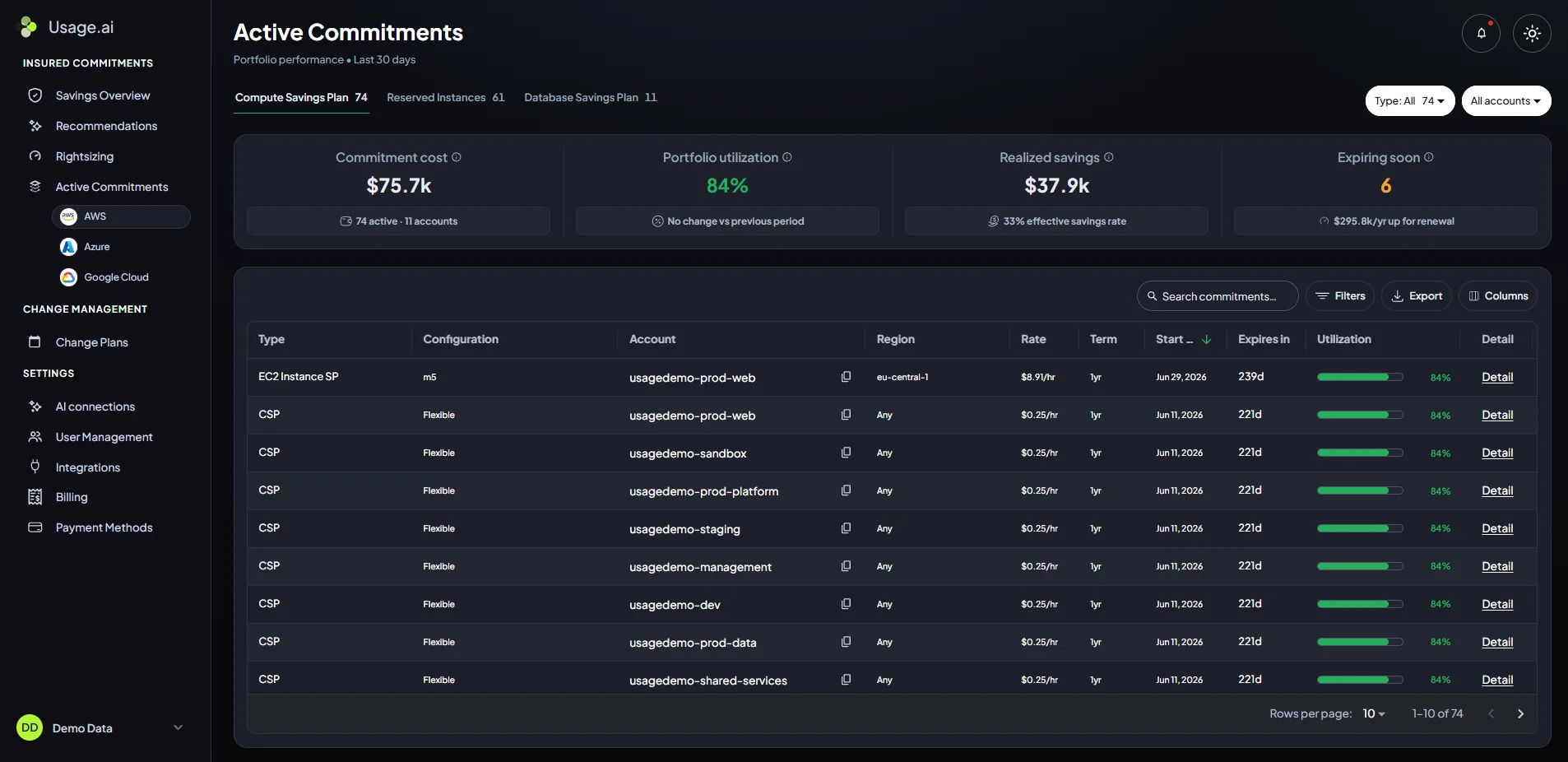
At Usage.ai, we help businesses reduce cloud costs by identifying and managing eligible commitments. We analyze usage patterns and existing coverage to find additional savings opportunities while keeping purchasing decisions aligned with changing demand.
How it compares to Finout
Finout combines cost reporting, allocation, and optimization, including documented commitment-management capabilities. We specialize in ongoing commitment purchasing, with approval-based or automated execution and conditional Cashback Protection.
For teams already using Finout, we can complement their existing reporting and governance workflows rather than requiring a complete platform replacement.
Pros
✅ Automated commitment management: Our Autopilot purchases eligible commitments within authorized controls, while CoPilot lets teams approve individual recommendations.
✅ Multi-cloud savings: We optimize eligible AWS, Azure, and Google Cloud commitments based on usage patterns and existing coverage.
✅ Cashback Protection: Our Flex Insured Commitments provide conditional financial protection when qualifying commitments become underutilized.
✅ No workload disruption: We manage commitments at the billing layer without stopping, resizing, or modifying production infrastructure.
✅ Read-only evaluation: Our Savings Test helps identify potential additional savings before purchasing access is authorized.
❌ Specialized capabilities: We focus on cloud commitment optimization and savings rather than Finout’s broader cost allocation, budgeting, and unit-economics features.
We charge an agreed percentage of realized savings from eligible Usage.ai-managed commitments, rather than charging for savings generated by commitments customers already owned.
Bottom line
If Finout already handles your cloud cost reporting, we can help capture additional AWS, Azure, and GCP commitment savings through managed purchasing and conditional Cashback Protection, without replacing your existing platform.
2. CloudZero: best for unit economics
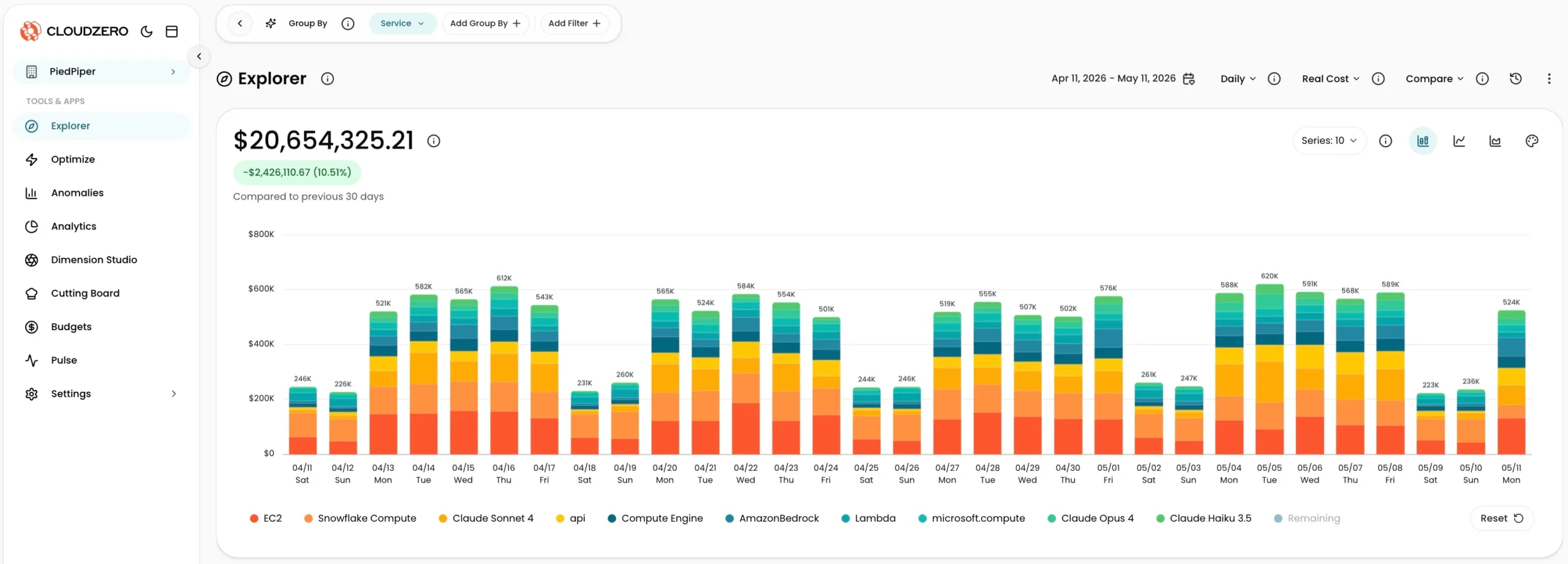
CloudZero connects cloud spending with business metrics, helping teams evaluate whether infrastructure costs are increasing faster than business activity.
How it compares to Finout
Both CloudZero and Finout support unit economics and cloud cost allocation. The key difference to evaluate is how effectively each platform connects spending to your products, customers, and business metrics.
Pros
✅ Business-level allocation: Connects costs to products and customers.
✅ Unit economics: Measures cost per customer, transaction, or other business metric.
✅ Cost intelligence: Offers forecasting, anomaly detection, and recommendations.
❌ Overlapping capabilities: Finout already supports unit economics. Ask CloudZero to reproduce a complex allocation using your actual data before switching.
❌ Quote-based pricing: Custom-quoted subscriptions make upfront cost comparisons harder without a proposal.
CloudZero offers custom-quoted subscriptions. For a closer look at its pricing model and factors that influence costs, read our CloudZero pricing guide
Bottom line
CloudZero is relevant when financial attribution matters more than automated commitment purchasing.
3. Vantage: best for reporting and AWS Savings Plan automation
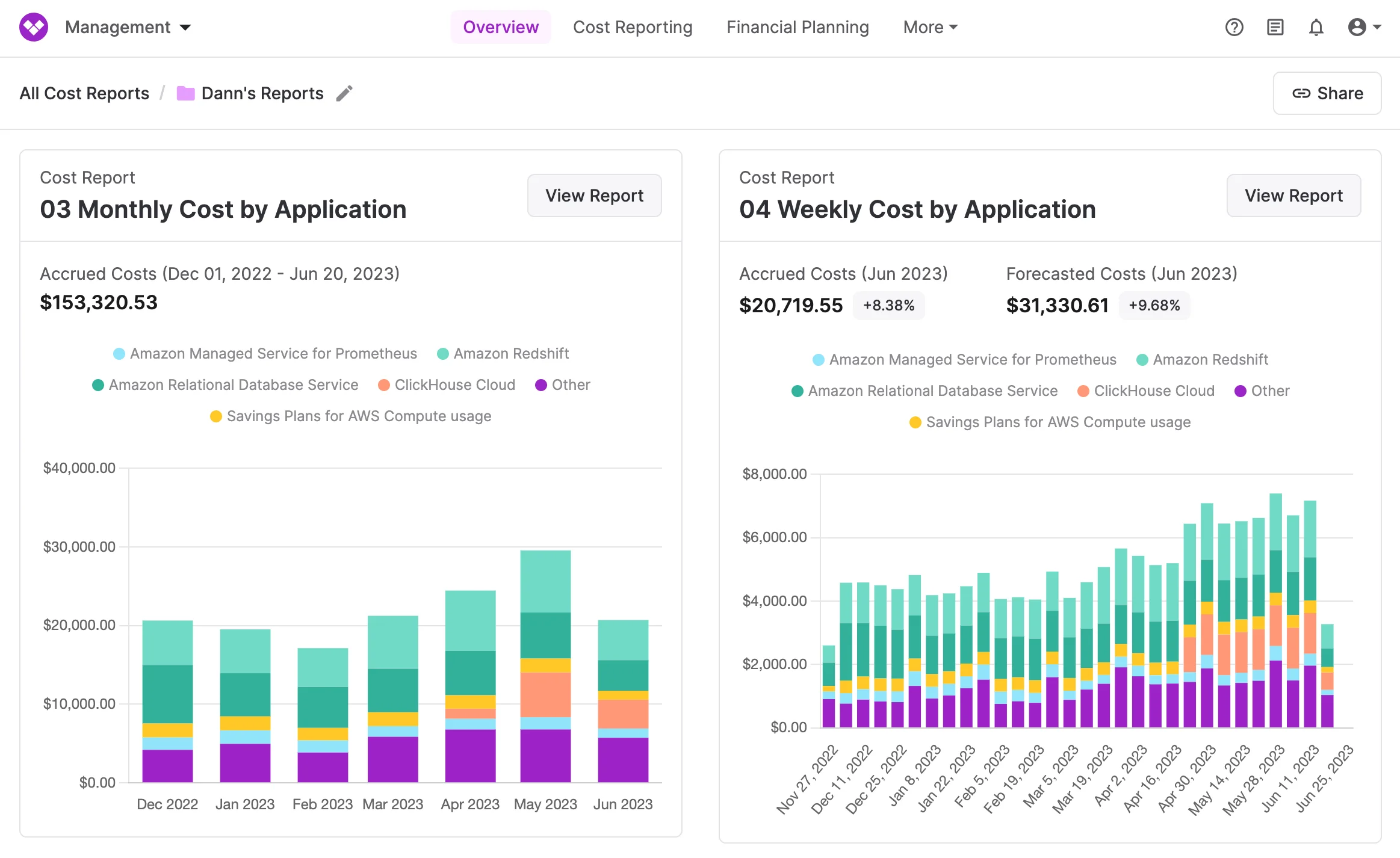
Vantage combines spending reports, budgets, virtual tagging, and unit-cost analysis.
How it compares to Finout
Vantage combines multi-cloud reporting with AWS commitment automation through Autopilot and its FinOps Agent. Alongside Savings Plans, the FinOps Agent supports purchases of several AWS Reserved Instance types. Compare its purchasing controls and supported instruments with Finout’s commitment-management capabilities.
Pros
✅ Cost visibility: Reporting across supported cloud services.
✅ AWS Autopilot: Automatic or approval-based Savings Plan purchases.
✅ Published pricing: Entry-level subscription prices available online.
❌ AWS-focused commitment automation: Documented FinOps Agent commitment purchases cover supported AWS Savings Plans and Reserved Instances. Don't assume equivalent purchasing capabilities for Azure or Google Cloud.
❌ Extra costs and limits: Tracked-spend limits apply, and Autopilot separately charges 5% of realized savings. Compare total fees.
Its pricing includes Starter at no charge, Pro at $30/month, Business at $200/month, and custom Enterprise plans. Tracked-spend limits apply.
Autopilot separately charges 5% of realized savings.
Bottom line
Vantage is worth evaluating when both reporting and AWS Savings Plan execution matter.
4. IBM Cloudability: best for enterprise financial governance
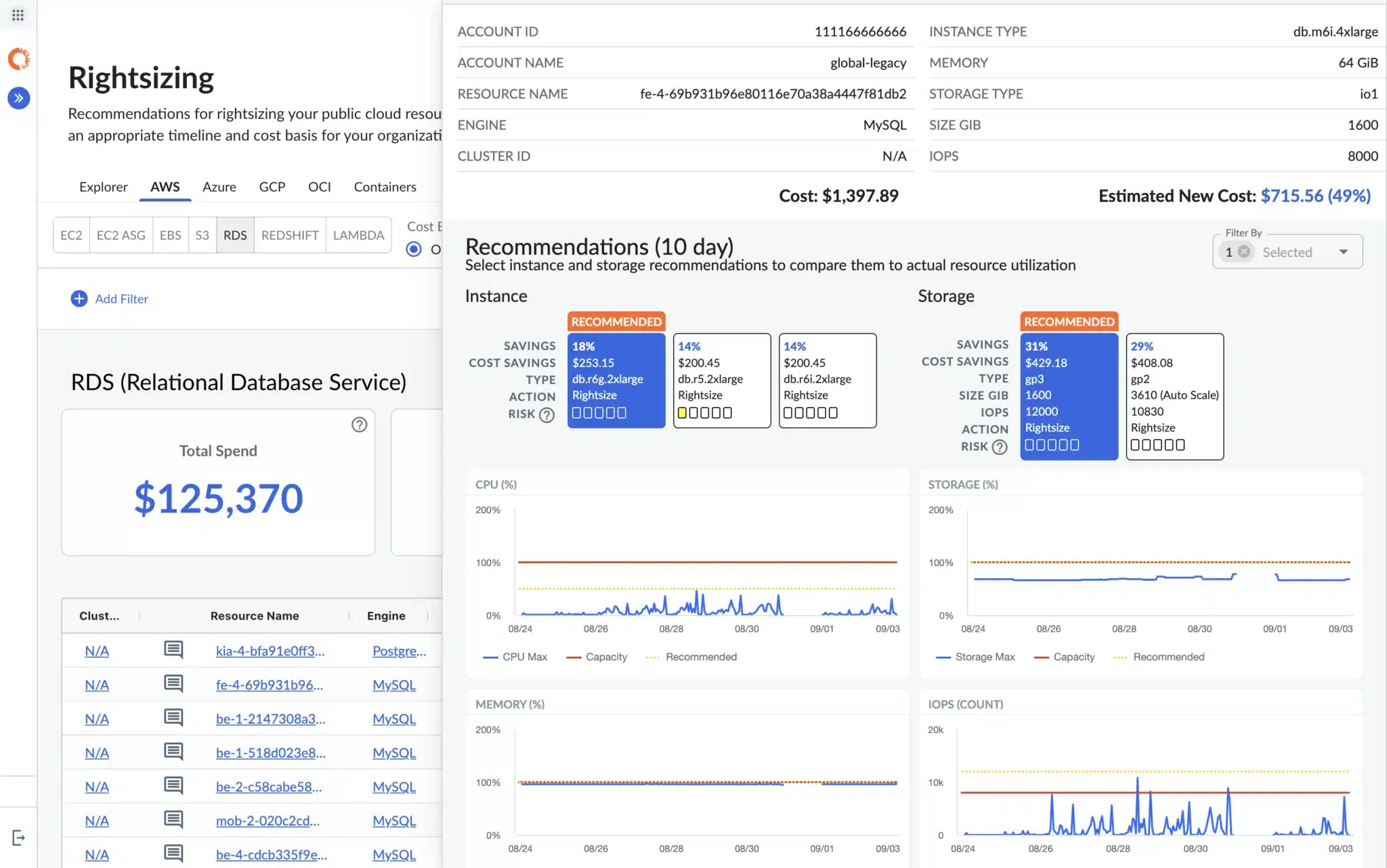
IBM Cloudability provides cost visibility, allocation, financial planning, and optimization.
How it compares to Finout
Both Finout and IBM Cloudability support allocation and optimization; Cloudability is relevant when enterprise-wide financial planning is a priority.
Pros
✅ Cost allocation: Organizes spending across financial owners.
✅ Planning: Supports budgets, forecasts, and unit economics.
✅ Optimization: Includes commitment analysis and additional capabilities by edition.
❌ Edition-dependent capabilities: Confirm which package includes your required financial planning, commitment management, and execution capabilities.
❌ Quote-based pricing: A direct cost comparison requires a quote for the relevant edition and features.
IBM offers Essentials, Standard, and Premium, with functionality varying across packages.
Request a quote through IBM Cloudability. For a detailed breakdown of pricing, overages, and contract terms, read our IBM Cloudability pricing guide.
Bottom line
Cloudability fits enterprise-wide financial accountability. It may be broader than necessary for commitment management alone.
5. Flexera One FinOps: best for broader technology-spend governance
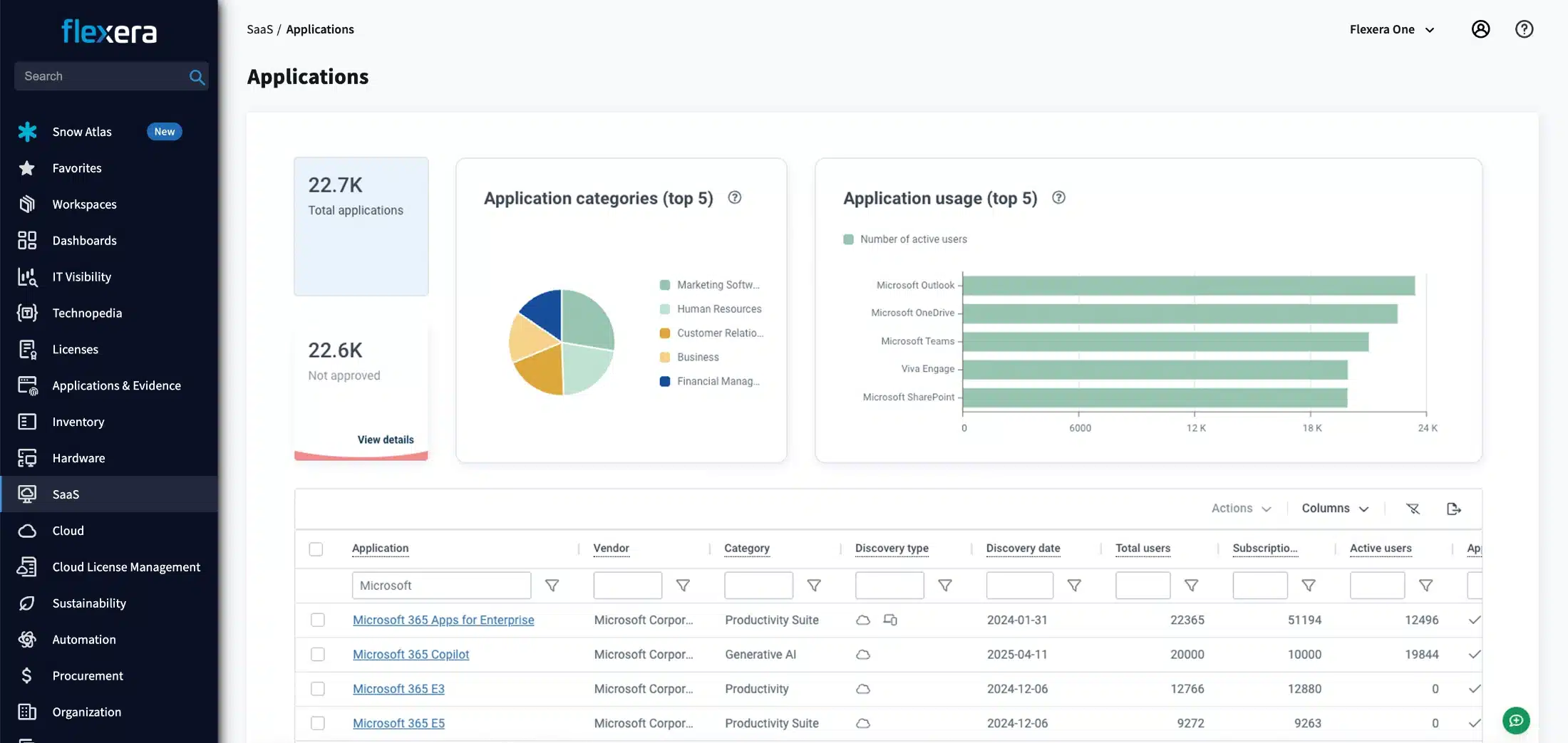
Flexera One FinOps provides allocation, forecasting, governance, and optimization across its portfolio.
How it compares to Finout
Finout combines cost reporting and optimization, while Flexera One FinOps addresses broader technology-spend governance.
Pros
✅ Financial governance: Coordinates reporting and cost controls.
✅ Workload optimization: Addresses unnecessary infrastructure consumption.
✅ Commitment management: Its ProsperOps portfolio supports autonomous commitment optimization across AWS, Azure, and Google Cloud.
❌ Module-dependent features: Ask which modules, purchasing controls, and automation capabilities are included in the quote. For more on commitment automation and risk protection, read our Usage.ai vs ProsperOps comparison .
❌ Package-dependent pricing: Costs depend on the products and commercial arrangement, making quick upfront comparisons difficult.
Pricing depends on the selected products and commercial arrangement. Flexera also offers outcome-based pricing options through ProsperOps+ bundles, so buyers should confirm which capabilities and savings calculations apply to their quote. Read our Flexera pricing guide to understand its pricing structure and potential contract costs.
Bottom line
Flexera makes sense when the organization needs a broader FinOps operating model rather than one specialist tool.
6. Harness: best for engineering-led optimization
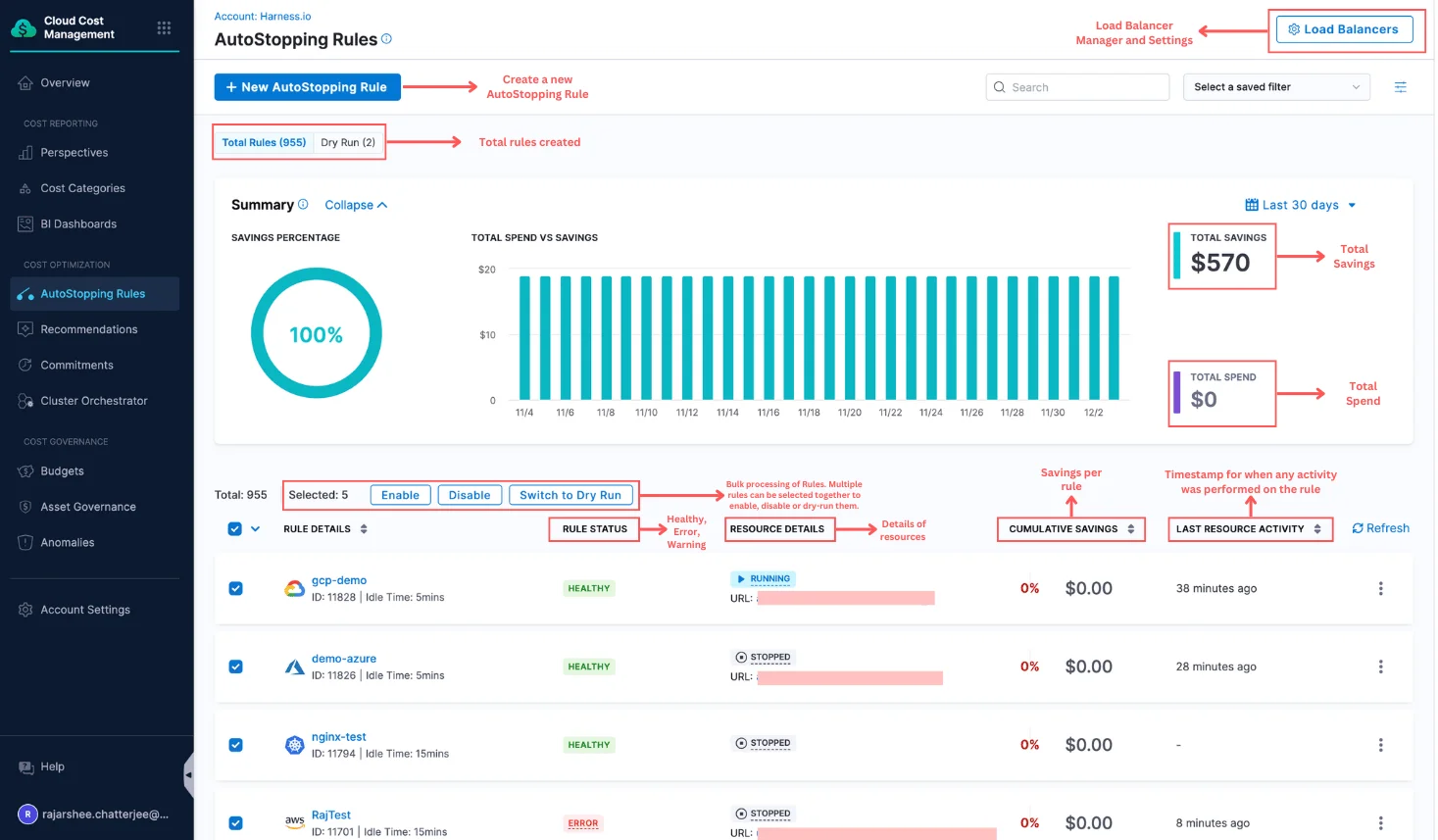
Consider a development environment running all weekend without being used. A discount lowers its hourly rate, but stopping unnecessary resources may save more.
How it compares to Finout
Both platforms address cloud cost optimization, but Harness also emphasizes engineering-led workload automation such as AutoStopping.
Pros
✅ AutoStopping: Stops support idle workloads and restarts them when required.
✅ Kubernetes optimization: Helps improve cluster resource efficiency.
✅ Commitment Orchestrator: Supports automated commitment purchases and coverage management.
❌ Workload suitability: Confirm AutoStopping eligibility and restart behavior for your environments before making changes.
❌ Configuration and scope: Check required permissions and supported commitment types.
Pricing varies by product and contract. Harness’s published licensing terms describe tracked-spend-based fees for certain optimization modules, including Commitment Orchestrator and AutoStopping. Read our Usage.ai vs Harness guide.
Bottom line
Harness is relevant when engineering-led workload changes and commitment optimization are both priorities.
Should you replace Finout or add another platform?
Not every improvement requires replacing your existing FinOps software.Keep Finout: When allocation, reporting, and existing optimization features already meet your needs.
Add a specialist: When reporting works but workload automation or commitment execution needs improvement.
Replace Finout: When another platform can demonstrate better results for your essential reporting, governance, or optimization workflows. For example, a company with accurate Finout reporting but uncovered eligible AWS compute usage may benefit more from commitment management than rebuilding its allocation system.
Six questions to ask before buying
Use the same billing history, existing commitments, and workload assumptions for every shortlisted provider.Which clouds can you actively optimize? Confirm supported services, commitment types, accounts, and regions.
Who controls purchases? Separate recommendations, approvals, and automatic execution.
What happens to existing commitments? Check ownership, remaining terms, and overlapping coverage.
What if usage declines? Verify financial exposure and contractual protection.
What's the complete cost? Include subscriptions, fees, implementation, and ongoing work.
Can you demonstrate additional value? Compare the proposed result with your current approach.
This makes the evaluation about financial and operational outcomes rather than feature counts.
How to compare the savings your team keeps
A larger advertised discount doesn’t always mean a better financial outcome.Compare proposals using the same usage baseline, negotiated rates, and existing commitments.
For example, $30,000 in incremental provider savings, minus $6,000 in fees and $2,000 in other costs, leaves $22,000 in retained benefit before qualifying rebates.
These numbers are illustrative. Repeat the calculation assuming usage declines to see whether the strategy remains worthwhile.
What should your next FinOps platform actually improve?
Switching platforms only makes sense if the new solution fixes a problem your current setup can’t solve effectively. Better dashboards won’t help much if your biggest challenge is turning cloud cost opportunities into actual savings.Before choosing a Finout alternative, focus on three things:
Real savings: What additional value can the platform deliver beyond existing discounts?
Execution: Does it only recommend changes, or can it help implement them?
Financial impact: What savings remain after fees, implementation costs, and commitment risks?
At Usage.ai, we focus on improving cloud commitment savings through managed purchasing and Cashback Protection for qualifying Flex Commitment losses.
Final verdict
The best Finout alternative depends on what your business needs to improve, whether that’s cost visibility, governance, workload optimization, or commitment savings. If Finout already handles reporting well, replacing it may be unnecessary. Usage.ai can complement your existing setup with automated AWS, Azure, and GCP commitment management and conditional Cashback Protection.If Finout handles your reporting, explore additional commitment savings without replacing your existing platform.
Explore AWS, Azure, and GCP commitment savings with a read-only Savings Test—no purchasing approval needed.
Frequently asked questions
What are the best Finout alternatives in 2026?
Usage.ai, CloudZero, Vantage, IBM Cloudability, Flexera One FinOps, and Harness are six options worth comparing. They address different needs, including unit economics, cost reporting, enterprise governance, infrastructure optimization, and commitment management. The right choice depends on which capabilities you need to replace or improve.
Is there a cheaper alternative to Finout?
Potentially. Vantage publishes paid plans starting at $30/month alongside a free tier, while Finout uses fixed quoted pricing. However, Vantage has tracked-spend limits and an additional AWS Autopilot fee. Compare your actual spending, required features, and total costs before deciding.
Does Finout automate cloud commitments?
Finout documents CostOptimizer, AWS Reserved Instance management, and commitment recommendations through CostGuard. Its public website also describes an opt-in Orchestration agent for approved optimization actions. Confirm the supported cloud services, commitment instruments, purchasing permissions, and automation features included in your plan.
Can Usage.ai replace Finout?
We can address eligible commitment optimization, but we don’t replace Finout’s complete cost allocation, budgeting, or unit-economics capabilities. If those already work well, using both may be appropriate. Keep purchasing responsibilities separate and measure only the additional savings generated.
What happens to commitments if we cancel Finout?
Cloud-provider commitments generally remain active in their respective accounts after a third-party FinOps subscription ends. Existing provider payment obligations don’t automatically disappear. Review cancellation terms, inventory active commitments, and transfer purchasing responsibility before disconnecting the platform.
If you notice incorrect or outdated information, contact us at [email protected]. We’ll review it and update the article where appropriate.