.png)



Cloud computing was supposed to make infrastructure cheaper and easier to manage. Instead, for many organizations, cloud spending has become one of the hardest parts of operating modern software.
Cloud pricing is flexible — and that flexibility creates complexity. One of the biggest complexities comes from commitment-based discounts like Savings Plans or Reserved Instances. These programs can significantly reduce compute costs, but they require organizations to commit to future usage. If workloads change, teams risk paying for capacity they no longer need.
This is why many organizations struggle with continuous cloud cost optimization. Costs do not just need to be optimized once — they must be monitored, adjusted, and improved continuously as infrastructure evolves.
This guide breaks down the 10 biggest cloud cost optimization challenges organizations face today, and the specific practices that solve each one. Understanding these challenges is the first step toward building a sustainable cloud cost strategy.
Why Cloud Cost Optimization Is So Difficult
Before diving into specific cloud cost optimization challenges, it is important to understand why controlling cloud spend is inherently difficult. Unlike traditional infrastructure, where costs were relatively predictable, cloud environments are dynamic, distributed, and constantly changing.
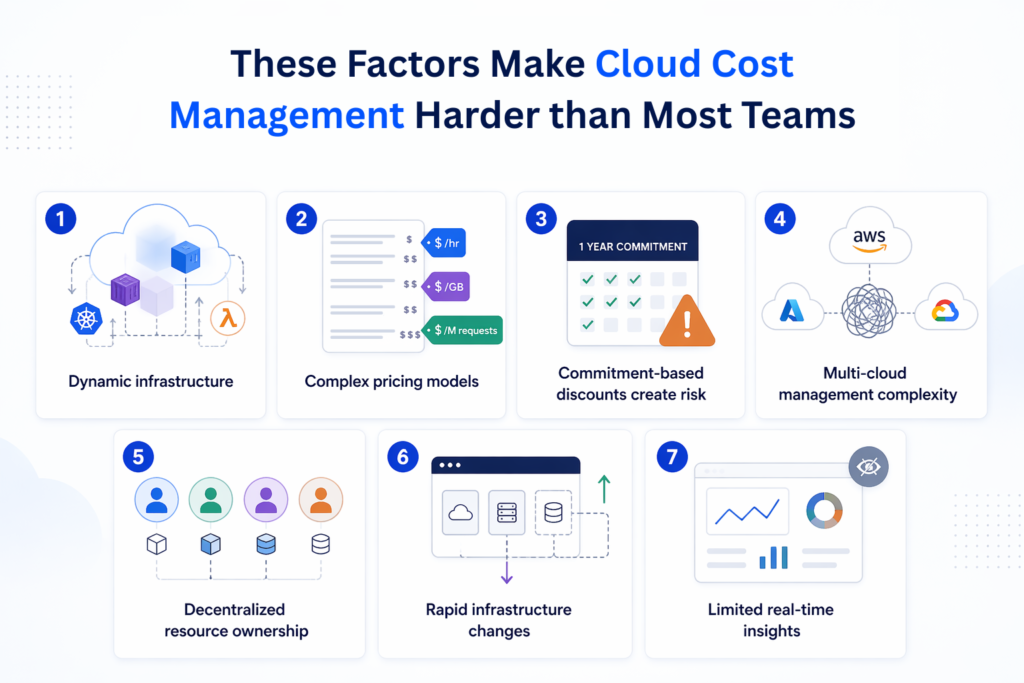
Several structural factors make cloud cost management harder than most teams expect:
- Dynamic infrastructure: Cloud resources scale automatically. Instances, containers, and services can start or stop within seconds, which means costs change continuously.
- Complex pricing models: Cloud providers offer multiple pricing options such as on-demand, reserved capacity, Savings Plans, and spot instances. Choosing the right mix is difficult without dedicated tooling.
- Commitment-based discounts create risk: Discounts like Savings Plans or Reserved Instances reduce costs but require long-term commitments. If usage drops, organizations may pay for unused capacity.
- Multi-cloud management complexity: Many organizations use multiple cloud providers (AWS, Azure, GCP). Each has different pricing models, billing tools, and optimization strategies.
- Decentralized resource ownership: Engineers can launch resources independently, which speeds up development but can lead to uncontrolled spending.
- Rapid infrastructure changes: Modern architectures like microservices, containers, and autoscaling change constantly, making continuous cloud cost optimization necessary.
- Limited real-time insights: Many cloud cost tools provide delayed recommendations, which means teams often discover inefficiencies after costs have already accumulated.
Because of these factors, managing cloud spending requires more than simple budgeting. It requires ongoing monitoring, automation, and strategic cost optimization practices.
The 10 Biggest Cloud Cost Optimization Challenges
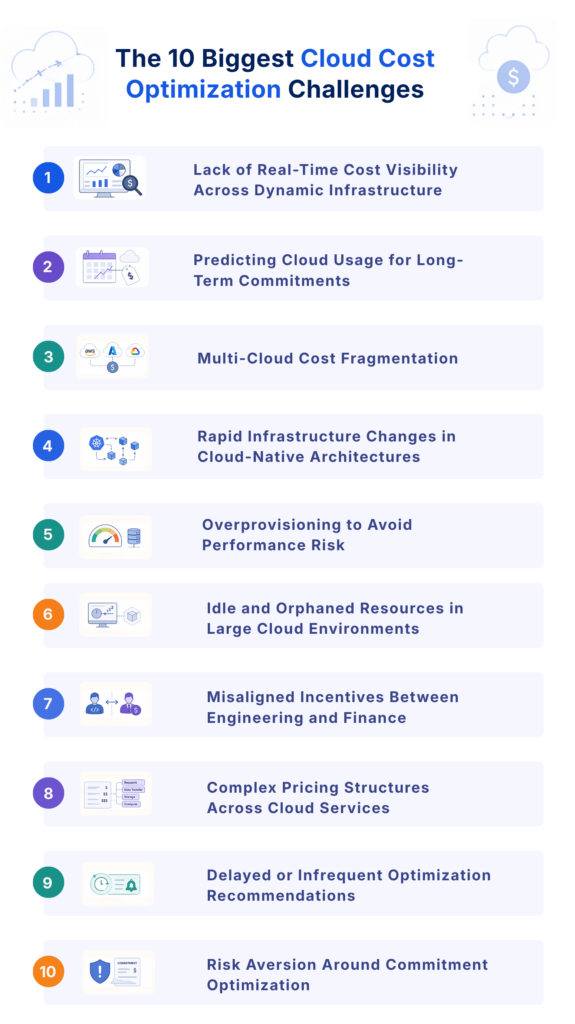
1. Lack of Real-Time Cost Visibility Across Dynamic Infrastructure
One of the biggest cloud cost optimization challenges is understanding where money is actually being spent in real time.
Cloud environments are highly dynamic. Resources such as EC2 instances, containers, and serverless functions can be created and destroyed within minutes. However, most cost reporting tools operate on delayed billing data — which means teams are often looking at yesterday’s infrastructure while today’s costs continue to grow.
This creates a fundamental FinOps problem: engineering teams deploy resources instantly while finance teams analyze spending hours or days later. The result is that cost anomalies — runaway workloads or misconfigured autoscaling — may go unnoticed until significant spending has already occurred.
AWS Cost Explorer refreshes every 72+ hours. Usage.ai refreshes every 24 hours. At $6-12K/day in uncovered spend, that 3-day lag compounds to $18K+ per refresh cycle — a measurable business outcome, not just a reporting preference.
2. Predicting Cloud Usage for Long-Term Commitments
Commitment-based discounts are one of the most powerful cloud cost optimization strategies. Programs such as Savings Plans, Reserved Instances, and committed-use discounts can reduce compute costs significantly. However, these discounts require organizations to predict their infrastructure usage months or years in advance.
This prediction is difficult because modern cloud architectures evolve rapidly. Workloads may migrate to containers, serverless architectures may replace traditional compute, or new product features may drastically increase traffic.
If usage grows faster than expected, organizations undercommit and miss potential savings. If usage declines, they overcommit and pay for unused capacity. This uncertainty is one of the main reasons many companies leave commitment coverage — and significant savings — on the table.
3. Multi-Cloud Cost Fragmentation
As organizations adopt multiple cloud providers, cloud cost management becomes fragmented across platforms. Each provider introduces its own pricing models, billing formats, discount programs, and cost management tools.
- AWS offers Savings Plans and Reserved Instances
- Azure provides Reservations and Hybrid Benefits
- GCP uses Committed Use Discounts
Because these programs differ in structure and flexibility, FinOps teams struggle to maintain a unified optimization strategy across providers. Instead of optimizing one environment, teams must constantly evaluate multiple pricing ecosystems simultaneously.
4. Rapid Infrastructure Changes in Cloud-Native Architectures
Modern applications are built using microservices, containers, and autoscaling systems, which dramatically increase infrastructure variability. Kubernetes clusters scale nodes dynamically, autoscaling groups add compute instances during traffic spikes, and CI/CD pipelines launch temporary environments during deployments.
These systems are not designed for cost predictability. Infrastructure consumption patterns may change daily or even hourly, making static optimization strategies ineffective. Cloud cost optimization therefore becomes a continuous operational process, not a quarterly review.
5. Overprovisioning to Avoid Performance Risk
Developers are typically incentivized to prioritize reliability over cost efficiency. When launching infrastructure, engineers often allocate more resources than necessary to ensure applications remain stable under peak load — provisioning larger instance sizes than required, allocating excess storage capacity, and maintaining larger Kubernetes clusters than workloads demand.
While this reduces performance risk, it results in significant resource underutilization. At scale, overprovisioning can account for 20-35% of total cloud spend at organizations without active rightsizing programs.
6. Idle and Orphaned Resources in Large Cloud Environments
Another major cloud cost management challenge is the accumulation of unused infrastructure. Teams frequently create temporary environments for testing, experimentation, and feature development — but these resources are not always decommissioned when projects end. Common examples include unattached storage volumes, unused load balancers, inactive Kubernetes namespaces, and abandoned development clusters. For a structured approach to finding these, see: cloud waste.
Because these resources are rarely visible in day-to-day operations, they often remain active for long periods — quietly increasing cloud spending without delivering any business value.
7. Misaligned Incentives Between Engineering and Finance
Cloud cost optimization is also an organizational challenge. Engineering teams focus on product velocity, system reliability, and scalability. Finance teams focus on budget predictability, cost reduction, and financial efficiency.
Without a structured FinOps culture, these priorities conflict. Engineers deploy infrastructure rapidly to support product growth while finance teams attempt to control spending after the fact. This misalignment makes sustainable cloud cost governance difficult to implement. For a deeper look at why this pattern persists, see: why cloud cost management fails.
8. Complex Pricing Structures Across Cloud Services
Cloud providers offer hundreds of services, each with its own pricing model. Costs may depend on compute instance type, storage performance tiers, network data transfer, and regional pricing differences. Many services use consumption-based billing where pricing depends on API calls, compute hours, storage operations, and data processing volume.
This complexity makes it extremely difficult to accurately forecast cloud costs or identify the most efficient pricing models — particularly in multi-cloud environments where no single billing standard applies.
9. Delayed or Infrequent Optimization Recommendations
Many native cloud optimization tools generate recommendations on weekly or monthly intervals. While useful, they are often too slow for modern cloud environments where workloads evolve rapidly. Infrastructure patterns may change between deployments, new services may be introduced frequently, and traffic patterns may shift unexpectedly.
When optimization insights arrive too late, organizations miss savings windows that close quickly. The cost of delay is not abstract — at $6-12K/day in uncovered spend, even a 3-day lag has a measurable dollar value.
10. Risk Aversion Around Commitment Optimization
Even though commitment programs can provide the largest cloud discounts, many organizations hesitate to adopt them aggressively — because commitments introduce financial risk. If infrastructure usage drops or workloads shift to different services, organizations may be locked into commitments they cannot fully utilize.
This risk often leads teams to maintain lower commitment coverage than is mathematically optimal, which means they continue paying higher on-demand prices. Organizations may leave significant cost savings unrealized simply because they cannot confidently manage commitment risk.
Modern platforms like Usage.ai solve this directly through cashback-assured commitments — if commitments are underutilized, customers receive real cash back. For the full picture of how commitment risk is managed, see: cloud cost governance framework.
How FinOps Teams Solve These Cloud Cost Optimization Challenges
While the challenges above are common across cloud environments, mature organizations address them by adopting structured FinOps practices, automation, and smarter commitment strategies. Below are the key approaches successful DevOps and FinOps teams use.
1. Establish Real-Time Cost Visibility
The foundation of effective cloud cost optimization is clear and timely visibility into spending. FinOps teams solve this by implementing centralized cost dashboards that aggregate usage and billing data across services, accounts, and environments. These dashboards help teams understand which workloads generate the highest costs, identify unusual spending patterns, and monitor cost trends over time — so anomalies are caught in hours, not weeks.
2. Implement Strong Cost Allocation and Ownership
One of the biggest cloud cost management challenges is the lack of clear ownership. When spending cannot be traced back to specific teams or applications, accountability becomes difficult. Organizations address this by implementing consistent tagging strategies that map infrastructure resources to cost centers, projects, or engineering teams. Once teams can see the direct financial impact of their infrastructure decisions, they are far more likely to optimize usage and eliminate unnecessary resources.
3. Shift From Periodic Reviews to Continuous Optimization
Traditional cost management approached relied on monthly or quarterly infrastructure reviews. Modern cloud environments change far too quickly for this approach. Autoscaling systems, container orchestration platforms, and continuous deployment pipelines constantly modify infrastructure usage. FinOps teams therefore implement continuous monitoring systems that track changes in resource consumption and detect anomalies as they occur — responding to inefficiencies immediately rather than discovering them weeks later.
Also read: What Is the Difference Between Cloud Cost Optimization and Cloud Cost Management?
4. Optimize Commitment Coverage Strategically
Commitment programs such as Savings Plans and Reserved Instances can significantly reduce cloud costs, but they require careful planning. FinOps teams analyze historical usage data to determine baseline infrastructure demand and gradually increase commitment coverage. Instead of making large commitments upfront, organizations adopt incremental strategies that expand coverage as usage patterns become clearer — capturing long-term discounts while maintaining operational flexibility.
5. Use Automation to Manage Commitment Optimization
Managing commitments manually becomes extremely difficult in large-scale cloud environments. Workloads change frequently, making it hard to determine when to purchase additional commitments or adjust coverage levels. Automation platforms help solve this challenge by continuously analyzing infrastructure usage and recommending optimized commitment strategies. Some systems can even automate the purchasing process itself, ensuring organizations consistently capture available discounts. See: how Usage.ai solves this.
6. Reduce Risk Associated With Long-Term Commitments
One of the main reasons organizations hesitate to increase commitment coverage is the risk of underutilization. Modern optimization platforms address this issue by introducing mechanisms that reduce commitment risk — models that return cashback or financial protection when commitments are underutilized. Usage.ai is the only platform in the industry providing both cashback and credits on the slightest underutilization of commitments, allowing organizations to increase commitment coverage with greater confidence while minimizing financial exposure. For background, see: identify idle and underutilized AWS resources.
7. Strengthen Collaboration Between Engineering and Finance
Successful cloud cost optimization requires alignment between technical and financial stakeholders. FinOps practices help bridge this gap by establishing shared metrics, cost accountability frameworks, and regular review processes. When engineering teams gain visibility into the financial impact of infrastructure decisions, they can incorporate cost efficiency into everyday development workflows — rather than treating it as a finance problem.
8. Automate Cost Governance Policies
Automation plays an important role in enforcing cost governance across cloud environments. Instead of relying on manual oversight, organizations implement automated policies that help prevent unnecessary spending — automatically detecting idle resources, shutting down unused development environments, and enforcing tagging standards. By embedding these rules into cloud operations, teams can prevent many common sources of waste before they accumulate.
9. Optimize Infrastructure Architecture for Efficiency
Cloud cost optimization is not only about reducing resource usage — it also involves designing architectures that scale efficiently. Engineering teams improve cost efficiency by adopting architectures that match resource consumption to actual demand: autoscaling compute environments, container-based infrastructure, and serverless workloads that only incur costs when executed. These approaches allow organizations to maintain high performance while minimizing baseline infrastructure costs.
10. Treat Cloud Cost Optimization as an Ongoing Discipline
Perhaps the most important shift is recognizing that cost optimization is not a one-time initiative. Because infrastructure usage constantly evolves, optimization must become a continuous process.
Organizations that succeed embed cost awareness into daily engineering practices — continuous monitoring, automated optimization, and regular review of commitment strategies as infrastructure evolves.
For a complete set of practices, see: cloud cost optimization best practices.
How Usage.ai Addresses the Biggest Cloud Cost Optimization Challenges
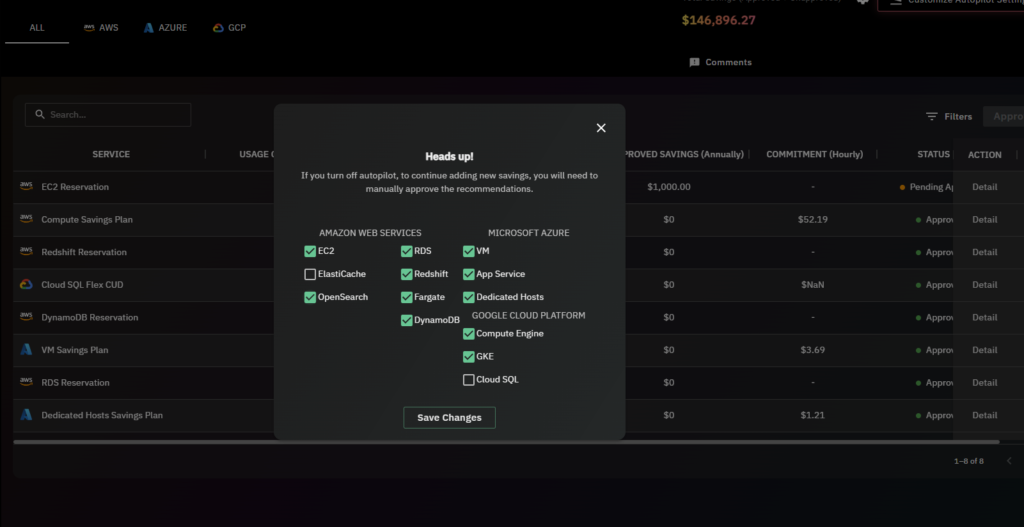
Usage.ai is built specifically to solve the cloud cost optimization challenges that are hardest to address manually: commitment risk, delayed recommendations, and multi-cloud complexity.
The platform has delivered $91M+ in savings across 300+ enterprise customers including Motive, EVGo (NASDAQ: EVGO), Blank Street Coffee, and Secureframe. Here is how it addresses the specific challenges outlined above:
- Challenge 1 and 9 (delayed visibility and stale recommendations): Usage.ai refreshes commitment recommendations every 24 hours vs AWS native tools at 72+ hours. At $6-12K/day in uncovered spend, that gap compounds to $18K+ per refresh cycle.
- Challenge 2 (forecasting uncertainty): Usage.ai’s AI/ML recommendation engine analyzes real-time billing and usage patterns rather than historical snapshots, producing recommendations that reflect current workload behavior.
- Challenge 3 (multi-cloud complexity): Usage.ai manages commitments across AWS, Azure, and GCP from a single platform — normalizing different discount structures into unified coverage and savings metrics.
- Challenge 10 (commitment risk aversion): Usage.ai is the only platform offering real cashback (not credits) on underutilized commitments — eliminating the primary reason organizations under-commit and leave savings unrealized.
- Pricing alignment: Fees apply only to realized savings. Zero savings means zero fees. This makes Usage.ai a fully aligned partner rather than a vendor with conflicting incentives.
Setup takes 30 minutes via billing-layer access only — no infrastructure changes required. See exactly how it works: how Usage.ai solves this.
Conclusion
Controlling cloud costs has become one of the most complex operational challenges for modern engineering organizations. As infrastructure becomes more dynamic, distributed, and automated, traditional approaches to cost management often struggle to keep pace.
The 10 challenges outlined in this guide highlight why cloud cost optimization requires continuous monitoring, smarter financial strategies, and close collaboration between engineering and finance teams. None of these challenges is insurmountable — but each requires a deliberate approach rather than relying on native cloud tools to surface the right insight at the right time.
Automation-driven FinOps platforms can make a meaningful difference. By continuously analyzing usage patterns, recommending optimized commitments, and helping teams safely increase discount coverage, platforms like Usage.ai enable organizations to unlock cloud savings while reducing the risk associated with long-term commitments. Usage.ai even provides cashback protection if commitments are underutilized — allowing teams to pursue deeper savings with greater confidence.
Book a free savings test to analyze your current cloud usage and identify potential savings opportunities.
FAQ: Cloud Cost Optimization Challenges
1. What are the biggest cloud cost optimization challenges?
The biggest cloud cost optimization challenges include limited real-time cost visibility, unpredictable infrastructure usage, complex pricing models across multiple cloud providers, and the financial risk associated with commitment-based discounts. These issues arise because cloud environments scale dynamically and infrastructure usage changes frequently, making continuous cost optimization difficult for most FinOps teams.
2. Why is cloud cost optimization difficult?
Cloud cost optimization is difficult because cloud infrastructure is highly dynamic. Resources can scale up or down automatically, new services are deployed frequently, and pricing models vary across services and regions. This makes it challenging for DevOps and FinOps teams to accurately predict usage, maintain efficient cost strategies, and respond to inefficiencies before they compound.
3. What causes cloud costs to increase unexpectedly?
Overprovisioned resources, idle or orphaned infrastructure, misconfigured autoscaling systems, or sudden traffic spikes most often cause unexpected cloud cost increases. Lack of real-time cost visibility can also delay the detection of cost anomalies, allowing spending to grow before teams notice the issue. In multi-cloud environments, fragmented billing data further compounds the problem.
4. How do FinOps teams reduce cloud costs?
FinOps teams reduce cloud costs by implementing real-time cost visibility tools, monitoring infrastructure usage continuously, rightsizing resources, and optimizing commitment programs like Savings Plans or Reserved Instances. Automation and governance policies help prevent unnecessary spending. The most effective teams treat cost optimization as a continuous operational discipline rather than a periodic review exercise.
5. What role do commitment discounts play in cloud cost optimization?
Commitment programs such as Savings Plans, Reserved Instances, and Committed Use Discounts can reduce compute costs by 20-72% (verify at provider pricing pages — rates change). However, they require organizations to commit to future usage, which introduces financial risk if workloads change. The biggest cloud cost optimization challenge around commitments is not understanding them — it is having the confidence to increase coverage without risking stranded spend.
6. How can organizations manage cloud costs across multiple providers?
Organizations manage multi-cloud cost optimization by implementing centralized cost monitoring platforms that aggregate billing data across AWS, Azure, and GCP. These platforms help teams track spending trends, identify inefficiencies, and apply consistent optimization strategies across environments. Usage.ai specifically automates commitment management across all three providers from a single platform, normalizing different discount structures into unified coverage metrics.
7. What is the fastest way to reduce cloud costs without infrastructure changes?
The fastest way to reduce cloud costs without infrastructure changes is to increase commitment coverage — purchasing Savings Plans, Reserved Instances, or Committed Use Discounts on workloads that are already running on-demand. For most organizations with less than 60% commitment coverage, this single lever delivers 20-40% cost reduction with zero architectural work. Usage.ai automates this process and provides cashback protection if commitments are underutilized.
8. How does overprovisioning contribute to cloud cost optimization challenges?
Overprovisioning is one of the most common and costly cloud cost optimization challenges. Engineers typically provision more capacity than workloads require to ensure stability under peak load. At scale, this resource underutilization can account for 20-35% of total cloud spend. Rightsizing recommendations, combined with autoscaling policies, address this — but they require accurate usage data and the operational discipline to act on recommendations promptly.