 AWS
 Microsoft Azure
 Google Cloud


When comparing the best enterprise cloud cost management platforms, look for:
Organizational mapping: Group costs by business unit, application, product, or cost center across accounts and providers.
Explainable allocation: Distribute shared infrastructure costs using rules that teams can review and Finance can reconcile.
Delegated controls: Give teams appropriate visibility and authority within a central cloud cost governance framework.
Financial consistency: Account for discounts, commitments, credits, and billing adjustments in reporting.
Workflow integration: Connect reporting and optimization tasks to the systems your teams already use.
Best Enterprise Cloud Cost Management Platforms at a Glance
The best enterprise cloud cost management platforms address different parts of the operating model. Use this comparison to shortlist options based on the responsibilities you need to support across Finance, FinOps, and Engineering.| Platform | Primary Scope | Enterprise use case | Core capabilities | What to verify |
|---|---|---|---|---|
| Usage.ai | Commitment specialist | Commitment management across AWS, Azure, and Google Cloud | Automated commitment purchasing, approval-based workflows, and Cashback protection for eligible Flex Insured Commitments | Supported services, purchasing controls, and Cashback eligibility. |
| IBM Cloudability | Broad FinOps | Financial accountability across teams and business units | Cost allocation, organizational views, budgeting, and forecasting | Required edition, financial planning scope, and ownership mappings. |
| Flexera One FinOps | Broad FinOps | Cloud financial management within a broader technology portfolio | Multi-cloud visibility, allocation, policy governance, and optimization capabilities | Which ITAM, SaaS, and optimization products are included in the proposal. |
| CloudHealth | Broad FinOps | Business-level reporting and policy governance | Perspectives for grouping costs and resources, organizational reporting, and policy controls | Perspective limits, allocation exceptions, and administration across organizations. |
| CloudZero | Allocation and unit economics | Connecting infrastructure costs to business outcomes | Product and customer cost analysis, business dimensions, and unit economics | Business-data inputs and how costs map to revenue-generating activity. |
| Finout | Allocation and unit economics | Shared-cost allocation across cloud and technology sources | Consolidated cost data, Virtual Tags, shared-cost allocation, and showback | Connector coverage and ownership of allocation rules as the organization changes. |
How We Compared These Enterprise Platforms
We assessed the best enterprise cloud cost management platforms using official product documentation, public pricing information, and documented workflows. This is a research-based comparison, rather than a hands-on benchmark.We included platforms supporting enterprise financial management, allocation, governance, or specialist commitment management. The list is not exhaustive, and we evaluate each platform against its intended role.
Our comparison focuses on:
Organizational fit: Business-unit mapping, shared costs, and delegated access.
Financial reporting: Allocation, budgeting, forecasting, and reconciliation capabilities.
Coverage: Supported providers, services, and technology cost sources.
Execution: Recommendations, approval workflows, automated actions, and required permissions.
Operating effort and pricing: Implementation responsibilities, ongoing maintenance, and commercial scope.
1. Usage.ai
For Enterprise Commitment Management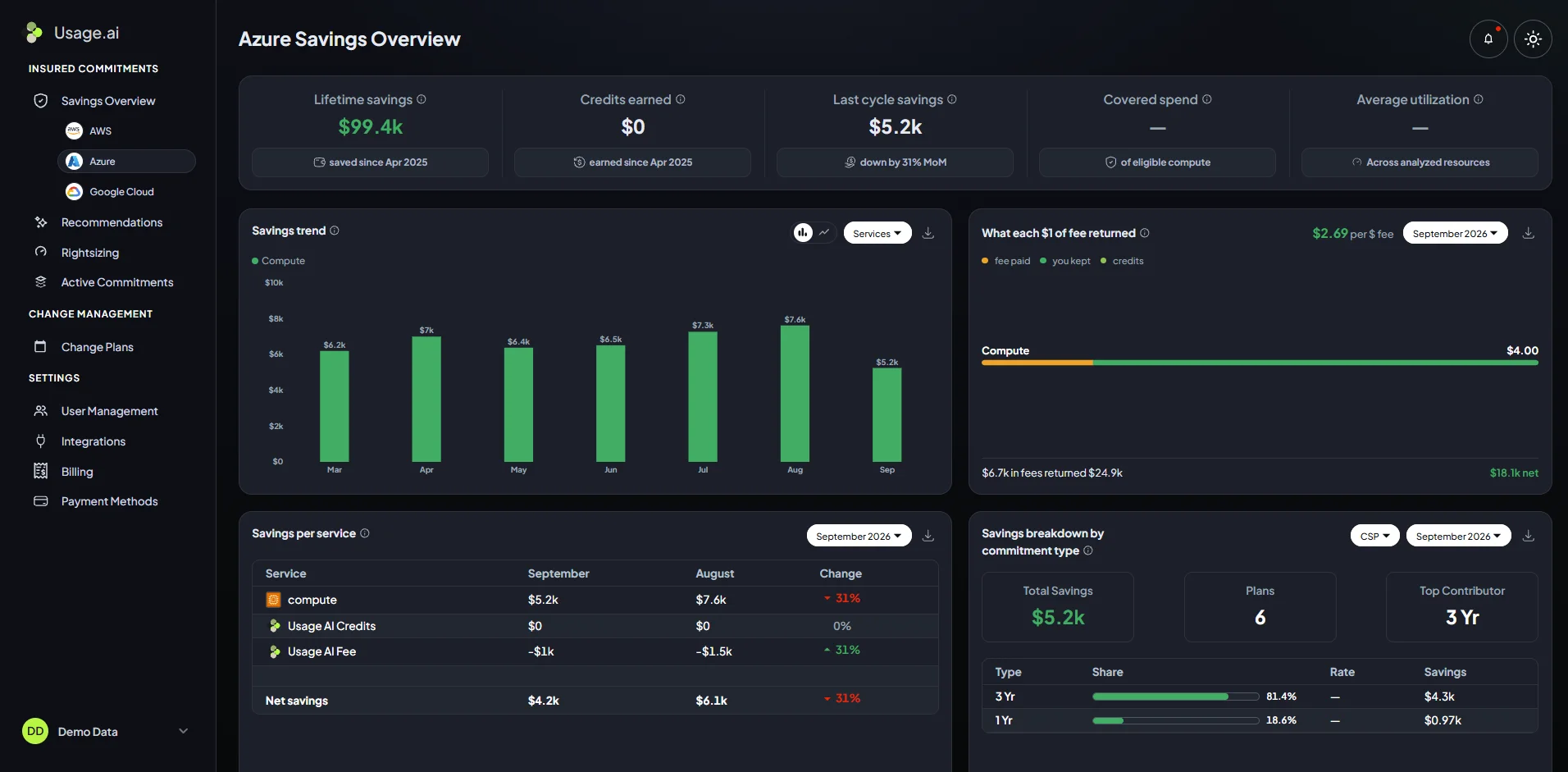
Key Features
Autopilot and Copilot: Automate eligible purchases within approved controls or review recommendations before approving them.
Continuous assessment: Analyze usage and existing commitments to adjust future purchasing decisions.
Customer-owned commitments: Purchases remain in your cloud accounts, with ownership and visibility retained by your team.
Savings and coverage tracking: Monitor commitment performance alongside FinOps support.
Cashback protection: Eligible Flex Insured Commitments provide financial protection for qualifying underutilization.
- ✅ Service-level purchasing modes let teams choose their preferred level of automation.
- ✅ Billing-layer implementation requires no agents or application changes.
- ✅ Our fee applies to new savings we generate, with no charge on savings from existing commitments.
- ❌ Our commitment automation does not resize, stop, or modify production resources; your team implements infrastructure changes.
- ❌ Cashback has eligibility conditions, including 30 consecutive days of underutilization. Protection ends when the managed service ends, and payouts occur 90 days after accrual. See how Cashback works.
Our Free plan supports companies spending under $200,000 monthly on cloud services, with spend visibility, rightsizing recommendations, and MCP support. Managed Optimization, for $200,000 or more monthly, charges a percentage of realized savings with no upfront fee.
Read how Usage.ai pricing works for the detailed breakdown.
2. IBM Cloudability
For Enterprise Financial Accountability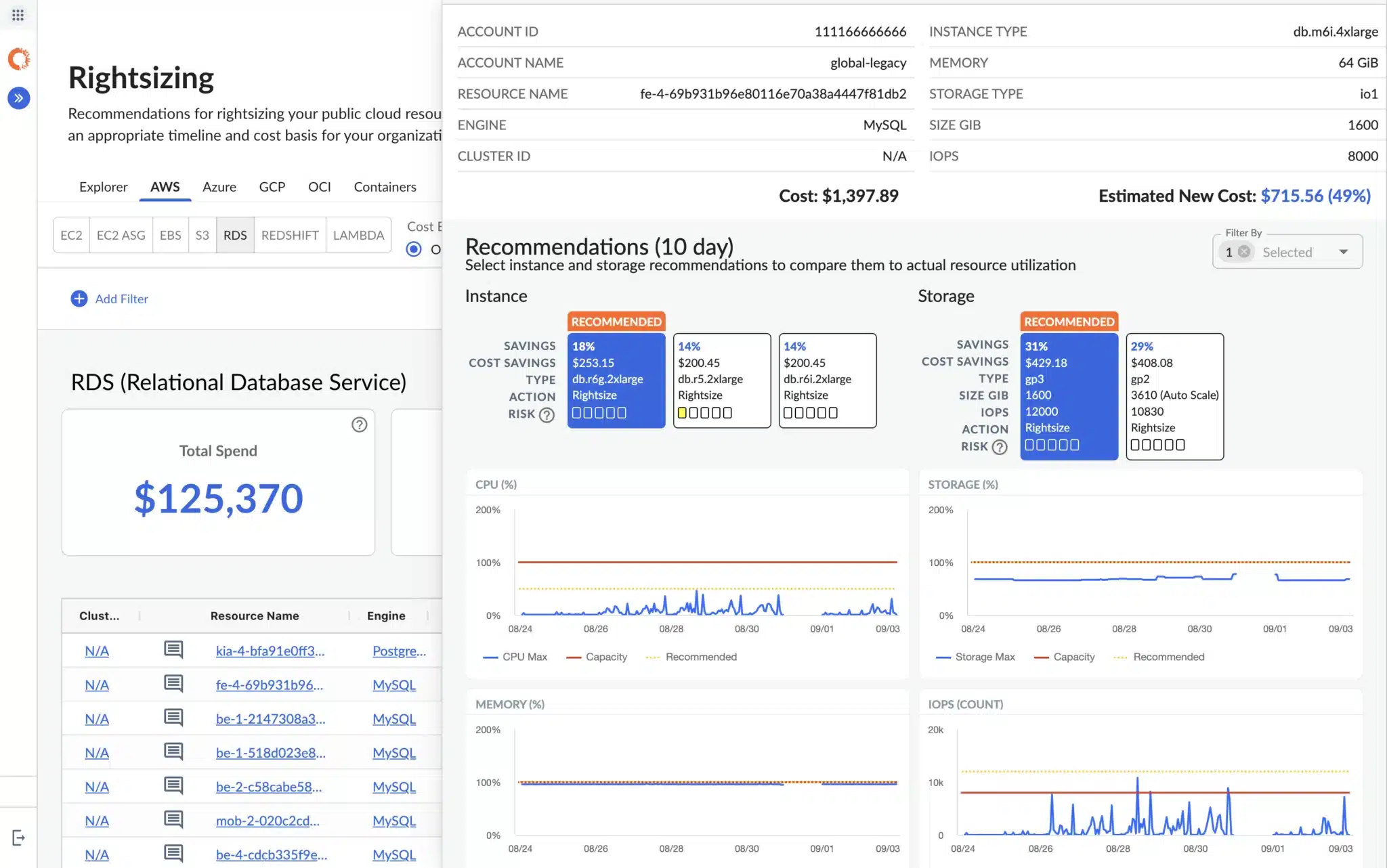
Key Features
Business mapping and cost sharing: Allocate direct and shared costs to teams, applications, and business units.
Organizational Views: Group accounts and services around reporting structures, with multiple budgets per View.
Budgeting and forecasting: Track spending against budgets, forecast future costs, and notify owners of potential overruns.
Optimization capabilities: Identify rightsizing opportunities and monitor commitment coverage, utilization, and waste.
- ✅ Supports enterprise chargeback through business mappings and shared-cost allocation.
- ✅ Connects business-unit budgets with centralized financial reporting.
- ✅ Offers allocation methods including even splits, fixed weights, and proportional distribution.
- ❌ Capability depth varies by package; advanced optimization and extended automation sit in Premium.
- ❌ Consumption-based shared-cost allocation requires relevant telemetry data; confirm edition availability with IBM.
IBM offers Essentials, Standard, and Premium packages, with pricing available through a quote. Enterprise buyers should confirm the edition and capabilities included in their proposal. Our Cloudability pricing guide explains additional commercial considerations.
3. Flexera One FinOps
For Broader Technology Spend Governance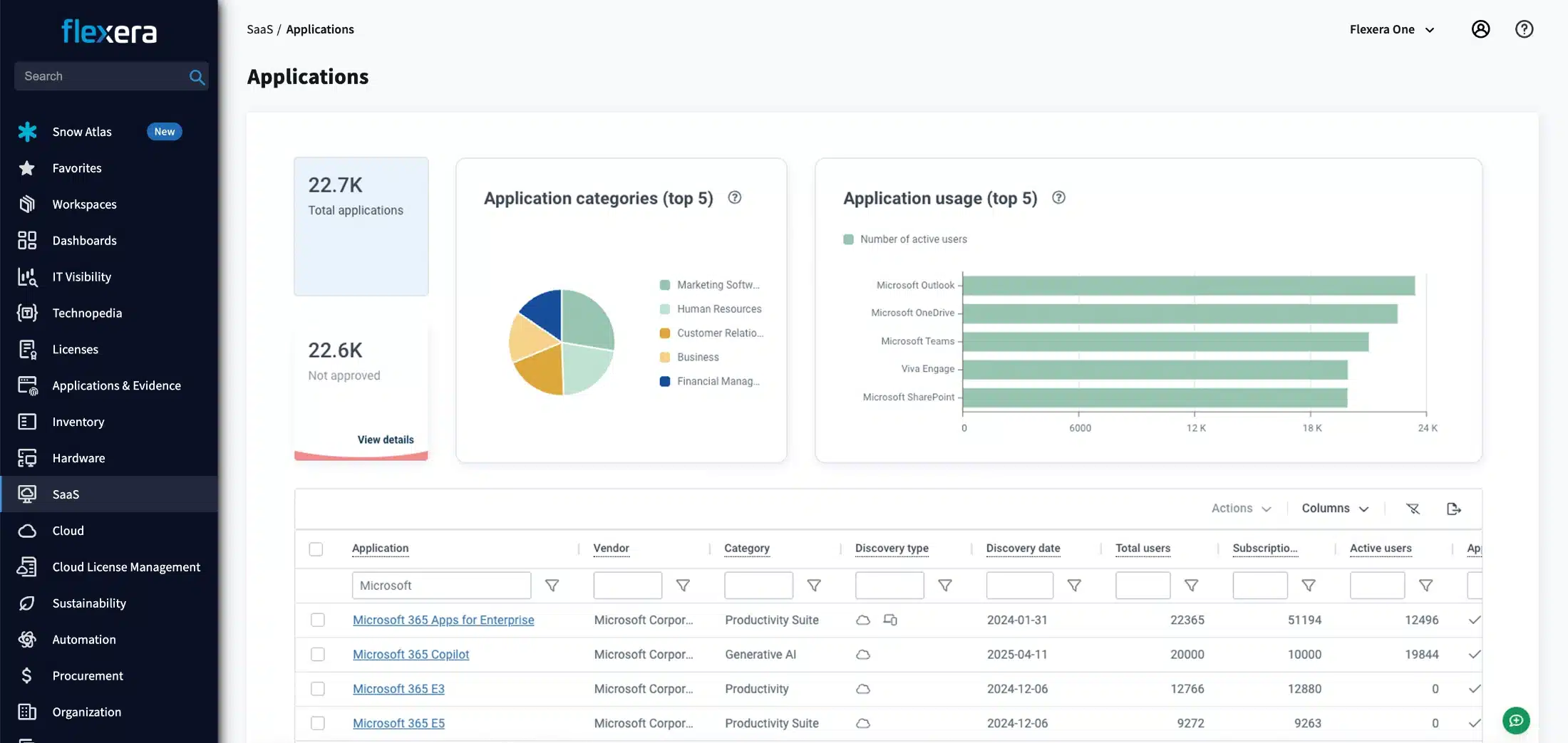
Key Features
Multi-cloud allocation: Normalize cost and usage data and map spending to business ownership.
Financial planning: Support budgeting, forecasting, reporting, and anomaly management.
Policy-based governance: Identify violations, trigger alerts, and execute configured corrective actions, with ITSM integrations for approval workflows.
Specialist optimization products: Extend capabilities through commitment management, workload optimization, and data-cloud optimization.
Broader technology context: Connect cloud analysis with licensing and SaaS capabilities across the Flexera portfolio.
- ✅ Relevant for enterprises evaluating cloud costs alongside a wider technology estate.
- ✅ Supports collaboration between central governance teams, business units, and resource owners.
- ✅ Offers a path from financial visibility to policy-driven execution and specialist automation.
- ❌ Portfolio breadth requires careful scoping: commitment, workload, data-cloud, and SaaS capabilities should not be assumed to be included in one purchase.
- ❌ Kubernetes cost visibility can involve Kubecost or OpenCost integrations, adding dependencies to evaluate during implementation.
Contact Flexera for a scoped proposal covering the required products, integrations, and optimization capabilities. Our Flexera pricing guide explains the commercial considerations to review.
4. CloudHealth
For Enterprise Cloud Governance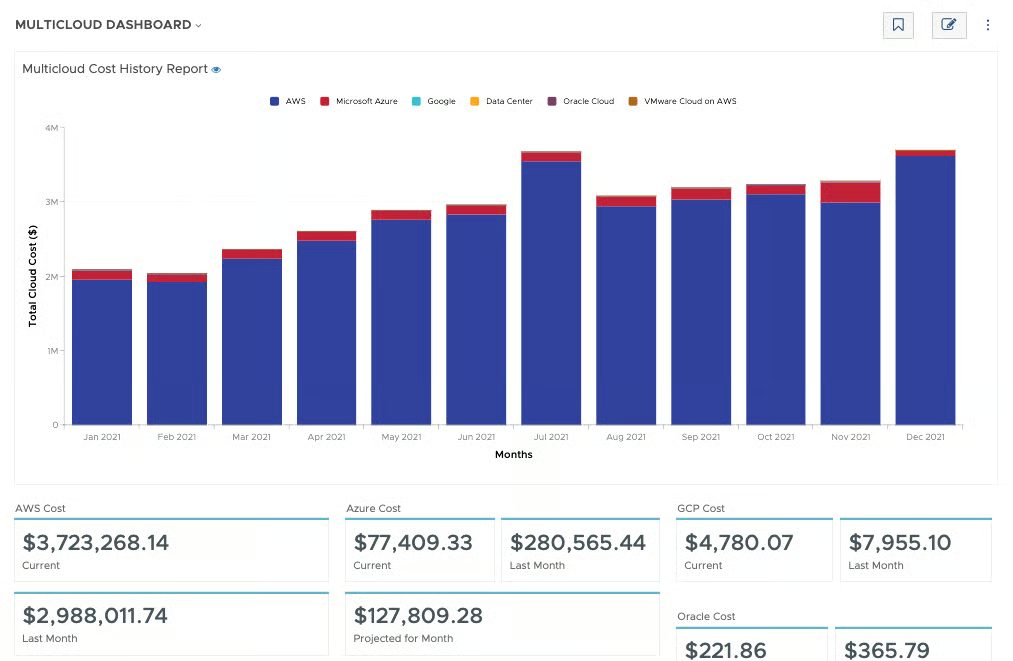
Key Features
Business-level Perspectives: Group resources by product, owner, environment, business unit, or cost center.
Organizational controls: Use FlexOrgs to manage access, sharing, and delegation across organizational levels.
Cost reallocation: Distribute indirect costs through allocation rules to support showback and chargeback.
Budgets and forecasting: Compare actual spending with budgets and alert stakeholders to projected overruns.
Scoped policies: Apply policies to selected accounts or sub-organizations.
- ✅ Supports business-oriented reporting across supported clouds.
- ✅ Combines centralized organizational controls with delegated access.
- ✅ Reuses Perspectives across reports, policies, recommendations, and cost reallocation.
- ❌ Perspective group limits require attention at scale; additional matching assets can become unallocated when limits are reached.
- ❌ Perspectives cannot migrate between tenants, creating additional work during tenant consolidation or restructuring.
Request a current proposal from CloudHealth or an authorized partner. Confirm the managed-spend allowance, overage charges, contract term, and included capabilities before comparing its cost with other platforms.
For a closer comparison of governance and commitment-management responsibilities, see Usage.ai vs. CloudHealth.
5. CloudZero
For Product and Customer Unit Economics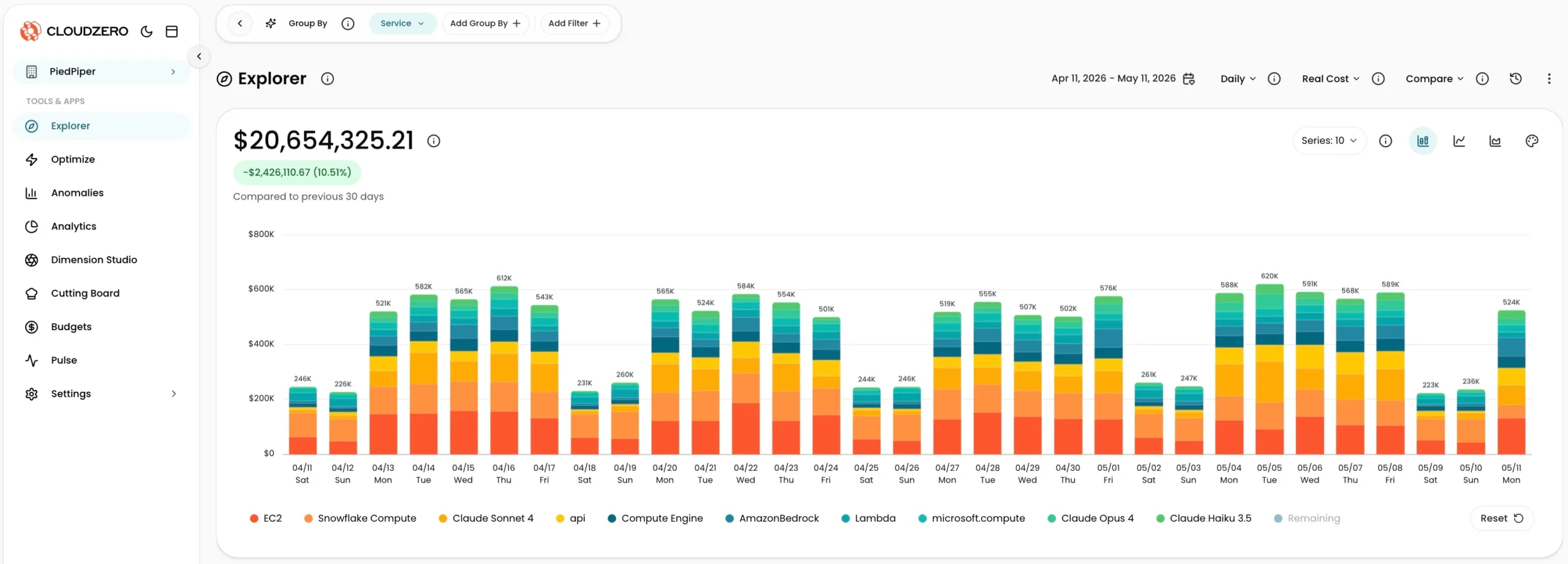
Key Features
Business dimensions: Organize spending by customer, product, team, environment, or other business categories.
Shared-cost allocation: Distribute costs through equal splits, proportional rules, or usage telemetry.
Business dimensions: Organize spending by customer, product, team, environment, or other business categories.Unit economics: Analyze cost per customer, transaction, feature, or other measurable outcome.
Visual and code-based configuration: Build allocation rules through Dimension Studio or CostFormation YAML.
Allocation governance: Separate definitions by team or project using namespaces with independent version histories and access controls.
- ✅ Connects spending to business measures that support product and margin decisions.
- ✅ Supports allocation using account metadata and custom rules when tagging is incomplete.
- ✅ Offers visual configuration alongside version-controlled allocation definitions.
- ❌ Consumption-based allocation requires your team to supply relevant usage data, such as customer API calls or storage consumption.
- ❌ Business mappings require configuration and maintenance as products, teams, and ownership change.
CloudZero offers a custom-priced subscription aligned with the scale and complexity of the environment. Its pricing page lists unlimited users, cost sources, dimensions, and dashboards among the included capabilities.
See our CloudZero pricing guide for commercial considerations.
6. Finout
For Shared-Cost Allocation Across Technology Sources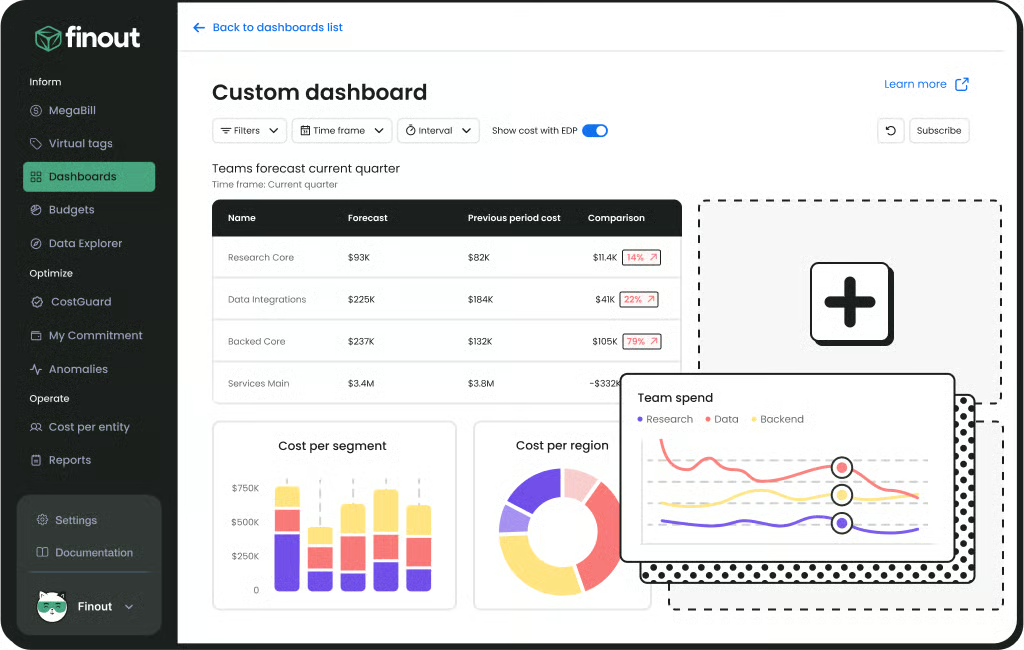
Key Features
Consolidated billing: Bring supported cloud, Kubernetes, AI, and other technology cost sources into MegaBill.
Virtual Tags: Normalize different naming conventions and map spending to business ownership.
Shared-cost allocation: Distribute expenses using custom rules or consumption telemetry.
Financial oversight: Connect allocation with dashboards, budgets, forecasts, and anomaly detection.
Data exports: Use APIs to bring allocation mappings into existing business intelligence workflows.
- ✅ Supports a consistent ownership model across different providers and services.
- ✅ Handles allocation scenarios such as shared databases, support charges, and data transfer.
- ✅ Makes allocation mappings available beyond the platform through APIs.
- ❌ Virtual Tag rules are evaluated in priority order, so overlapping rules require careful configuration to avoid unintended allocation.
- ❌ Kubernetes and other required capabilities can affect packaging and price; buyers should confirm their scope in the proposal.
Finout charges a flat contract fee tied to a committed cloud and AI spend tier. Quotes reflect the environment’s scale, integrations, and selected capabilities. The fee remains fixed during the contract term despite monthly spend fluctuations, and a free trial is available.
The Enterprise Test
What Happens When Your Organization Changes?A platform can allocate today’s bill correctly and still create problems when ownership changes. When comparing the best enterprise cloud cost management platforms, you need to test how each handles a reorganization, acquisition, or new shared service.
Consider a hypothetical enterprise with three business units sharing Kubernetes clusters, databases, and support costs. It acquires another company halfway through the financial year. Now, finance will need consolidated reporting, while each business unit must retain appropriate access and accountability.
Ask shortlisted vendors to demonstrate these scenarios using representative data:
| Enterprise change | What to test | Evidence to request |
|---|---|---|
| A new business unit joins | Add accounts, map ownership, and restrict access appropriately | A consolidated view plus a restricted business-unit view |
| Shared infrastructure expands | Distribute costs using agreed consumption or allocation rules | A breakdown that reconciles to the original shared cost |
| A team changes ownership | Update mappings while preserving the required historical treatment | Reports showing costs before and after the change |
| Finance closes the month | Handle late credits, refunds, and billing adjustments | An explanation of how closed-period reports change |
| Purchasing authority changes | Transfer approvals and remove previous permissions | Updated access controls and an audit record |
Assign an owner to each mapping, allocation rule, and approval workflow. For AWS-specific buying considerations at scale, see our guide to FinOps platforms for $1M+ in monthly AWS spend.
Are Native Cloud Tools Enough?
Your enterprise may already have the tools it needs for cost reporting and oversight:AWS Cost Explorer provides cost analysis, forecasts, and Reserved Instance recommendations.
Microsoft Cost Management supports reporting, budgets, alerts, shared-cost allocation, and data exports.
Google Cloud Billing Reports lets you analyze spending and forecasts by project, service, location, and other dimensions.
When comparing the best enterprise cloud cost management platforms, identify the specific gap a paid product must close. That might be consistent allocation across providers, product-level economics, delegated governance, or ongoing commitment automation.
Enterprise size alone is not a reason to buy another platform. Compare the expected improvement with the fees and operating effort involved. Our cloud cost optimization ROI guide explains how to assess that value.
Which Enterprise Cloud Cost Management Platform Fits Your Organization?
Evaluate Usage.ai if you want automated commitment management across AWS, Azure, and Google Cloud, with approval controls and Cashback protection for eligible underutilization.
Consider IBM Cloudability if your Finance and FinOps teams need business-level cost allocation, budgeting, forecasting, and financial accountability.
Explore Flexera One FinOps if you need cloud governance within a broader technology portfolio that includes software licensing, SaaS, and hybrid environments.
Consider CloudHealth if you need to organize reporting, access, and policies around multiple business units and cost centers.
Evaluate CloudZero if you want to connect infrastructure spending to products, customers, and measurable business outcomes.
Explore Finout if your priority is allocating shared costs consistently across cloud providers and other technology sources.
Explore commitment purchasing, approval workflows, and coverage tracking in one demo.
Frequently asked questions
What are the best enterprise cloud cost management platforms?
The best enterprise cloud cost management platforms to evaluate include Usage.ai, IBM Cloudability, Flexera One FinOps, CloudHealth, CloudZero, and Finout. Choose based on your requirements for commitment automation, financial governance, shared-cost allocation, reporting, and unit economics.
What is the difference between cloud financial management and cloud cost optimization tools?
Cloud financial management tools support allocation, budgeting, forecasting, and financial accountability. Optimization tools focus on reducing costs through actions such as rightsizing, scheduling, or commitment management. Many platforms cover both, but their depth and execution capabilities differ.
What should you look for in multi-cloud cost management tools?
Check whether the platform can normalize billing data, allocate shared costs consistently, and apply appropriate access controls across your providers. Verify service-level coverage separately for reporting, recommendations, and automated actions.
How should you use Gartner’s Magic Quadrant when choosing a platform?
Use it to understand vendor positioning and build your research shortlist. Gartner evaluates providers on Ability to Execute and Completeness of Vision. Validate your own requirements through demonstrations, contractual checks, and testing with your data. Gartner Peer Insights is a separate source of customer reviews.
If you notice any material information that is incorrect, outdated, or no longer applicable, please contact us at [email protected]. We’ll review it and update the article where appropriate.